Category: Regions

  • Castile-La Mancha, Spain: Where History Echoes Through Ancient Walls

    Castile-La Mancha, Spain: Where History Echoes Through Ancient Walls

    Castile-La Mancha is one of Spain’s most distinctive inland regions, a land of vast plains, medieval cities, historic castles, traditional villages, world-famous windmills, vineyards, and literary heritage. Located in the heart of the Iberian Peninsula, it is closely associated with Miguel de Cervantes’ Don Quixote, the dramatic landscapes of La Mancha, and centuries of cultural exchange between Christian, Muslim, and Jewish communities.

    Although it lies close to Madrid, Castile-La Mancha offers a different side of Spain: quieter historic towns, expansive natural parks, traditional cuisine, and rural landscapes that have inspired Spanish literature and art for generations.

    From the medieval streets of Toledo and Cuenca to the windmills of Consuegra, the vineyards of Valdepeñas, and the natural wonders of the Tagus River and Alto Tajo, the region offers a rich variety of experiences for travelers interested in history, culture, gastronomy, and nature.

    1. Castile-La Mancha

    Regional profile

    Official name: Castilla-La Mancha

    Country: Spain

    Capital and seat of regional government: Toledo

    Largest urban center: Albacete

    Area: Approximately 79,400 km²

    Population: Around 2.1 million inhabitants, depending on the reference year

    Autonomous status: Autonomous community of Spain

    Provinces: Albacete, Ciudad Real, Cuenca, Guadalajara, and Toledo

    Language: Spanish

    Currency: Euro (€)

    Climate: Predominantly continental Mediterranean, with hot summers and cold winters

    Known for: Don Quixote, windmills, castles, Manchego cheese, saffron, wine, and historic towns

    Castile-La Mancha occupies much of the southern part of Spain’s central plateau. Its landscapes range from the open plains of La Mancha to mountain ranges, river valleys, forests, wetlands, and limestone gorges.

    The region borders Madrid, Castile and León, Aragón, the Valencian Community, Murcia, Andalusia, and Extremadura. Its central position makes it a useful destination for road trips connecting Madrid with southern and eastern Spain.

    The modern autonomous community was established during Spain’s transition to democracy and the creation of the country’s system of autonomous communities. It brings together five provinces with distinct local traditions but a shared historical and cultural identity.

    2. Geography and natural landscapes

    Castile-La Mancha is one of Spain’s largest autonomous communities by area. Much of its territory belongs to the Meseta Central, the broad interior plateau that defines the geography of central Spain.

    The plains of La Mancha

    La Mancha is the region’s most recognizable landscape. Its broad horizons, dry farming fields, vineyards, olive groves, and scattered villages are strongly associated with the adventures of Don Quixote.

    The plains are particularly impressive in spring, when green fields and wildflowers transform the countryside, and in late summer, when golden landscapes reflect the region’s dry climate.

    Mountain ranges and highlands

    Although the region is famous for flat terrain, its geography is considerably more varied.

    • Sierra de Alcaraz: A mountainous area in Albacete province with forests, traditional villages, and scenic hiking routes.
    • Serranía de Cuenca: A landscape of pine forests, limestone formations, ravines, and river valleys.
    • Montes de Toledo: A range of hills and mountains separating parts of Toledo and Ciudad Real provinces.
    • Sierra Morena: Its northern foothills extend into the southern parts of the region, creating rugged countryside and important wildlife habitats.
    • Sistema Ibérico: Mountainous terrain in the northeast, including the spectacular Alto Tajo area.

    Rivers and wetlands

    The Tagus and Guadiana are two of the most important rivers associated with Castile-La Mancha. Their tributaries have shaped the region’s agricultural valleys, wetlands, and natural reserves.

    The Lagunas de Ruidera form one of the region’s most remarkable aquatic landscapes, while the Tablas de Daimiel National Park protects a rare wetland ecosystem of international importance.

    Agriculture and land use

    Agriculture has played a central role in the region’s economy and identity. Vineyards occupy extensive areas, particularly in Ciudad Real, Toledo, and Albacete provinces. Wheat, barley, olives, almonds, and saffron are also important products.

    Livestock farming, especially sheep farming, supports the production of Manchego cheese, one of Spain’s best-known regional foods.

    3. History of Castile-La Mancha

    The history of Castile-La Mancha reflects the many civilizations that have shaped central Spain. Its archaeological sites, Roman ruins, medieval fortifications, religious monuments, and historic towns reveal a past that stretches back thousands of years.

    Prehistoric settlements

    Human communities inhabited the territory long before the emergence of the Roman Empire. Archaeological discoveries include prehistoric settlements, burial sites, cave paintings, and evidence of early agricultural societies.

    The region’s rivers, elevated areas, and fertile valleys provided resources for communities that developed farming, livestock raising, and trade.

    Iberian and Celtic peoples

    Before Roman conquest, the area was inhabited by several indigenous groups, including Celtiberian and Carpetani communities. Their settlements developed around agriculture, metalworking, trade, and fortified hilltop locations.

    These peoples interacted with other Mediterranean cultures and contributed to the cultural foundations of the region.

    Roman rule

    The Romans incorporated the territory into Hispania and established settlements, roads, agricultural estates, and mining operations. Roman infrastructure helped connect inland communities with other parts of the Iberian Peninsula.

    One of the most important archaeological sites is Segóbriga, a Roman city with remains of a theatre, amphitheatre, public buildings, and defensive structures. The ancient mining district of Almadén also demonstrates the region’s historical importance in mineral extraction.

    Visigothic Spain

    Following the decline of Roman imperial authority in the West, the Visigoths became the dominant political power in much of the Iberian Peninsula.

    Toledo emerged as a major political and religious center. Its importance increased considerably, and the city hosted councils that played significant roles in Visigothic government and ecclesiastical life.

    Muslim rule and medieval frontier

    In the early eighth century, Muslim forces conquered much of the Iberian Peninsula. Toledo became an important urban center under Muslim rule and developed a rich mixture of architectural, intellectual, commercial, and religious traditions.

    The territory formed part of a changing frontier between Muslim and Christian political powers. Castles and fortified settlements became strategically important, particularly around Toledo, the Tagus Valley, and the approaches to La Mancha.

    The Christian conquest and medieval kingdoms

    Toledo was captured by the forces of Alfonso VI of León and Castile in 1085. Its incorporation into the Christian kingdoms marked a major turning point in the history of central Spain.

    During subsequent centuries, religious institutions, military orders, noble families, and agricultural communities helped shape the region. The Orders of Santiago, Calatrava, and Saint John of Jerusalem held extensive territories and constructed or controlled important fortifications.

    Christian, Muslim, and Jewish communities left lasting marks on urban architecture, crafts, agriculture, language, and intellectual life.

    The Spanish Golden Age

    During the sixteenth and seventeenth centuries, cities such as Toledo and Almagro developed important artistic and cultural traditions.

    Toledo became associated with the painter El Greco, whose distinctive religious paintings contributed to the city’s artistic reputation.

    The region also entered world literature through Miguel de Cervantes and his novel Don Quixote. The landscape of La Mancha became inseparable from the adventures of the idealistic knight and his companion, Sancho Panza.

    Modern transformation

    Over the following centuries, the region remained predominantly agricultural, although mining, manufacturing, trade, and transport gradually diversified its economy.

    The twentieth century brought major social and economic changes, including urbanization, agricultural modernization, and improvements in infrastructure.

    The creation of the autonomous community of Castilla-La Mancha in the 1980s established a regional political framework for its five provinces. Today, the region combines its historic identity with modern agriculture, services, industry, renewable energy, and tourism.

    4. The five provinces of Castile-La Mancha

    Castile-La Mancha is made up of five provinces. Each has a different combination of historic cities, natural landscapes, cultural attractions, and local products.

    1. Toledo

    Historic capital and cultural heritage

    Toledo province is home to the regional capital, the medieval city of Toledo, and the celebrated windmills of Consuegra. Other destinations include Talavera de la Reina, Oropesa, and the Montes de Toledo.

    Highlights: Toledo Old Town, Alcázar, Toledo Cathedral, Consuegra Castle, Talavera ceramics, and historic villages.

    2. Albacete

    Urban culture, crafts, and natural landscapes

    Albacete is an important commercial and industrial center. Its wider province includes the mountains of the Sierra de Alcaraz, historic towns, wetlands, and traditional villages.

    Highlights: Albacete city, Alcalá del Júcar, Almansa Castle, the Lagunas de Pétrola, and the natural scenery around Riópar.

    3. Ciudad Real

    Wine country, wetlands, and Don Quixote landscapes

    Ciudad Real province occupies a large part of La Mancha and is closely associated with vineyards, windmills, historic towns, and protected natural areas.

    Highlights: Almagro, Campo de Criptana, Valdepeñas, Tablas de Daimiel National Park, Cabañeros National Park, and the Calatrava castles.

    4. Cuenca

    Medieval architecture and dramatic natural formations

    Cuenca combines a spectacular historic city with pine forests, limestone gorges, reservoirs, and small rural settlements. Its landscapes are particularly appealing to hikers, photographers, and road-trip travelers.

    Highlights: Cuenca Old Town, the Hanging Houses, Serranía de Cuenca Natural Park, the Enchanted City, and Belmonte Castle.

    5. Guadalajara

    Mountain scenery, castles, and historic villages

    Guadalajara province extends from the urban area near Madrid to quieter mountain districts, river valleys, and traditional villages. It offers a different landscape from the dry plains associated with La Mancha.

    Highlights: Guadalajara city, Sigüenza, Molina de Aragón, the villages of the Black Architecture route, and Alto Tajo Natural Park.

    For a broad introduction to the region, Toledo and Cuenca are excellent cultural starting points, while Ciudad Real is particularly appealing for wine tourism and Don Quixote routes. Albacete and Guadalajara offer rewarding combinations of local culture and outdoor exploration. The official regional tourism portal provides further destination ideas for all five provinces.

    5. The best cities and towns to visit

    Castile-La Mancha’s appeal extends beyond its principal cities. Small towns often preserve some of the region’s most memorable monuments, local traditions, and landscapes.

    Toledo

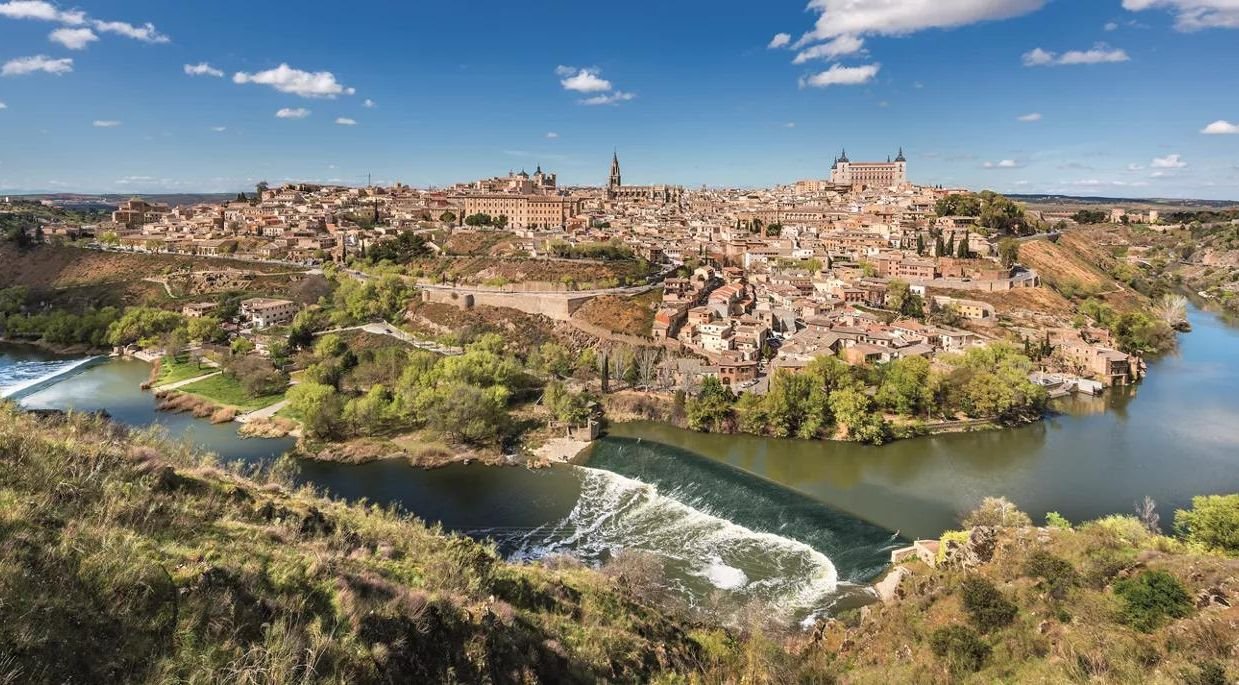
    Toledo is one of Spain’s most celebrated historic cities and a UNESCO World Heritage Site. Its position above a bend in the Tagus River gives it a dramatic setting, while its streets preserve centuries of Christian, Muslim, and Jewish heritage.

    Explore Toledo Cathedral, the Alcázar, the Monastery of San Juan de los Reyes, the Synagogue of Santa María la Blanca, and the historic Jewish Quarter. The city is also famous for its sword-making traditions, damascened metalwork, marzipan, and views across the river valley.

    Cuenca

    Cuenca’s old town occupies a rocky ridge between deep river gorges. Its most famous landmarks are the Casas Colgadas, or Hanging Houses, whose wooden balconies project over the Huécar gorge.

    Visit the Gothic cathedral, cross the San Pablo Bridge, walk through the medieval streets, and enjoy viewpoints over the surrounding landscape. Cuenca is especially rewarding for travelers who enjoy architecture, photography, and access to nearby natural attractions.

    Albacete

    Albacete is a lively provincial capital known for its commercial activity, knife-making tradition, museums, and regional fair. It is less dominated by medieval tourism than Toledo or Cuenca, offering a more contemporary picture of everyday life in Castile-La Mancha.

    Explore the Cathedral of San Juan Bautista, the Pasaje de Lodares, local markets, and the Museum of Albacete. The city is also a convenient base for excursions to Almansa, Alcalá del Júcar, and the Sierra de Alcaraz.

    Ciudad Real

    Ciudad Real offers historic churches, squares, museums, and access to the surrounding wine-producing countryside. The Gothic Cathedral of Santa María del Prado and the medieval-era Puerta de Toledo are among its notable landmarks.

    The city is a practical base for exploring Almagro, Valdepeñas, the windmills of Campo de Criptana, and the wetlands around Daimiel.

    Guadalajara

    Guadalajara city is known for the Palacio del Infantado, an impressive palace associated with the Mendoza family. Other attractions include historic religious buildings, public parks, and cultural institutions.

    The surrounding province is especially attractive for travelers looking to discover quieter Spain, with medieval villages, castles, forested hills, and the dramatic scenery of the Alto Tajo region.

    Almagro

    Almagro is one of the region’s finest historic towns. Its Plaza Mayor is recognizable for its green glazed windows and traditional arcaded buildings.

    The town’s principal cultural attraction is the Corral de Comedias, a historic open-air theatre that preserves the atmosphere of Spain’s Golden Age. Almagro is also an important destination for classical theatre performances and traditional Manchego cuisine.

    Talavera de la Reina

    Located in Toledo province, Talavera de la Reina is internationally associated with its decorative ceramics. Its tilework, pottery traditions, churches, and historic center make it an excellent destination for visitors interested in Spanish crafts.

    Look for traditional ceramic panels in religious buildings and public spaces, visit workshops when available, and explore the town’s connection with the River Tagus.

    Sigüenza

    Sigüenza is a historic town in Guadalajara province dominated by its medieval castle and cathedral. Its stone streets, old squares, and traditional buildings create a distinctive atmosphere.

    The town is ideal for a cultural weekend, particularly for travelers interested in medieval architecture, regional gastronomy, and rural landscapes.

    Alcalá del Júcar

    This picturesque village in Albacete province clings to a steep hillside above a bend in the Júcar River. Whitewashed houses, caves built into the rock, a castle, and a historic bridge give it one of the region’s most distinctive settings.

    Visitors can walk through the old village, explore rock-cut spaces where open to the public, and enjoy viewpoints over the river gorge.

    Other rewarding stops include Consuegra, Campo de Criptana, Belmonte, Oropesa, Molina de Aragón, Atienza, Brihuega, and Alarcón. They are particularly suitable for travelers exploring the region by car.

    6. Top attractions and landmarks

    Beyond its major cities, Castile-La Mancha has an exceptional collection of castles, archaeological sites, religious monuments, windmills, and unusual geological formations.

    Windmills of Consuegra

    Toledo province

    The twelve historic windmills on Cerro Calderico, overlooking the plains of La Mancha, are among Spain’s most recognizable rural landmarks. Together with the medieval castle, they create the quintessential Don Quixote landscape. Some windmills preserve their traditional machinery.

    Windmills of Campo de Criptana

    Ciudad Real province

    This historic windmill landscape is another important destination associated with Cervantes’ novel. The windmills stand above the town and provide excellent views across the surrounding countryside.

    Belmonte Castle

    Cuenca province

    A remarkably picturesque fifteenth-century fortress, Belmonte Castle features imposing walls, towers, and a striking architectural design. It is a highlight for visitors interested in medieval warfare, noble families, and historic fortifications.

    The Enchanted City — Ciudad Encantada

    Cuenca province

    This natural geological site contains unusual limestone formations shaped by erosion over millions of years. Marked trails lead visitors past rocks that resemble animals, human figures, and other familiar shapes.

    Almansa Castle

    Albacete province

    Rising above Almansa on a rocky outcrop, this medieval castle dominates the surrounding landscape. It is one of the province’s most striking historic monuments and a useful stop on a route between Albacete and the Mediterranean coast.

    Palacio del Infantado

    Guadalajara city

    This distinguished palace combines late Gothic and Renaissance influences. Its decorative façade and historical connection with the powerful Mendoza family make it one of Guadalajara’s principal architectural attractions.

    Segóbriga Archaeological Park

    Cuenca province

    Explore the remains of a Roman settlement, including its theatre, amphitheatre, and other public structures. It offers insight into Roman urban life and the importance of mining and trade in ancient central Spain.

    Other significant attractions include the Royal Palace of Aranjuez area near the regional border, the medieval castle of Calatrava la Nueva, the historic center of Oropesa, and the rock formations and archaeological sites scattered throughout Cuenca province.

    7. Natural parks and outdoor destinations

    Castile-La Mancha is an excellent destination for outdoor tourism. Its protected areas include Mediterranean forests, wetlands, river canyons, mountains, limestone landscapes, and habitats for many bird species. The official regional tourism service highlights both its national parks and its extensive network of nature reserves.

    Tablas de Daimiel National Park

    One of Spain’s most important wetland environments, this national park protects shallow waters, marsh vegetation, and habitats for resident and migratory birds. Boardwalks and observation points allow visitors to experience the landscape without disturbing sensitive areas.

    It is particularly appealing to birdwatchers, photographers, and nature enthusiasts. Water levels and wildlife visibility vary with seasonal conditions.

    Cabañeros National Park

    Often associated with the wild landscapes of central Spain, Cabañeros contains Mediterranean woodland, scrubland, and open grasslands. Its wildlife includes deer and numerous bird species, including birds of prey.

    Guided excursions, nature observation, and hiking on authorized trails are among the principal activities. Certain areas require organized visits, so check current access arrangements before traveling.

    Lagunas de Ruidera Natural Park

    This chain of interconnected lakes is famous for its clear blue-green waters, limestone barriers, and small waterfalls. It is one of the region’s most attractive destinations for swimming in designated areas when permitted, kayaking, walking, and photography.

    Summer is popular, while spring often brings attractive water conditions and a greener surrounding landscape.

    Alto Tajo Natural Park

    Alto Tajo is characterized by deep limestone canyons, forested slopes, dramatic cliffs, and a river that winds through a relatively remote part of Guadalajara province.

    It is ideal for hiking, scenic driving, photography, and exploring rural villages. The area is particularly rewarding for travelers seeking quiet landscapes away from major urban centers.

    Serranía de Cuenca Natural Park

    The Serranía de Cuenca combines pine forests, rugged mountains, limestone formations, springs, and river valleys. Attractions include the Ventano del Diablo viewpoint and routes around the Enchanted City.

    It is a strong choice for hiking, nature photography, and road trips through the mountainous interior.

    Hoces del Cabriel

    The Cabriel River has carved dramatic gorges through rocky landscapes along the eastern edge of the region. The area offers opportunities for walking, wildlife observation, and selected water-based activities where conditions and regulations allow.

    More nature destinations

    • Nacimiento del Río Mundo: A spectacular spring and waterfall system near Riópar in Albacete province.
    • Las Chorreras del Cabriel: Waterfalls and rock formations in the Enguídanos area of Cuenca province.
    • Barrancas de Burujón: Clay cliffs overlooking the Tagus River near Toledo.
    • Buendía Reservoir and the Route of the Faces: A walking route through woodland featuring sculpted faces carved into sandstone rock.
    • Volcanic landscapes of Campo de Calatrava: A distinctive geological region with volcanic hills, ancient volcanic features, and mineral-rich terrain.
    • Hoces del Júcar: Scenic river gorges and viewpoints around Alcalá del Júcar and other parts of Albacete province.

    Nature enthusiasts should check seasonal trail closures, fire restrictions, water levels, and access rules before visiting. Summer heat can make exposed routes difficult, while heavy rain and winter weather can affect mountain roads and hiking trails.

    8. Don Quixote and the landscapes of La Mancha

    Few literary works have become as closely associated with a landscape as Don Quixote has with La Mancha.

    Published in two parts in 1605 and 1615, Miguel de Cervantes’ novel follows an idealistic man who imagines himself a knight and sets out to revive chivalric ideals in a changing world. His adventures with Sancho Panza combine humor, social criticism, philosophical reflection, and observations of everyday Spanish life.

    The windmills of La Mancha are particularly famous because of the episode in which Don Quixote mistakes them for giants. Although the novel’s precise geography is not always easy to reconstruct, several towns in the region have developed cultural routes inspired by its characters and landscapes.

    Important stops on a Don Quixote route

    • Consuegra: Windmills and a hilltop castle overlooking the plains.
    • Campo de Criptana: A celebrated group of historic windmills above the town.
    • El Toboso: Associated with Dulcinea, the idealized lady of Don Quixote’s imagination.
    • Argamasilla de Alba: A town traditionally linked to the origins of Cervantes’ story.
    • Puerto Lápice: A historic settlement associated with the novel’s journeys and roadside inns.
    • Almagro: A major cultural stop with a preserved Golden Age theatre and traditional architecture.

    The best way to experience this literary landscape is by car, stopping in villages, visiting local museums, enjoying traditional food, and exploring the countryside at an unhurried pace.

    9. Food and gastronomy of Castile-La Mancha

    The cuisine of Castile-La Mancha is rooted in rural traditions, seasonal produce, sheep farming, hunting, grain cultivation, and a climate that favors robust, satisfying dishes. Its food culture is particularly appealing to visitors interested in regional Spanish cooking.

    Manchego cheese

    Queso Manchego is the region’s most internationally recognized product. Made from the milk of Manchega sheep, it has a firm texture and flavors that become more complex as it matures.

    It is commonly served in slices with bread, olives, cured meats, or wine. Authentic Manchego cheese benefits from a protected designation of origin, so look for the relevant certification when buying it.

    Pisto manchego

    Pisto manchego is a traditional vegetable dish made with ingredients such as tomatoes, peppers, courgettes, and onions. It is often served with a fried egg and bread.

    Although it resembles other Mediterranean vegetable preparations, its regional identity comes from the ingredients, cooking style, and local tradition.

    Gazpachos manchegos

    Despite the name, gazpachos manchegos is not the cold tomato soup known elsewhere in Spain. It is a hearty cooked dish generally prepared with pieces of flatbread and meat, often rabbit or poultry, in a rich broth.

    It is a particularly characteristic example of the region’s traditional rural cuisine.

    Migas

    Migas are made from bread crumbs or pieces of stale bread cooked with garlic, olive oil, and other ingredients. Depending on the locality and recipe, they may include chorizo, bacon, peppers, or grapes.

    This dish reflects the resourcefulness of traditional rural cooking, in which simple ingredients were transformed into substantial meals.

    Atascaburras

    Atascaburras is a traditional dish particularly associated with Albacete and neighboring areas. It combines salt cod, potatoes, olive oil, and garlic, often finished with hard-boiled eggs and walnuts.

    It is especially associated with colder weather and traditional winter meals.

    Duelos y quebrantos

    This traditional Manchego dish is prepared with eggs and cured pork products, often including bacon or chorizo. It has a strong association with the literary world of Don Quixote and the food traditions of La Mancha.

    Saffron from La Mancha

    Saffron is one of the region’s prized agricultural products. Its delicate flavor, aroma, and color make it an important ingredient in rice dishes, stews, and other traditional recipes.

    The saffron harvest, especially around parts of Toledo and Ciudad Real provinces, is also part of the region’s agricultural heritage.

    Marzipan from Toledo

    Toledo is famous for its marzipan, made primarily from almonds and sugar. It is sold throughout the year but is particularly prominent during Christmas celebrations.

    Traditional confectionery shops offer shaped marzipan sweets, filled pastries, and other regional specialties.

    Other regional foods

    • Ajoarriero: A preparation based on salt cod, garlic, olive oil, and other ingredients, with recipes varying by locality.
    • Carcamusas: A well-known Toledo dish of stewed meat, commonly served with tomatoes, peas, and sometimes cured pork.
    • Morteruelo: A rich pâté-like preparation associated with Cuenca, traditionally made with game or other meats, liver, spices, and bread.
    • Alajú: A traditional sweet associated with Cuenca and neighboring areas, typically made with honey, almonds or nuts, and breadcrumbs.
    • Olive oil: Particularly important in parts of Toledo, Ciudad Real, and Albacete provinces.
    • Vinegar, honey, almonds, and cured meats: Other products that feature prominently in local markets and traditional kitchens.

    Wines of Castile-La Mancha

    Castile-La Mancha is one of Spain’s major wine-producing regions. Its extensive vineyards produce red, white, and rosé wines, as well as sparkling wines and other styles.

    Important wine areas include La Mancha, Valdepeñas, Manchuela, Méntrida, Almansa, and Ribera del Júcar. Tempranillo is widely planted for red wines, while white varieties such as Airén are particularly important in the region’s wine-growing history.

    Wine tourism can include cellar visits, tastings, vineyard walks, and local food pairings. Visitors should check booking arrangements in advance, particularly at smaller family-run wineries.

    10. Wine tourism and vineyard routes

    The vineyards of Castile-La Mancha stretch across vast areas of the central plateau. For travelers interested in wine, the region offers an opportunity to explore Spain’s agricultural traditions outside the better-known wine destinations of the north.

    La Mancha wine region

    The La Mancha designation covers a large wine-producing area with broad vineyards and a strong agricultural identity. Visitors can explore wineries around towns such as Alcázar de San Juan, Tomelloso, and Socuéllamos.

    Valdepeñas

    Valdepeñas is one of the region’s best-known wine towns. It combines an established winemaking tradition with museums, cellars, and local restaurants.

    Manchuela

    Located primarily in the eastern part of the region, Manchuela offers a different combination of vineyards, river landscapes, and rural communities. Its wines are worth discovering as part of a trip through Albacete and Cuenca provinces.

    Méntrida and Almansa

    Méntrida, near the western part of Toledo province, and Almansa, in Albacete province, provide additional opportunities to explore regional wine styles and rural heritage.

    Practical tip: Arrange tastings ahead of time and consider hiring a driver or joining an organized tour if you plan to sample several wines.

    11. Culture, festivals, and traditions

    The region maintains a lively calendar of religious celebrations, local fairs, theatre performances, agricultural festivals, and traditional crafts. These events provide a deeper understanding of local identity and community life.

    Feria de Albacete

    Held in September, the Albacete Fair is one of the region’s most important popular celebrations. It combines concerts, entertainment, food, markets, and traditional festivities in and around the historic fairgrounds.

    Corpus Christi in Toledo

    Toledo’s Corpus Christi celebration is renowned for its religious procession, elaborate decorations, and ceremonial atmosphere. The historic center becomes a focal point for visitors interested in religious heritage and traditional Spanish festivals.

    Semana Santa in Cuenca

    Holy Week in Cuenca is particularly notable for its solemn processions through the steep streets of the historic city. The surrounding architecture and dramatic topography contribute to the atmosphere of the celebrations.

    Classical Theatre Festival of Almagro

    Almagro’s International Classical Theatre Festival celebrates Spain’s Golden Age drama and other classical theatrical traditions. Performances take place in historic venues, including the Corral de Comedias.

    Consuegra Medieval

    Consuegra hosts historical commemorations and medieval-themed events that draw on the town’s castle, its regional history, and the wider heritage of La Mancha. Dates and programs vary from year to year.

    Tamborada of Hellín

    Hellín, in Albacete province, is famous for its drumming traditions, especially during Holy Week. The powerful sound of thousands of drums is a distinctive part of its cultural identity.

    Crafts and traditional industries

    Castile-La Mancha has a rich heritage of handmade products:

    • Toledo: Damascened metalwork, swords, and traditional confectionery.
    • Talavera de la Reina: Decorative ceramics and glazed tiles.
    • Cuenca: Traditional handicrafts, regional textiles, and food products.
    • Albacete: Knife-making and cutlery.
    • La Mancha: Pottery, agricultural crafts, and traditional food production.

    For cultural travelers, workshops and craft museums can be as rewarding as visits to major monuments.

    12. Outdoor activities and experiences

    The region is well suited to travelers who want to combine sightseeing with outdoor recreation.

    Hiking and walking

    Explore the trails of Serranía de Cuenca, Alto Tajo, the Sierra de Alcaraz, and Cabañeros. Routes range from easy nature walks to more demanding mountain excursions.

    Water sports

    In designated areas and during permitted seasons, lakes and reservoirs offer opportunities for kayaking, canoeing, and other water activities. Always check local regulations and water conditions.

    Cycling and scenic drives

    Rural roads connect historic villages, vineyards, windmills, and castles. Mountainous areas provide more challenging cycling, while the plains are suitable for longer rides in cooler weather.

    Wildlife watching

    Wetlands, forests, and open countryside provide opportunities to observe migratory birds, raptors, deer, and other wildlife. Binoculars and an early start are particularly useful.

    Stargazing

    Remote areas of Guadalajara and Cuenca provinces offer excellent opportunities for night-sky observation, particularly away from urban light pollution. Choose clear nights and check local access conditions.

    Food and wine experiences

    Visit wineries, taste Manchego cheese, explore food markets, and discover traditional dishes in family-run restaurants and rural inns.

    13. Climate and the best time to visit

    Castile-La Mancha generally has a continental Mediterranean climate. Summers are hot and dry, winters can be cold, and temperature differences between day and night may be significant, especially in inland and mountainous areas.

    SeasonTypical conditionsBest experiences
    Spring: March–MayMild to warm, with variable rainfallCity sightseeing, hiking, countryside drives, wildflowers
    Summer: June–AugustVery hot and generally dryEarly-morning sightseeing, lakes, evening events, selected mountain routes
    Autumn: September–NovemberWarm at first, then cooler; harvest seasonWine tourism, food festivals, villages, photography
    Winter: December–FebruaryCold mornings, possible frost or snow in higher areasMuseums, historic cities, seasonal cuisine, quieter cultural trips

    Spring

    Spring is one of the most attractive seasons for exploring the countryside. Temperatures are often comfortable for walking, and vegetation is greener than in midsummer.

    It is an excellent time to visit Cuenca’s natural areas, explore Toledo on foot, or follow a Don Quixote route through the plains.

    Summer

    Summer brings long days and lively festivals, but inland temperatures can become very high. Plan outdoor activities early in the morning or later in the evening, carry water, and avoid strenuous walks during peak heat.

    Autumn

    September and October are particularly appealing for vineyard visits, local food, and cultural events. The summer heat begins to ease, although early autumn can remain warm.

    Winter

    Winter is a quieter period for city breaks and cultural tourism. Toledo, Cuenca, Almagro, and Guadalajara remain attractive destinations, but mountain roads may be affected by snow, ice, or fog.

    For most travelers, April to June and September to October offer a good balance of comfortable temperatures, outdoor activities, and cultural experiences.

    14. Where to stay in Castile-La Mancha

    Accommodation options range from historic hotels and contemporary city properties to rural guesthouses, countryside cottages, and vineyard accommodations.

    Toledo

    Best for first-time visitors, cultural sightseeing, and a short trip from Madrid.

    Choose accommodation inside or near the historic center if you want to explore monuments on foot. Hotels outside the old town may offer easier parking and access for road trips.

    Cuenca

    Best for historic architecture, photography, and nature excursions.

    Staying in the old town offers atmosphere and views, while the newer parts of the city can be more convenient for parking, shopping, and transport connections.

    Albacete

    Best for a practical urban base, business travel, and exploring eastern Castile-La Mancha.

    The city has a range of hotels, restaurants, and transport links. It works particularly well as a starting point for trips to Alcalá del Júcar, Almansa, and the Sierra de Alcaraz.

    Ciudad Real and Valdepeñas

    Best for wine tourism and exploring the plains of La Mancha.

    These towns provide access to wineries, agricultural landscapes, and historic destinations. Rural accommodation can be an appealing option for visitors looking for quiet surroundings.

    Almagro

    Best for theatre, heritage, and traditional architecture.

    The town’s historic center is particularly attractive for an overnight stay, allowing visitors to enjoy the squares, restaurants, and evening atmosphere after day-trippers leave.

    Sigüenza and Guadalajara province

    Best for medieval towns, castles, rural retreats, and outdoor activities.

    Historic inns and rural houses are ideal for travelers seeking a slower pace, while accommodation near major roads can be convenient for exploring the province by car.

    Rural accommodation

    Country houses, small hotels, and rural guesthouses can provide a more intimate experience of the region. They are especially useful for visiting natural parks, small villages, and remote parts of the countryside.

    Check whether accommodation offers heating or air conditioning appropriate to the season, parking, restaurant facilities, and access to nearby services.

    15. Getting to Castile-La Mancha

    Castile-La Mancha is well connected to other parts of Spain, particularly Madrid. The best arrival point depends on which province you intend to visit.

    By air

    Madrid-Barajas Airport is the main international gateway for many visitors. From Madrid, travelers can continue to Toledo, Guadalajara, Cuenca, Albacete, and Ciudad Real by road or rail, depending on their destination.

    Some travelers may also consider other Spanish airports when combining Castile-La Mancha with a longer trip through the country.

    By train

    Spain’s rail network provides connections between Madrid and several cities in the region. Toledo, Cuenca, Albacete, and Ciudad Real have rail services, although routes, journey times, and service frequencies vary.

    High-speed rail is especially useful for certain intercity journeys, but it does not serve every small town or natural attraction. Always check the destination station and onward transport requirements.

    By bus

    Intercity buses connect major cities and many smaller towns. They can be useful for travelers without a car, but service frequency is generally lower in rural areas.

    Plan carefully if you intend to visit windmills, natural parks, castles, or villages away from the main transport corridors.

    By car

    Driving is often the most flexible way to explore the region, especially if your itinerary includes several provinces.

    A rental car makes it easier to visit Consuegra, Campo de Criptana, Almagro, Belmonte, Alcalá del Júcar, and remote natural areas. Major roads connect the principal cities, while smaller regional roads provide access to villages and countryside attractions.

    Driving advice: Allow additional time for rural routes, check parking arrangements in historic centers, and avoid assuming that all attractions are open every day. Some castles, wineries, and small museums operate seasonal or reduced schedules.

    16. Suggested itineraries

    The ideal itinerary depends on how much time you have and whether you prefer cultural sightseeing, nature, or a combination of both.

    One day: Toledo

    • Morning: Explore Toledo Cathedral, the old town, and the historic streets.
    • Afternoon: Visit the Alcázar area, the Jewish Quarter, and selected historic religious buildings.
    • Evening: Enjoy a viewpoint overlooking the city and the Tagus River, followed by traditional Manchego food.

    Best for travelers based in Madrid who want a concentrated introduction to the region.

    Two days: Toledo and Consuegra

    • Day 1: Spend the day in Toledo, focusing on its historic center, monuments, and cuisine.
    • Day 2: Drive to Consuegra to visit the windmills and castle, then continue through the plains of La Mancha.

    Best for combining major cultural heritage with the region’s iconic literary landscape.

    Three days: Cuenca and its natural surroundings

    • Day 1: Explore Cuenca’s old town, cathedral, Hanging Houses, and San Pablo Bridge.
    • Day 2: Visit the Enchanted City and viewpoints in Serranía de Cuenca.
    • Day 3: Explore nearby villages and scenic routes, adapting the itinerary to weather and road conditions.

    Best for architecture, photography, and outdoor scenery.

    • Day 1: Visit Toledo and its historic center.
    • Day 2: Explore Consuegra and its windmills.
    • Day 3: Continue to Campo de Criptana and El Toboso.
    • Day 4: Discover Almagro and its historic theatre.
    • Day 5: Visit Valdepeñas or another nearby wine area, with a prearranged winery tour.

    Best for travelers interested in literature, history, gastronomy, and rural Spain.

    Seven days: A comprehensive regional road trip

    • Day 1: Toledo.
    • Day 2: Consuegra and the plains of La Mancha.
    • Day 3: Ciudad Real and Almagro.
    • Day 4: Tablas de Daimiel or Lagunas de Ruidera.
    • Day 5: Cuenca and the Hanging Houses.
    • Day 6: Serranía de Cuenca or a scenic route through the eastern countryside.
    • Day 7: Albacete, Alcalá del Júcar, or a selected destination in Guadalajara province, depending on your preferred route.

    Best for visitors who want a broader regional experience. Because the area is large, the itinerary should be adjusted to avoid excessive driving.

    17. Shopping and local products

    Shopping in Castile-La Mancha is less about large designer districts and more about traditional crafts, food, wine, and locally made products.

    The best souvenirs include:

    • Manchego cheese: Choose vacuum-packed products if you need to transport them.
    • Saffron: A distinctive regional ingredient sold in specialist food shops and markets.
    • Toledo marzipan: Traditional almond confectionery, particularly popular around Christmas.
    • Talavera ceramics: Decorative plates, tiles, bowls, and traditional pottery.
    • Toledo damascene work: Decorative metal objects featuring intricate gold or silver inlays.
    • Albacete cutlery: Knives and traditional cutlery associated with the city’s craft heritage; check applicable transport restrictions before purchasing.
    • Regional wines and olive oil: Widely available at wineries, specialist shops, and food markets.
    • Local honey and preserves: Useful gifts that reflect the region’s agricultural traditions.

    For the most authentic experience, buy directly from established workshops, specialist shops, cooperatives, or producers. Ask about provenance and certification when purchasing products that have protected regional designations.

    18. Traveling with children

    Castile-La Mancha can be a rewarding destination for families because it combines castles, unusual landscapes, historic villages, and outdoor activities.

    Family-friendly experiences include:

    • Exploring the windmills and castle of Consuegra.
    • Discovering the Hanging Houses and bridges of Cuenca.
    • Visiting the Enchanted City and its unusual rock formations.
    • Walking through the historic streets and squares of Toledo.
    • Learning about Roman life at Segóbriga.
    • Enjoying designated recreational areas around Lagunas de Ruidera.
    • Visiting museums and traditional craft workshops.
    • Exploring vineyards and local food traditions through age-appropriate activities.

    Families should account for hot summer temperatures, uneven historic streets, and the distances between rural attractions. A car can be particularly helpful when traveling with younger children.

    19. Practical travel tips

    A successful trip to Castile-La Mancha benefits from a little planning, particularly if you intend to visit rural areas.

    Transport: Major cities have public transport links, but many villages, castles, and nature reserves are easier to reach by car.

    Walking: Toledo and Cuenca contain steep streets, staircases, and uneven historic paving. Comfortable footwear is essential.

    Weather: Carry sun protection and water in summer. In winter, bring warm layers and check conditions before traveling into the mountains.

    Opening hours: Museums, castles, wineries, and smaller attractions may close on certain weekdays or operate reduced seasonal hours.

    Dining: Lunch is often the main meal of the day, and restaurant schedules may differ from those in northern Europe. Check serving times if you plan to eat outside conventional Spanish hours.

    Language: Spanish is the principal language. English is more likely to be understood at major tourist attractions and larger hotels than in small rural communities.

    Booking: Reserve accommodation during major festivals and busy holiday periods. Winery visits and guided excursions may also require advance booking.

    Respect for nature: Remain on marked trails, follow fire restrictions, and avoid disturbing wildlife in protected areas.

    Accessibility: Historic buildings and medieval streets may have limited wheelchair access. Check individual attractions before visiting.

    20. Is Castile-La Mancha worth visiting?

    Castile-La Mancha is an excellent choice for travelers who want to discover a less crowded, culturally rich side of Spain. It offers a combination of major heritage cities, rural traditions, distinctive cuisine, literary landscapes, and protected natural areas.

    Its greatest strengths are its variety and authenticity. You can spend a morning exploring a Gothic cathedral, an afternoon walking among medieval windmills, and the following day discovering a river gorge or tasting regional wine.

    The region is particularly suitable for:

    • History lovers: Toledo, Cuenca, Roman archaeological sites, and medieval castles.
    • Literature enthusiasts: The Don Quixote route and the landscapes of La Mancha.
    • Food and wine travelers: Manchego cheese, saffron, regional dishes, and vineyard visits.
    • Nature lovers: National parks, wetlands, mountains, forests, and river canyons.
    • Road-trip travelers: Historic villages and countryside routes connecting the five provinces.
    • Cultural travelers: Classical theatre, religious festivals, ceramics, and traditional crafts.
    • Travelers seeking quieter destinations: Rural towns and landscapes beyond Spain’s busiest coastal resorts.

    Frequently asked questions about Castile-La Mancha

    What is Castile-La Mancha famous for?

    Castile-La Mancha is best known for Don Quixote, traditional windmills, Toledo and Cuenca, medieval castles, Manchego cheese, saffron, wine, and its extensive plains. It is also recognized for natural areas such as Tablas de Daimiel, Cabañeros, and Lagunas de Ruidera.

    What is the capital of Castile-La Mancha?

    Toledo is the capital and the seat of the regional government. It is one of Spain’s most important historic cities and a UNESCO World Heritage Site.

    How many provinces does Castile-La Mancha have?

    The autonomous community has five provinces: Albacete, Ciudad Real, Cuenca, Guadalajara, and Toledo.

    How many days do you need to visit Castile-La Mancha?

    Two or three days are sufficient for a short trip focused on Toledo or Cuenca and their immediate surroundings. Four to seven days allow for a wider itinerary including windmills, wine country, historic villages, and natural parks. Exploring all five provinces in depth would require considerably longer.

    What is the best time to visit?

    April to June and September to October are generally excellent periods for sightseeing and outdoor activities. Spring is attractive for greener landscapes, while autumn is particularly appealing for wine tourism and local festivals.

    Can you visit Castile-La Mancha without a car?

    Yes. Toledo, Cuenca, Albacete, Ciudad Real, and Guadalajara can be reached using combinations of rail and bus services. However, a car is more convenient for reaching small villages, windmills, castles, wineries, and remote natural areas.

    What food should you try?

    Start with Manchego cheese, pisto manchego, gazpachos manchegos, migas, atascaburras, duelos y quebrantos, and Toledo marzipan. Regional wines and dishes made with locally produced saffron are also worth discovering.

    Is Castile-La Mancha suitable for a family holiday?

    Yes. Its castles, historic cities, windmills, geological formations, museums, and designated nature trails provide activities for different ages. Families should plan around summer heat and the distances between some attractions.

    What is the difference between Castile-La Mancha and Castile and León?

    They are two separate autonomous communities in central and northern Spain. Castile-La Mancha lies mainly south of Madrid and includes Toledo, Cuenca, Albacete, Ciudad Real, and Guadalajara. Castile and León lies farther north and includes cities such as Valladolid, Salamanca, Burgos, and León. Both share historical Castilian traditions, but their geography, regional institutions, and cultural attractions differ.

    Is Castile-La Mancha expensive?

    Compared with Spain’s most prominent international city destinations, many towns in Castile-La Mancha offer relatively affordable accommodation and dining. Costs vary by season, location, and festival dates. Historic city centers and major events may be more expensive than smaller rural destinations.


    Castile-La Mancha captures a distinctive part of Spain’s identity: the medieval streets of Toledo, the extraordinary setting of Cuenca, the windmills immortalized by Don Quixote, the traditions of Manchego cuisine, and the quiet beauty of inland landscapes.

    Its five provinces offer more than a collection of historic monuments. They reveal the connections between literature, agriculture, architecture, regional crafts, and the natural environment.

    For travelers willing to venture beyond Spain’s most famous coastal destinations, Castile-La Mancha provides a rewarding combination of cultural discovery, rural exploration, outdoor recreation, and memorable food. Whether visited on a short excursion from Madrid or explored over a week-long road trip, it is a region that deserves a place on a comprehensive Spanish travel itinerary.
  • Castile and Leon, Spain: Travel, History, Culture and Regional Guide

    Castile and León (Castilla y León) is one of Spain’s most historically significant and geographically extensive autonomous communities. Located in the northwestern part of the Iberian Peninsula, it is renowned for its medieval castles, Romanesque churches, Gothic cathedrals, UNESCO World Heritage Sites, historic university cities, traditional villages and vast landscapes of wheat fields, mountains and river valleys.

    The region occupies a central place in the development of the Spanish language, the history of the Kingdom of Castile and the Christian kingdoms of medieval Iberia. Its cities preserve centuries of architectural and cultural heritage, while its countryside offers opportunities for hiking, wine tourism, gastronomy, wildlife observation and journeys along historic pilgrimage routes.

    From the monumental aqueduct of Segovia and the university streets of Salamanca to the cathedral of Burgos and the dramatic walls of Ávila, Castile and León offers a particularly rich experience for travelers interested in Spanish history and authentic regional culture.

    1. Castile and Leon

    Castile and León is an autonomous community consisting of nine provinces. It was formed in 1983 through the administrative union of the historic regions of Old Castile and León.

    Its territory covers a large part of the northern Spanish plateau, known as the Meseta Norte. Much of the region lies at a relatively high elevation and is characterized by open plains, agricultural land, river basins and mountain ranges along its northern, eastern and southern boundaries.

    The regional capital is Valladolid, one of the principal urban and economic centers of the community. Other important cities include Burgos, León, Salamanca, Segovia, Ávila, Palencia, Soria and Zamora.

    Castile and León is particularly notable for its concentration of historic monuments. Several of its cities and monuments have been recognized by UNESCO, and the region is crossed by the French Way of the Camino de Santiago, one of Europe’s most important pilgrimage routes.

    Key facts

    FeatureInformation
    Official Spanish nameCastilla y León
    CountrySpain
    Administrative statusAutonomous community
    CapitalValladolid
    Provinces9
    Largest city by populationValladolid
    Main languageSpanish (Castilian)
    CurrencyEuro (€)
    Time zoneCentral European Time / Central European Summer Time
    LandscapeHigh plateau, plains, mountains, valleys and forests
    Major riversDuero, Pisuerga, Esla, Tormes and Adaja
    Famous forCastles, cathedrals, historic cities, wine and medieval heritage
    Major pilgrimage routeCamino de Santiago, French Way
    Important wine areasRibera del Duero, Rueda, Toro and Bierzo

    2. Geography and Natural Landscapes

    Castile and León is Spain’s largest autonomous community by area. Its geography is dominated by the northern plateau, but the landscape is far more varied than its extensive agricultural plains might suggest.

    The Northern Plateau

    The central part of the region consists of a broad elevated plateau with fertile valleys, grasslands, cereal fields and low hills. Wheat, barley, sunflowers and other agricultural crops shape the landscape, particularly in the provinces of Valladolid, Palencia, Zamora and parts of Burgos and León.

    Historic towns and castles often stand on elevated ground overlooking these plains, reflecting the strategic importance of controlling roads, river crossings and agricultural territories during the Middle Ages.

    Mountain ranges

    Mountain systems define much of the region’s perimeter.

    • Cantabrian Mountains: Form the northern boundary, with rugged peaks, deep valleys, forests and traditional mountain villages, particularly in León and northern Palencia.
    • Picos de Europa: The spectacular limestone mountains extend into the northeastern part of León, offering dramatic scenery, hiking routes and opportunities for wildlife observation.
    • Sistema Central: The southern mountain system includes the Sierra de Gredos, which contains high peaks, glacial lakes, pine forests and alpine landscapes in the province of Ávila.
    • Sistema Ibérico: Mountain ranges in the east and southeast, especially in Soria and eastern Burgos, include forests, rocky formations and remote valleys.

    Rivers and valleys

    The Duero River is the region’s most important river system. It crosses the plateau and supports agricultural areas, vineyards and historic settlements before continuing westward into Portugal, where it is known as the Douro.

    Other important rivers include the Pisuerga, Esla, Tormes, Adaja and Arlanza. Their valleys have historically supported settlement, agriculture, transport and the development of cities.

    Forests, wetlands and protected areas

    The region contains pine forests, oak woodlands, mountain meadows, riverbank habitats and wetlands. These environments support diverse wildlife, including deer, wild boar, birds of prey and numerous migratory bird species.

    Protected areas include the Picos de Europa National Park, the Sierra de Guadarrama National Park along the border with Madrid, and numerous natural parks and reserves within Castile and León.

    3. The Nine Provinces of Castile and León

    Castile and León is divided into nine provinces, each with its own provincial capital, cultural identity and travel attractions.

    ProvinceCapitalMain attractions and characteristics
    ÁvilaÁvilaMedieval city walls, Gothic heritage, Sierra de Gredos
    BurgosBurgosBurgos Cathedral, Atapuerca archaeological sites, Camino de Santiago
    LeónLeónLeón Cathedral, historic city center, Picos de Europa and Bierzo
    PalenciaPalenciaRomanesque churches, Tierra de Campos, mountain landscapes
    SalamancaSalamancaHistoric university, Plaza Mayor, sandstone architecture
    SegoviaSegoviaRoman aqueduct, Alcázar, historic old town
    SoriaSoriaMedieval heritage, forests, river landscapes and rural villages
    ValladolidValladolidRegional capital, museums, historic architecture and wine tourism
    ZamoraZamoraRomanesque churches, medieval castle and Duero River scenery

    Ávila

    Ávila is famous for its remarkably preserved medieval walls, which surround the historic center with imposing stone defenses and numerous towers. The city has a strong association with Saint Teresa of Ávila and Spanish religious history.

    Beyond the city, the province includes the Sierra de Gredos, known for hiking, mountain scenery, traditional villages and high-altitude lakes.

    Burgos

    Burgos is one of the region’s most important historical destinations. Its Gothic cathedral dominates the city, while the nearby archaeological sites of the Sierra de Atapuerca have contributed significantly to the study of early human evolution in Europe.

    The province also contains medieval villages, monasteries, castles and important sections of the Camino de Santiago.

    León

    León combines a historic city center with a wide variety of rural and mountain landscapes. Its cathedral is renowned for its stained-glass windows, while the Basilica of San Isidoro is associated with some of the most important Romanesque art in Spain.

    The province also encompasses the Bierzo region, the Las Médulas mining landscape and parts of the Cantabrian Mountains and Picos de Europa.

    Palencia

    Palencia is especially interesting for travelers seeking quieter destinations and Romanesque architecture. Its cathedral, historic churches and countryside are complemented by the Romanesque monuments of northern Palencia, including the area around Aguilar de Campoo.

    The province extends from open agricultural plains into the Cantabrian mountain foothills.

    Salamanca

    Salamanca is one of Spain’s great university cities. Its historic center features golden sandstone buildings, an impressive Plaza Mayor, Renaissance palaces and one of Europe’s oldest universities.

    The province also includes historic towns, rural landscapes and the Arribes del Duero canyon region near the Portuguese border.

    Segovia

    Segovia is best known for its enormous Roman aqueduct, medieval Alcázar and Gothic cathedral. The city is one of the region’s most rewarding destinations for a short cultural visit.

    The wider province offers mountain scenery, historic villages and access to the southern edge of the Castilian plateau.

    Soria

    Soria is among the least densely populated parts of the region and offers a quieter experience of inland Spain. Visitors can explore medieval monasteries, Romanesque churches, pine forests, archaeological sites and landscapes associated with Spanish writers and poets.

    The province is also known for traditional rural settlements and the natural scenery around the Lobos River Canyon.

    Valladolid

    Valladolid is the regional capital and an important center for administration, education, commerce and culture. Its attractions include historic squares, churches, museums and the National Sculpture Museum.

    The surrounding province is also important for wine production, especially in the Rueda and Ribera del Duero wine regions, which extend across several provinces.

    Zamora

    Zamora has one of Spain’s most impressive concentrations of Romanesque architecture. Its historic center contains medieval churches, a cathedral, a castle and viewpoints over the Duero River.

    The province also includes the natural landscapes of the Arribes del Duero and traditional villages that preserve the architectural character of rural Castile and León.

    4. Best Places to Visit in Castile and León

    The region’s attractions range from Roman engineering and medieval fortifications to Renaissance palaces, archaeological landscapes and mountain villages. The following destinations are among the most rewarding places to include in a trip.

    4.1 Segovia: The Roman Aqueduct and Alcázar

    Segovia is one of the region’s most recognizable historic cities. Its old town is built on a rocky ridge between river valleys, and its monuments reflect Roman, medieval and early modern history.

    Main attractions:

    • Aqueduct of Segovia: A monumental Roman structure built from granite blocks, traditionally dated to the Roman imperial period. Its towering arches are the city’s defining landmark.
    • Alcázar of Segovia: A dramatic fortified palace overlooking the confluence of two rivers. Its towers, courtyards and historical interiors make it one of Spain’s best-known castles.
    • Segovia Cathedral: A magnificent Gothic cathedral overlooking the historic center.
    • Plaza Mayor: The central square, surrounded by cafés, historic buildings and the cathedral.
    • Jewish Quarter: A network of historic streets that preserves traces of the city’s medieval Jewish community.
    • Monastery of Santa María del Parral: A historic monastery associated with the city’s religious and architectural heritage.

    Segovia is also famous for cochinillo asado, or roast suckling pig, a traditional dish served in many local restaurants.

    4.2 Salamanca: A Historic University City

    Salamanca is celebrated for its golden sandstone architecture, lively university atmosphere and exceptionally preserved historic center.

    The University of Salamanca, founded in 1218, is one of Europe’s oldest universities. For centuries, the city has been a major center of scholarship, theology, literature and intellectual exchange.

    What to see:

    • Plaza Mayor: An elegant Baroque square with arcaded façades, particularly atmospheric in the evening.
    • University of Salamanca: Famous for its historic façade and intricate Plateresque decoration.
    • Old and New Cathedrals: Two connected cathedrals that demonstrate different architectural periods.
    • Casa de las Conchas: A historic building decorated with carved stone shells.
    • Convento de San Esteban: A Dominican convent with an elaborate Renaissance façade.
    • Roman Bridge: A historic crossing over the Tormes River, offering views of the old city.

    Salamanca is an excellent destination for travelers who enjoy architecture, history, cafés, Spanish-language study and a lively cultural scene.

    4.3 Ávila: The Medieval Walled City

    Ávila is famous for its imposing medieval walls, which form one of Europe’s most impressive surviving urban fortifications.

    The walls extend around much of the historic center, with towers, gates and walkways that illustrate the defensive architecture of medieval Castile.

    Main attractions:

    • The medieval city walls and their accessible sections.
    • Ávila Cathedral, whose fortified appearance integrates religious and defensive architecture.
    • The Basilica of San Vicente, a major Romanesque monument.
    • The Convent of Saint Teresa and sites associated with the mystic Saint Teresa of Ávila.
    • Plaza del Mercado Chico, the historic central square.
    • Fourteenth- and fifteenth-century palaces and traditional stone streets.

    The city is particularly atmospheric in cooler weather, when its stone buildings and surrounding high plateau evoke the medieval character of inland Spain.

    4.4 Burgos: Gothic Architecture and Medieval History

    Burgos played an important role in medieval Castile and remains one of the region’s most important heritage destinations.

    The city’s greatest landmark is Burgos Cathedral, a masterpiece of Gothic architecture with elaborate towers, sculptural decoration, chapels and an exceptionally rich interior.

    Other attractions include:

    • Arco de Santa María: A monumental historic gateway near the cathedral.
    • Monastery of Las Huelgas: A major medieval religious complex with connections to the Castilian monarchy.
    • Cartuja de Miraflores: A Carthusian monastery known for its late Gothic architecture and sculpture.
    • Castle of Burgos: A hilltop fortress site with panoramic views over the city.
    • Museum of Human Evolution: A museum explaining discoveries associated with the nearby Atapuerca archaeological sites.

    Burgos is also a significant stop on the Camino de Santiago and an excellent place to explore Castilian cuisine.

    4.5 León: Cathedral, Romanesque Heritage and the Camino

    León combines monumental architecture, lively public squares and a strong connection to the pilgrimage route to Santiago de Compostela.

    The city’s cathedral is particularly renowned for its medieval stained glass, which fills the interior with colored light.

    Key attractions include:

    • León Cathedral, a major Gothic landmark.
    • The Basilica of San Isidoro, famous for its Romanesque art and historic royal pantheon.
    • Casa Botines, an architectural work by Antoni Gaudí.
    • The former Convent of San Marcos, now associated with historic hospitality and cultural heritage.
    • Plaza Mayor and the old town.
    • Barrio Húmedo, known for its bars, restaurants and tapas culture.

    León is also an excellent starting point for exploring the province’s mountains, traditional villages, Roman-era heritage and the mining landscape of Las Médulas.

    4.6 Valladolid: The Regional Capital

    Valladolid is the administrative capital of Castile and León and one of its most important urban centers. It offers a combination of historic architecture, museums, food markets, cultural events and convenient transport connections.

    Notable places include:

    • Plaza Mayor: One of Spain’s historically significant main squares.
    • National Sculpture Museum: A leading collection of Spanish religious sculpture.
    • Valladolid Cathedral: An important architectural project associated with Juan de Herrera.
    • Church of San Pablo: Famous for its elaborate Gothic façade.
    • Casa de Cervantes: A museum associated with the writer Miguel de Cervantes.
    • Campo Grande: A central park with landscaped paths and mature trees.

    Valladolid is also a practical base for exploring nearby wineries, castles and historic towns.

    4.7 Zamora: The City of Romanesque Churches

    Zamora is a rewarding destination for visitors interested in medieval architecture and quieter historic cities.

    Its old town contains a remarkable collection of Romanesque churches, alongside a cathedral, castle remains, historic streets and views over the Duero River.

    The city is particularly famous for its Holy Week processions, which are among the most significant religious and cultural events in Spain.

    The surrounding province offers access to Lake Sanabria, traditional rural villages and the dramatic river landscapes of Arribes del Duero.

    4.8 Soria: History, Literature and Nature

    Soria is a quieter destination with a strong connection to Spanish literature, medieval architecture and natural landscapes.

    Highlights include the Hermitage of San Saturio, situated beside the Duero River, and the Monastery of San Juan de Duero, known for its unusual cloister arches.

    The surrounding province offers opportunities to visit:

    • The Lobos River Canyon.
    • The Laguna Negra glacial lake.
    • The medieval village of Calatañazor.
    • The ruins of Numantia, associated with ancient Celtiberian resistance to Rome.
    • Forested areas and rural settlements in the Urbión mountains.

    Soria is especially suitable for travelers seeking nature, hiking, photography and a slower pace.

    4.9 Palencia: Romanesque Art and Quiet Countryside

    Palencia is often overlooked by international tourists, but it has considerable architectural and cultural value.

    The provincial capital features a Gothic cathedral, historic churches, public squares and a distinctive large sculpture of Christ known as the Cristo del Otero.

    Beyond the city, northern Palencia contains an important concentration of Romanesque churches and monasteries. The Montaña Palentina area provides a contrasting landscape of forests, mountain valleys and traditional villages.

    4.10 Peñafiel: Castle and Wine Country

    Peñafiel is one of the most attractive small towns for visitors interested in castles and wine tourism.

    Its elongated medieval castle stands on a ridge above the town and surrounding vineyards. The fortress houses the Provincial Wine Museum, which introduces visitors to the history and culture of wine production in the area.

    Peñafiel is a particularly good stop for travelers exploring the Ribera del Duero wine route.

    5. Castles and Medieval Heritage

    Castile and León is often associated with castles because fortifications played an essential role in the political and military history of medieval Iberia. The official regional tourism service identifies more than 300 castles across the community.

    Many were built or expanded during periods of territorial competition between Christian kingdoms and Muslim-ruled territories, while others later served as aristocratic residences, administrative centers or defensive strongholds.

    Some of the most interesting castles include:

    CastleProvinceWhy visit
    Alcázar of SegoviaSegoviaDramatic royal fortress and palace
    Castle of PeñafielValladolidLong ridge-top fortress and wine museum
    Castle of CocaSegoviaOutstanding brickwork and Mudéjar architecture
    Castle of La MotaValladolidMajor fortress associated with Castilian history
    Castle of PonferradaLeónExtensive fortress linked to the Knights Templar
    Burgos CastleBurgosHistoric hilltop fortifications and city views
    Castle of GormazSoriaVast medieval fortress overlooking the countryside
    Castle of AmpudiaPalenciaWell-preserved castle in a historic village

    The architectural legacy of medieval Castile

    Castilian castles differ considerably in appearance. Some are massive stone fortresses with thick walls and defensive towers; others feature elaborate brickwork, decorated courtyards and residential sections that reflect later periods.

    The Mudéjar style, which incorporates artistic traditions associated with Muslim craftsmanship in Christian-ruled Iberia, is especially visible in parts of the region’s brick architecture.

    Visiting castles also provides a way to explore smaller towns that might otherwise be missed on a standard city-focused itinerary.

    6. UNESCO World Heritage and Archaeological Sites

    Castile and León has an exceptional concentration of internationally recognized heritage. The region’s official tourism information highlights the historic cities of Ávila, Salamanca and Segovia, Burgos Cathedral, the French Way of the Camino de Santiago, the Atapuerca archaeological sites and Las Médulas among its major UNESCO-related attractions.

    Las Médulas

    Located in the province of León, Las Médulas is a remarkable landscape created by Roman gold mining. Ancient mining techniques transformed the hills into dramatic reddish cliffs, ravines and unusual rock formations.

    The site illustrates the scale of Roman engineering and the environmental impact of ancient resource extraction. Today, walking trails and viewpoints allow visitors to appreciate its unusual scenery.

    Atapuerca

    The Sierra de Atapuerca, near Burgos, contains archaeological and paleontological deposits that have provided important evidence about early human populations in Europe.

    The discoveries have contributed significantly to research on human evolution. Museum exhibitions and guided visits can help visitors understand the scientific importance of the area.

    Siega Verde

    Siega Verde, in Salamanca province near the Portuguese border, is an important open-air rock-art site featuring prehistoric engravings. It is part of the wider transnational UNESCO World Heritage property associated with the prehistoric art of the Côa Valley and Siega Verde.

    Historic cities

    The historic centers of Ávila, Salamanca and Segovia are especially important for their preservation of medieval urban layouts, religious monuments and historic architecture.

    Burgos Cathedral is another major heritage landmark, celebrated for its Gothic design and extensive artistic decoration.

    The Camino de Santiago

    The French Way crosses several provinces of Castile and León, including Burgos, Palencia and León. Its churches, monasteries, bridges and historic towns reflect centuries of pilgrimage.

    Travelers do not need to complete the entire route to appreciate its cultural importance. Walking even a short section can provide insight into the traditions and hospitality associated with the Camino.

    7. Natural Parks and Outdoor Destinations

    Although Castile and León is famous for its historic cities, its natural heritage is equally impressive. The region contains mountain ranges, glacial lakes, limestone canyons, forests, wetlands and landscapes shaped by centuries of agriculture and traditional settlement.

    Picos de Europa National Park

    The Picos de Europa are among the most spectacular mountains in northern Spain. Their steep limestone peaks, deep gorges and green valleys create a striking contrast with the surrounding plateau.

    The park extends across Asturias, Cantabria and León. On the Castile and León side, visitors can explore mountain villages, viewpoints, forest trails and landscapes around the Riaño area.

    Popular activities include hiking, photography, wildlife watching and scenic drives. Conditions can change quickly at higher elevations, so mountain routes should be selected according to weather, experience and fitness.

    Lake Sanabria Natural Park

    Lake Sanabria, in the province of Zamora, is one of the region’s best-known natural attractions. Its large glacial lake is surrounded by wooded hills, mountain scenery and small settlements.

    Visitors can enjoy lakeside walks, swimming in designated areas during suitable conditions, kayaking where permitted, and exploring nearby villages.

    The park is particularly attractive in summer, when the lake offers a cooler alternative to the hotter lowland areas.

    Sierra de Gredos Regional Park

    The Sierra de Gredos, in Ávila province, features granite peaks, glacial cirques, mountain streams and high-altitude lagoons.

    It is a major destination for hiking and mountaineering, with routes ranging from relatively accessible walks to demanding ascents.

    The area is also known for traditional mountain villages, rural accommodation and clear night skies in suitable conditions.

    Hoces del Río Duratón Natural Park

    The Duratón River has carved a deep canyon through the landscape of Segovia province. Its high cliffs, meandering river and surrounding vegetation create an attractive setting for hiking, photography and nature observation.

    The area is known for birds of prey, including griffon vultures. Visitor access, kayaking and walking routes may be subject to seasonal or conservation restrictions.

    The nearby town of Sepúlveda is an excellent base for exploring the canyon and sampling traditional Castilian cuisine.

    Lobos River Canyon Natural Park

    Located around the boundary between Soria and Burgos, the Lobos River Canyon is characterized by limestone cliffs, wooded areas, caves and striking rock formations.

    Walking trails follow parts of the canyon, while the Hermitage of San Bartolomé adds an important historical and architectural element to the landscape.

    Other natural areas worth exploring

    • Arribes del Duero Natural Park: Deep river canyons and scenic viewpoints along the Portuguese border.
    • Montaña Palentina Natural Park: Forests, rugged peaks and quiet mountain villages.
    • Las Batuecas–Sierra de Francia Natural Park: Mountain scenery, traditional villages and wooded valleys in Salamanca province.
    • Laguna Negra and the Urbión Glacial Cirques: A dramatic glacial lake and mountain landscapes in Soria.
    • Villafáfila Lagoons: Wetlands in Zamora province known for migratory birds, particularly during suitable seasons.
    • Ojo Guareña: A major karst cave system in Burgos province with important geological and archaeological interest.

    8. History of Castile and León

    The history of Castile and León spans prehistoric settlement, Roman rule, the emergence of medieval kingdoms, the expansion of Castilian political power and the formation of modern Spain.

    Prehistoric settlement

    Human populations inhabited the territory long before written history. Archaeological discoveries at Atapuerca have been especially important in reconstructing the presence and development of early humans in Europe.

    Other sites, including Siega Verde, preserve evidence of prehistoric artistic activity.

    The Celtiberians and Roman conquest

    Before Roman domination, the region was inhabited by various peoples, including Celtiberian communities. Numantia, near modern Soria, became famous for its resistance to Rome during the second century BCE.

    Following the Roman conquest, the territory became integrated into the empire’s political and economic systems. Roads, settlements, mining operations and agricultural production linked it with wider Roman Hispania.

    Roman engineering left a lasting legacy, most famously the aqueduct of Segovia. Mining also transformed parts of the landscape, as demonstrated by Las Médulas.

    The Visigothic period

    Following the decline of Roman imperial authority in the West, the Iberian Peninsula came under the rule of the Visigoths. Their kingdom incorporated much of the former Roman territory and developed its own political and religious institutions.

    The subsequent Muslim conquest of much of Iberia in the early eighth century reshaped the peninsula’s political geography.

    The Kingdom of León

    The Kingdom of León emerged from the Christian political communities of northern Iberia during the early Middle Ages. It became an important center of political authority and territorial expansion.

    Its history is closely connected with the development of medieval institutions, churches, monasteries and frontier settlements.

    The city of León preserves monuments associated with this period, particularly the Basilica of San Isidoro and its historic royal pantheon.

    The rise of Castile

    Castile developed as a frontier territory associated with fortified settlements and castles. Over time, it emerged as a powerful political entity.

    The county of Castile became a kingdom in the eleventh century. Through dynastic unions and territorial expansion, Castile increasingly shaped the political history of the Iberian Peninsula.

    The union of Castile and León

    Castile and León were united under Ferdinand III in 1230, creating a durable dynastic union that helped consolidate one of medieval Iberia’s most powerful kingdoms.

    The combined kingdom expanded its territory, developed urban institutions and strengthened its role in the peninsula’s political and economic life.

    The legacy of these centuries remains visible in the region’s cathedrals, castles, monasteries and historic towns.

    Castile and the formation of Spain

    The dynastic union of Isabella I of Castile and Ferdinand II of Aragon in 1469 was a major event in the political development of Spain. Their reigns helped consolidate royal authority and supported major transformations in the peninsula’s international position.

    Castile played a central role in the Spanish monarchy’s overseas expansion, including the voyages and conquests that connected Spain with the Americas.

    Salamanca, Valladolid and other cities became important centers of education, religion, administration and intellectual life during the early modern period.

    The early modern and modern periods

    During the sixteenth and seventeenth centuries, the region’s cities and institutions were deeply connected with the Spanish monarchy, religious culture and intellectual activity.

    Over subsequent centuries, economic change, industrial development and the growth of other Spanish regions altered the relative importance of Castile and León’s urban centers.

    Modern provincial boundaries and institutions developed gradually. Following Spain’s transition to democracy, Castile and León became an autonomous community under the 1983 regional framework.

    Today, its historical identity is expressed through heritage conservation, cultural festivals, universities, rural traditions and a strong association with the origins and development of the Castilian language.

    9. Culture, Language and Traditions

    Culture in Castile and León reflects a combination of medieval Christian traditions, older rural customs, university life, religious celebrations and regional artistic heritage.

    The Spanish language

    Castile and León occupies an important place in the history of Castilian Spanish, the variety that became the basis of modern standard Spanish.

    The region contains important historical records, monasteries and educational institutions associated with the development of written Spanish. However, the history of the language is complex, and modern Spanish developed through centuries of interaction among different linguistic and cultural traditions.

    Spanish is the principal language used in public life, education and administration.

    Religious heritage

    Religious architecture and traditions remain central to the region’s cultural identity. Cathedrals, monasteries, convents and parish churches are found in cities and small villages alike.

    Holy Week, or Semana Santa, is particularly important. Cities such as Valladolid, Zamora, León, Salamanca and Ávila hold processions featuring religious sculptures, traditional robes, music and carefully preserved ceremonial practices.

    These events combine religious devotion with public art, music and historical memory.

    Traditional music and dance

    Regional folk traditions include instrumental music, dances and songs associated with rural celebrations and community festivals.

    The dulzaina, a traditional double-reed instrument, is closely associated with festivities in parts of Castile. Drums, bagpipes in some northern areas, and other traditional instruments also contribute to local musical traditions.

    Rural architecture

    The countryside contains a wide variety of traditional building styles, shaped by local materials, climate and economic activity.

    Stone houses dominate many mountain villages, while adobe and brick construction is common in parts of the plateau. Timber-framed structures, traditional farm buildings and distinctive village squares provide additional insight into rural life.

    Festivals and local celebrations

    Festivals often coincide with religious calendars, harvest periods, local patron saints and historic commemorations.

    Alongside Holy Week, visitors may encounter traditional masquerades, folk festivals, agricultural fairs, medieval-themed events and food celebrations. Dates vary by municipality, so checking the local calendar before traveling is worthwhile.

    10. Food and Gastronomy of Castile and León

    Castile and León has one of Spain’s most substantial regional culinary traditions. Its cuisine reflects a continental climate, cereal farming, livestock raising, local legumes, cured meats and long-established methods of roasting and preserving food.

    Meals are often hearty, with recipes designed historically to provide nourishment during cold winters and demanding agricultural work.

    The region is also a major wine-producing area, with distinctive wine styles associated with different soils, elevations and grape varieties.

    Signature dishes

    Cochinillo asado

    Segovia

    Roast suckling pig with crisp skin and tender meat. It is one of Segovia’s most famous dishes and is traditionally prepared in a wood-fired oven.

    Lechazo asado

    Burgos, Valladolid and surrounding areas

    Roast milk-fed lamb, usually prepared simply with salt and cooked slowly in a traditional oven.

    Morcilla de Burgos

    Burgos

    A distinctive blood sausage typically made with rice, onion, pork fat and seasoning. It is commonly grilled, fried or included in regional dishes.

    Botillo del Bierzo

    León

    A traditional cured and smoked pork preparation cooked with vegetables, often cabbage and potatoes. It is especially associated with the Bierzo region.

    Judiones de La Granja

    Segovia

    A substantial stew prepared with large white beans, often accompanied by pork products and other traditional ingredients.

    Hornazo

    Salamanca

    A savory baked pastry filled with meat, commonly including cured sausage and pork. It is strongly associated with local celebrations and picnics.

    Other traditional foods

    • Sopa castellana: Garlic soup made with bread, paprika and often egg.
    • Lechazo churro: A traditional regional lamb specialty.
    • Chuletón: A substantial beef steak, particularly associated with cattle-raising areas.
    • Farmer-style lentils: Lentil dishes featuring locally grown legumes, vegetables and sometimes pork products.
    • Queso Zamorano: A sheep’s milk cheese from Zamora with a protected designation of origin.
    • Cecina de León: Air-dried and cured beef, a specialty with protected geographical recognition.
    • Yemas de Santa Teresa: Small egg-yolk sweets associated with Ávila.
    • Mantecados and regional pastries: Traditional baked sweets whose recipes vary by town and season.

    Wine regions

    Castile and León is among Spain’s most important wine-producing communities. Its vineyards span river valleys, plateaus and areas with different elevations and climates.

    Wine areaMain province or areaCharacteristics
    Ribera del DueroMainly Valladolid, Burgos and Soria, extending into SegoviaStructured red wines, particularly from Tempranillo
    RuedaMainly Valladolid, extending into neighboring provincesFresh aromatic white wines, especially Verdejo
    ToroMainly Zamora and parts of ValladolidPowerful reds, particularly from Tinta de Toro
    BierzoLeónReds based on Mencía and distinctive white wines
    CigalesMainly Valladolid and PalenciaRosé wines as well as reds and whites
    Rías?Not in Castile and LeónRías Baixas is in Galicia, not this region
    ArribesWestern Salamanca and ZamoraWines from local grape varieties and distinctive river-valley terrain
    ArlanzaBurgos and PalenciaWines from an inland continental climate
    Sierra de SalamancaMountain areas of SalamancaWines from local varieties, including Rufete

    The best way to explore these areas is to visit wineries, learn about local grape varieties and combine tastings with historic towns, vineyards and traditional restaurants. Winery visits generally require advance reservations.

    11. Wine Tourism and Rural Routes

    Wine tourism is an excellent way to experience the countryside of Castile and León beyond its major cities. The official regional tourism portal promotes multiple wine routes connecting wineries, vineyards, restaurants and historic settlements.

    Ribera del Duero Wine Route

    This is one of Spain’s best-known wine regions. Visitors can explore wineries around Peñafiel, Aranda de Duero and other historic towns, discovering the area’s relationship between wine production, castles and rural architecture.

    Rueda Wine Route

    Rueda is especially famous for Verdejo white wines. Its vineyards and wineries are accessible from Valladolid and can be combined with visits to Medina del Campo and other historic towns.

    Toro Wine Route

    The town of Toro, in Zamora province, has a historic center overlooking the Duero River. The area is known for robust red wines and offers opportunities to combine winery visits with architecture and local gastronomy.

    Bierzo Wine Route

    The Bierzo region in León combines mountain scenery, traditional villages, vineyards and the historic town of Ponferrada. Its wines are especially associated with Mencía and the area’s distinctive landscape.

    Practical advice for wine travelers

    • Reserve winery visits before arrival, especially on weekends.
    • Check whether tours and tastings are available in English.
    • Allow enough time for driving between wineries.
    • Avoid driving after drinking; use a designated driver or organized transport.
    • Combine wine tourism with local food, castles and village visits for a more complete experience.

    12. Best Towns and Villages to Visit

    Beyond the provincial capitals, Castile and León contains many small towns and villages where traditional architecture, regional cuisine and rural landscapes remain central to local identity.

    La Alberca — Salamanca

    La Alberca is one of Spain’s most distinctive traditional villages. Its narrow streets, timber-framed upper floors, stone houses and balconies decorated with flowers create an attractive setting in the Sierra de Francia.

    The village is an excellent base for exploring surrounding forests, mountain trails and other historic settlements.

    Pedraza — Segovia

    Pedraza is a beautifully preserved medieval village enclosed by defensive walls. Its stone houses, historic square and castle make it particularly appealing for a day trip from Segovia.

    Restaurants and traditional accommodation give visitors the opportunity to experience the village after day-trippers have left.

    Puebla de Sanabria — Zamora

    Puebla de Sanabria stands above the Tera River near Lake Sanabria. Its castle, historic streets and traditional stone buildings make it one of the most attractive settlements in northwestern Castile and León.

    It is also a convenient base for exploring the lake, surrounding mountains and the wider Sanabria region.

    Castrillo de los Polvazares — León

    This small village is known for its reddish stone houses, traditional streets and association with the Maragatería region.

    It is especially famous for cocido maragato, a substantial traditional stew. The village can be visited alongside Astorga and other historical destinations in León province.

    Other villages worth considering

    • Mogarraz, Salamanca: Traditional architecture, mountain scenery and a distinctive collection of portraits displayed on building façades.
    • Calatañazor, Soria: A small medieval village overlooking the surrounding countryside.
    • Molinaseca, León: A historic Camino de Santiago settlement with a stone bridge and riverside scenery.
    • Frías, Burgos: A dramatic hilltop town with a castle, historic bridge and tightly clustered houses.
    • Urueña, Valladolid: A walled historic village known for its literary character and bookshops.
    • Ayllón, Segovia: A historic town with medieval and Renaissance architecture.
    • Covarrubias, Burgos: A traditional settlement with timber-framed houses and important medieval heritage.
    • Aguilar de Campoo, Palencia: A historic town that provides access to the Romanesque heritage of northern Palencia.

    These smaller destinations are especially rewarding when explored by car, allowing travelers to combine several villages in a single day.

    13. The Camino de Santiago in Castile and León

    The Camino de Santiago, or Way of Saint James, is one of Europe’s most important historic pilgrimage networks. The French Way crosses a substantial part of Castile and León before continuing westward toward Galicia and Santiago de Compostela.

    The route connects medieval cities, rural villages, churches, monasteries and historic bridges. It also provides a distinctive way to experience the region at walking speed.

    Major stages and stops

    Burgos: A major pilgrimage city, known for its cathedral and historic center.

    Frómista: A small town in Palencia province famous for the Romanesque Church of San Martín.

    Carrión de los Condes: A historic pilgrimage settlement with religious architecture and a long association with the Camino.

    León: A major city where pilgrims can rest, visit the cathedral and explore traditional food districts.

    Astorga: A historic crossroads featuring a cathedral, the Episcopal Palace designed by Antoni Gaudí and Roman-era heritage.

    Ponferrada: Known for its extensive Templar castle and access to the Bierzo region.

    Villafranca del Bierzo: A historic town surrounded by vineyards and mountains, with important pilgrimage heritage.

    Walking the Camino

    You do not have to walk the complete route to appreciate it. A day walk or a multi-day section can provide a meaningful introduction.

    Practical considerations include:

    • Choose daily distances according to your fitness and experience.
    • Reserve accommodation during busy pilgrimage periods.
    • Carry water, sun protection and suitable footwear.
    • Check seasonal weather conditions before setting out.
    • Verify the current requirements if you want to obtain the official Compostela pilgrimage certificate.

    The Camino is both a physical journey and a cultural experience, with opportunities to meet fellow travelers and discover local traditions along the way.

    14. Economy and Agriculture

    Castile and León has a diverse regional economy built around agriculture, food processing, manufacturing, services, education, logistics and tourism.

    Agriculture

    The northern plateau is one of Spain’s important cereal-producing areas. Wheat and barley are particularly significant, alongside sunflowers, legumes and other crops.

    Agricultural production has shaped the landscape and influenced local cuisine, settlement patterns and rural architecture for centuries.

    Livestock and food production

    Sheep farming is important in several provinces, supporting the production of lamb, cheese and other regional foods. Cattle and pig farming also contribute to the region’s agricultural economy.

    Food processing industries produce meat products, dairy foods, baked goods, wine and other products that are distributed throughout Spain and beyond.

    Wine production

    Wine is one of the region’s most internationally recognizable agricultural products. Ribera del Duero, Rueda, Toro and Bierzo are among the best-known wine areas, each with distinctive grape varieties and production traditions.

    Manufacturing and industry

    Manufacturing activities include automotive production and supply chains, food processing, chemical industries, energy-related activities and other industrial operations.

    Valladolid and Burgos are among the important urban centers for industry and employment, while other towns specialize in particular manufacturing or agricultural sectors.

    Services, education and tourism

    The service economy includes public administration, health care, retail, finance, transport, education and tourism.

    Universities in Salamanca, Valladolid, León and Burgos contribute to education, research and regional cultural life. Tourism supports accommodation, restaurants, guiding services, transport and heritage conservation.

    15. Climate and Best Time to Visit

    Castile and León generally has a continental climate, with cold winters, warm to hot summers and significant temperature differences between day and night. Mountain areas are colder and receive more snow, while western and northern areas can experience different rainfall patterns from the drier central plateau.

    Spring: March to May

    Spring brings greener landscapes, flowering vegetation and generally comfortable conditions for sightseeing.

    It is an excellent season for historic cities, village visits and lower-altitude hiking. Mountain weather can remain unpredictable, so visitors should check forecasts before outdoor excursions.

    Summer: June to August

    Summer is popular for city breaks, festivals, mountain holidays and rural tourism. Days can become very hot in Valladolid, Salamanca and other lowland areas, while mountain destinations offer cooler conditions.

    Travelers should plan outdoor activities for mornings or evenings during heat waves and carry sufficient water.

    Autumn: September to November

    Autumn is particularly attractive for wine tourism, photography and countryside exploration. Vineyards change color, harvest activities take place in wine-producing areas, and many historic cities remain comfortable for walking.

    Temperatures become cooler as the season progresses, especially at night.

    Winter: December to February

    Winter brings cold temperatures, occasional snow and atmospheric conditions in historic towns. It is a good season for museums, churches, traditional food and festive events.

    Mountain destinations may offer snow sports, depending on conditions, while some hiking routes become difficult or unsafe.

    Seasonal comparison

    SeasonBest activitiesMain consideration
    SpringHistoric cities, countryside walks, cultural visitsChangeable weather
    SummerFestivals, villages, mountain trips, lakesHeat in lowland areas
    AutumnWine routes, photography, rural tourismShorter days and cooler evenings
    WinterMuseums, architecture, gastronomy, snow activitiesCold, snow and possible road disruption

    Best overall period: April to June and September to October are often excellent for a balanced trip combining cities, villages, outdoor activities and wine tourism.

    16. Getting to Castile and León

    Castile and León is connected to Madrid and other Spanish regions by rail, road and bus services. The most convenient arrival point depends on which cities and natural areas you plan to visit.

    By air

    Valladolid Airport serves the regional capital, although flight availability is more limited than at Spain’s major international airports.

    Many international visitors arrive through Madrid-Barajas Airport and continue by train, bus or rental car. Other airports in Spain may be convenient depending on the itinerary.

    Check current routes and schedules before booking, as services can change seasonally.

    By train

    Spain’s rail network connects Madrid with several cities in Castile and León. Valladolid and León have high-speed rail connections, while Burgos, Segovia, Salamanca and other destinations have their own rail services with varying journey times and service patterns.

    Segovia-Guiomar is the principal high-speed station serving Segovia, located outside the historic center. Travelers should account for the onward transfer into town.

    By bus

    Intercity buses connect many cities and towns, including destinations that are less convenient to reach by train.

    Bus travel can be useful for reaching rural areas, although frequency and journey times vary considerably. Advance planning is advisable for smaller destinations.

    By car

    A rental car offers the greatest flexibility for exploring castles, villages, wineries, mountain landscapes and natural parks.

    Major roads connect the principal cities, while secondary roads provide access to more remote destinations.

    Allow additional time for rural driving, mountain roads, parking in historic centers and seasonal weather conditions.

    17. Getting Around the Region

    The best transport option depends on the kind of trip you want to take.

    TransportBest forLimitations
    High-speed trainConnections between major cities on suitable routesStations may be outside historic centers
    Regional trainSelected intercity and regional journeysServices can be less frequent
    Intercity busTowns with direct bus connectionsTimetables may limit day trips
    Rental carVillages, castles, wine routes and natural parksParking and driving are necessary
    Guided tourSpecific heritage sites and winery visitsLess flexibility over the itinerary
    WalkingHistoric centers and Camino stagesUnsuitable for covering large distances between destinations

    A car is particularly useful if you want to visit several villages or natural parks in one trip. However, travelers focusing on Valladolid, Segovia, Salamanca and other well-connected cities can organize much of their journey using public transport.

    18. Where to Stay in Castile and León

    Accommodation ranges from modern city hotels and boutique properties to rural guesthouses, converted historic buildings, countryside cottages and traditional inns.

    The best base depends on whether your priorities are monuments, food, wine, hiking or a multi-city itinerary.

    Valladolid

    Best for travelers seeking a central base with transport connections, museums, restaurants and access to the surrounding wine regions.

    Salamanca

    Ideal for university culture, historic architecture, nightlife, food and longer city stays.

    Segovia

    A good choice for a short historic break, particularly for travelers interested in the Roman aqueduct, Alcázar and nearby villages.

    Burgos

    Suitable for cathedral visits, medieval history, Camino travel and exploring northern Burgos.

    León

    An excellent base for the cathedral, the Camino de Santiago, the Bierzo region and excursions toward the mountains.

    Rural villages

    For a quieter experience, consider staying in villages in the Sierra de Francia, Sanabria, Ribera del Duero, the Bierzo or the mountains of northern Palencia.

    Rural accommodation often provides easier access to walking trails, local restaurants and traditional architecture. A car may be essential in more remote areas.

    Historic hotels and Paradores

    Spain’s Paradores network includes accommodation in historic buildings and heritage-rich destinations. Availability, facilities and prices vary by property, so compare locations and book ahead during popular travel periods.

    19. Suggested Itineraries for Castile and León

    The region is extensive, so choosing a manageable itinerary is important. The following plans focus on different travel styles.

    Three-day itinerary: Historic highlights

    Day 1 — Segovia

    Explore the Roman aqueduct, Alcázar, cathedral and historic streets. Enjoy a traditional local meal and spend the evening in the old town.

    Day 2 — Salamanca

    Visit the university, Plaza Mayor, cathedrals and Casa de las Conchas. Leave time for cafés, local food and an evening walk.

    Day 3 — Ávila

    Discover the medieval walls, cathedral and historic churches before enjoying the local cuisine. This day works best with an overnight stay nearby or carefully planned transport.

    This itinerary is best suited to travelers who want to concentrate on major heritage cities. Travel between destinations should be checked in advance, and a car makes the route easier to customize.

    Five-day itinerary: Cities, castles and wine

    • Day 1: Valladolid — museums, historic squares and local cuisine.
    • Day 2: Peñafiel and Ribera del Duero — visit the castle and arrange a winery tour.
    • Day 3: Burgos — cathedral, old town and Museum of Human Evolution.
    • Day 4: León — cathedral, San Isidoro and traditional tapas.
    • Day 5: Astorga and Ponferrada — Gaudí’s Episcopal Palace, local architecture and the Templar castle.

    This route offers a broad introduction to the region’s historical, culinary and architectural heritage. It is more practical with a car, particularly if you want to include winery visits.

    Seven-day itinerary: Heritage and nature

    • Day 1: Segovia and its Roman and medieval monuments.
    • Day 2: Salamanca and its university heritage.
    • Day 3: Ávila and the surrounding countryside.
    • Day 4: Valladolid and the Ribera del Duero wine area.
    • Day 5: Burgos and Atapuerca.
    • Day 6: León and the Camino de Santiago.
    • Day 7: Astorga, Ponferrada or a selected natural destination in León province.

    This itinerary covers a broad selection of the region but involves significant travel between some destinations. For a more relaxed holiday, concentrate on two or three areas rather than trying to cover the entire community.

    Ten-day itinerary: The complete regional experience

    A ten-day trip allows more time for lesser-known destinations and rural landscapes.

    DaysDestinationMain focus
    1–2Segovia and ÁvilaRoman engineering, medieval walls and historic architecture
    3–4Salamanca and Sierra de FranciaUniversity heritage, villages and mountain scenery
    5Valladolid and PeñafielRegional capital, castles and wine
    6Burgos and AtapuercaGothic heritage and archaeology
    7–8León, Astorga and PonferradaCathedrals, Camino heritage and Las Médulas
    9Zamora and Lake SanabriaRomanesque architecture and natural landscapes
    10Soria or PalenciaQuiet historic towns, forests or Romanesque heritage

    The route can be adjusted to match arrival and departure points. Travelers interested mainly in nature may want to allocate more time to the Picos de Europa, Sierra de Gredos, Lake Sanabria or the river canyons.

    20. Shopping and Local Products

    Castile and León is an excellent destination for purchasing regional food, wine and traditional crafts.

    Food products

    Popular items include:

    • Cured meats, including Cecina de León.
    • Morcilla de Burgos.
    • Regional cheeses such as Queso Zamorano.
    • Traditional pastries and confectionery.
    • Legumes, lentils and beans from recognized production areas.
    • Honey, preserves and other locally produced foods.

    Wine

    Wine is one of the region’s most distinctive products. Bottles from Ribera del Duero, Rueda, Toro and Bierzo make popular purchases for visitors.

    Buy from reputable wine shops or wineries, and check luggage restrictions before carrying bottles on flights.

    Crafts and souvenirs

    Depending on the town, visitors may find traditional ceramics, leather goods, textiles, handmade decorative items, regional food products and reproductions of local architectural motifs.

    Historic centers often have independent shops that offer more distinctive souvenirs than generic tourist outlets.

    21. Festivals and Annual Events

    Festivals are an important part of the cultural calendar in Castile and León. Some are religious in origin, while others celebrate local history, food, wine or regional traditions.

    Holy Week

    Holy Week processions are among the region’s most important cultural events. Valladolid, Zamora, León, Salamanca and Ávila are especially well known for their ceremonies and religious sculpture.

    Accommodation can become more expensive and harder to find during major celebrations, so early reservations are recommended.

    San Juan and San Pedro

    León celebrates the San Juan and San Pedro festivities around late June with concerts, cultural activities, markets and public events.

    Local wine festivals

    Wine-producing towns organize events around harvest periods and local traditions. Activities may include tastings, food fairs, music and winery visits.

    Traditional masquerades and winter festivals

    Some communities preserve distinctive masquerade traditions and winter celebrations that combine music, costumes, ritual performances and community gatherings.

    Medieval festivals and historical reenactments

    Castles and historic towns frequently host themed events, markets and reenactments. Their dates vary, so travelers should consult local tourism calendars before planning a visit around a particular celebration.

    22. Practical Travel Tips

    A successful trip to Castile and León benefits from planning around distances, climate, opening hours and the difference between major cities and rural destinations.

    Plan realistic travel distances. The region is large, and mountain roads or rural routes can take longer than expected. Avoid attempting to visit too many provinces in a short stay.

    Reserve major attractions when necessary. Some monuments, guided archaeological visits and winery tours have limited capacity or seasonal opening schedules.

    Check opening hours. Churches, monasteries and museums may close during certain periods, on specific weekdays or between visiting sessions.

    Prepare for temperature changes. Even during summer, evenings can be cool on the plateau and significantly colder in the mountains.

    Carry water and sun protection. The central plateau can be exposed to strong sun, especially during summer walks and rural excursions.

    Respect protected areas. Follow marked trails, observe local conservation rules and check restrictions on swimming, kayaking, campfires and access to sensitive habitats.

    Learn a few Spanish expressions. English is available in many tourist services, but Spanish is particularly useful in small towns and rural areas.

    Book accommodation during major events. Holy Week, summer holidays and popular festivals can increase demand in the principal cities.

    Consider a mix of transport. Trains and buses work well for selected city connections, while a car provides greater freedom for villages, wineries and natural parks.

    23. Is Castile and León Worth Visiting?

    Yes. Castile and León is one of Spain’s most rewarding regions for travelers who want to explore the country’s historical foundations, architectural heritage, traditional cuisine and inland landscapes.

    It offers a different experience from Spain’s Mediterranean resorts and larger coastal cities. Instead of concentrating on beaches and seaside nightlife, visitors encounter monumental cathedrals, Roman engineering, medieval fortresses, university towns, vineyards and quiet villages.

    Its greatest strengths include:

    • History: Roman ruins, medieval kingdoms, castles and religious monuments.
    • Architecture: Gothic cathedrals, Romanesque churches, Renaissance palaces and traditional rural buildings.
    • Culture: Universities, religious processions, local festivals and regional traditions.
    • Food and wine: Roast lamb, suckling pig, cured meats, legumes and internationally recognized wine regions.
    • Nature: Mountain ranges, glacial lakes, forests, river canyons and hiking trails.
    • Rural tourism: Historic villages, countryside accommodation and opportunities to travel at a slower pace.

    The region is especially suitable for cultural travelers, road-trip enthusiasts, history lovers, food enthusiasts, hikers, photographers and visitors interested in destinations beyond Spain’s most heavily visited coastal areas.


    Castile and León is a region where Spain’s past remains visible in its cities, castles, churches, villages and landscapes. Its nine provinces offer a remarkable range of experiences, from the Roman aqueduct of Segovia and the university heritage of Salamanca to Burgos Cathedral, the Camino de Santiago and the extraordinary natural landscape of Las Médulas.

    Its appeal extends well beyond monuments. Traditional food, distinctive wines, mountain trails, historic villages and seasonal festivals provide opportunities to understand the region’s living culture.

    For a first visit, Segovia, Salamanca, Ávila, Burgos and León provide an excellent introduction. Travelers with more time can explore Ribera del Duero, the Sierra de Francia, Lake Sanabria, the Picos de Europa and the quieter rural areas of Soria and Palencia.

    Castile and León rewards visitors who travel beyond the main attractions and allow time to discover the connections between history, architecture, food, nature and everyday life.

  • Catalonia: Mountains that Inspire, Seas that Welcome

    Catalonia: Mountains that Inspire, Seas that Welcome

    Catalonia is one of Spain’s most distinctive regions, known for its Mediterranean coastline, historic cities, mountain landscapes, internationally recognized architecture, celebrated cuisine, and strong cultural identity. Located in the northeastern corner of the Iberian Peninsula, it combines cosmopolitan urban life with medieval villages, coastal resorts, wine-growing areas, and the dramatic peaks of the Pyrenees.

    Its capital, Barcelona, is among Europe’s best-known destinations, famous for the architectural works of Antoni Gaudí, the Sagrada Família, the Gothic Quarter, and its lively food and arts scenes. Yet Catalonia extends far beyond Barcelona. The region includes the beaches and fishing villages of the Costa Brava, the Roman heritage of Tarragona, the medieval streets of Girona, the vineyards of Penedès, and the mountain communities of the Catalan Pyrenees.

    Catalonia is also a region with its own language, traditions, institutions, and historical experience. Catalan is widely used alongside Spanish, while local festivals, human towers, traditional dances, and distinctive culinary customs remain important parts of everyday cultural life.

    Whether visitors are interested in architecture, history, hiking, beaches, gastronomy, wine tourism, winter sports, or rural escapes, Catalonia offers a remarkable range of experiences within a relatively compact area.

    2. Catalonia at a glance

    Country

    Spain

    Capital

    Barcelona

    Area

    Approximately 32,100 km²

    Population

    Over 8 million

    Official languages

    Catalan, Spanish, and Aranese in the Aran Valley

    Currency

    Euro (€)

    Time zone

    Central European Time / Summer Time

    Coastline

    Mediterranean Sea

    Autonomous community

    One of Spain’s 17

    Main airport

    Barcelona–El Prat Airport

    Catalonia borders France and Andorra to the north, the Spanish autonomous community of Aragon to the west, the Valencian Community to the south, and the Mediterranean Sea to the east. Its location has historically made it a meeting point between the Iberian Peninsula and the rest of Europe.

    The region is divided into four provinces: Barcelona, Girona, Lleida, and Tarragona. Each has its own landscape, traditions, historic towns, and tourism opportunities.

    3. Geography and natural landscapes

    Catalonia has an unusually varied geography for a region of its size. Its landscapes stretch from high mountain ranges in the north to fertile inland plains, river valleys, wetlands, and Mediterranean beaches in the east and south.

    The Pyrenees

    The Pyrenees form a natural barrier between Spain and France. The Catalan section contains high peaks, glacial valleys, mountain lakes, forests, and traditional villages.

    Popular outdoor destinations include the Aigüestortes i Estany de Sant Maurici National Park, the Vall de Núria, the Cerdanya valley, and the Val d’Aran. Activities include hiking, mountain biking, climbing, skiing, snowboarding, and wildlife observation.

    The Mediterranean coast

    Catalonia’s eastern and southern coastlines feature sandy beaches, rocky coves, fishing harbors, seaside promenades, and marine landscapes.

    The Costa Brava, north of Barcelona, is particularly famous for rugged cliffs and small coves. The central coastline includes the Maresme and Garraf areas, while the southern Costa Daurada is known for long sandy beaches and family-oriented resorts.

    Inland plains and agricultural regions

    The western interior includes the Lleida plain and the agricultural lands surrounding the Segre River. Orchards, cereals, olive groves, vineyards, and market gardens contribute to the region’s agricultural economy.

    The Penedès wine region, the plains around Lleida, and the countryside near Tarragona provide a different experience from the busy coastal cities.

    River systems and wetlands

    Important rivers include the Ebro, Segre, Ter, Llobregat, and Fluvià. The Ebro Delta in southern Catalonia is one of the region’s most important wetland environments, supporting rice cultivation, lagoons, coastal dunes, and large numbers of birds.

    Montserrat

    Montserrat is one of Catalonia’s most recognizable natural landmarks. Its unusual serrated rock formations rise dramatically above the surrounding countryside. The mountain is also home to the Benedictine monastery of Santa Maria de Montserrat, a major religious and cultural destination.

    4. History of Catalonia

    Catalonia’s historical identity developed through centuries of Mediterranean trade, Roman settlement, medieval political institutions, industrialization, and modern debates about regional autonomy.

    Ancient Iberian and Roman periods

    Before Roman rule, the area was inhabited by Iberian peoples and other communities connected to Mediterranean trading networks. The Romans established settlements and infrastructure, including the important city of Tarraco, present-day Tarragona.

    Tarraco became a major administrative center in Roman Hispania. Its surviving amphitheater, walls, circus remains, and other archaeological sites illustrate the region’s importance during antiquity.

    The medieval period

    Following the collapse of Roman authority and successive periods of Visigothic and Muslim rule, Christian counties emerged in parts of northeastern Iberia. The County of Barcelona gradually became particularly influential.

    During the Middle Ages, Catalonia developed political institutions and legal traditions of its own. Through dynastic union with the Kingdom of Aragon, the Catalan territories became part of the Crown of Aragon, a Mediterranean power with commercial and political connections extending to the Balearic Islands, Italy, and beyond.

    Barcelona grew into an important maritime and trading center, while towns such as Girona, Vic, Besalú, and Tarragona developed their own religious, commercial, and civic significance.

    Early modern transformations

    The dynastic union between the Catholic Monarchs in the late 15th century brought the crowns of Castile and Aragon under the same monarchs, although their institutions remained distinct for a long period.

    The 17th and early 18th centuries brought conflict and political change. The War of the Spanish Succession ended in Catalonia with the fall of Barcelona in 1714. The subsequent Bourbon reforms substantially altered the region’s traditional political institutions.

    Industrialization in the 19th century

    Catalonia became one of Spain’s leading centers of industrial development, particularly in textiles, manufacturing, commerce, and later other industrial sectors. Barcelona expanded rapidly, and its growing urban population helped transform the region’s economy and society.

    Industrialization also supported cultural movements that renewed interest in the Catalan language, literature, architecture, and historical heritage.

    Modernisme and cultural revival

    During the late 19th and early 20th centuries, Catalonia became associated with Modernisme, a distinctive artistic and architectural movement. Antoni Gaudí, Lluís Domènech i Montaner, and Josep Puig i Cadafalch were among its most influential figures.

    Their buildings helped shape Barcelona’s international reputation and remain central to the region’s cultural tourism.

    The Spanish Civil War and Franco era

    The Spanish Civil War of 1936–1939 brought severe disruption. After the victory of Francisco Franco’s forces, Catalan political autonomy was abolished and the public use of Catalan was restricted, especially during the earlier decades of the dictatorship.

    Despite repression, Catalan language and cultural traditions survived through families, cultural networks, publishing, and other forms of community life.

    Democracy and modern autonomy

    Following Franco’s death in 1975 and Spain’s transition to democracy, Catalonia regained democratic self-government under the 1978 Spanish Constitution and the Statute of Autonomy of 1979. A revised Statute was approved in 2006, although parts of it were subsequently challenged and altered through constitutional review.

    In the 21st century, debates over independence, constitutional arrangements, fiscal relations, and regional identity have become important features of Catalan politics. The 2017 independence referendum and the events surrounding it produced a major political and constitutional crisis.

    Today, Catalonia remains an autonomous community within Spain, with its own parliament, government, and substantial responsibilities in areas such as education, healthcare, culture, and regional administration.

    5. The four provinces of Catalonia

    Catalonia’s four provinces offer different experiences, from Barcelona’s metropolitan attractions to the Costa Brava, the Pyrenees, and the historic cities of southern Catalonia.

    1. Barcelona Province

    Barcelona Province is the region’s principal economic and cultural center. It includes the city of Barcelona, coastal towns, industrial cities, wine-producing areas, and mountain destinations.

    Main destinations: Barcelona, Sitges, Montserrat, Vic, Manresa, Mataró, and Terrassa.

    Best for: Architecture, museums, shopping, nightlife, gastronomy, beaches, business travel, and day trips.

    2. Girona Province

    Girona Province is famous for the Costa Brava, medieval towns, mountain scenery, and a rich culinary tradition. The provincial capital has a beautifully preserved historic center, while the coastline features fishing villages and rocky coves.

    Main destinations: Girona, Figueres, Cadaqués, Tossa de Mar, Begur, Besalú, and the Cerdanya area.

    Best for: Coastal road trips, medieval architecture, art, hiking, diving, and food tourism.

    3. Lleida Province

    Lleida Province is the most inland of the four provinces and is known for agricultural plains, the western Catalan Pyrenees, Romanesque churches, and winter sports.

    Main destinations: Lleida, Vielha, La Seu d’Urgell, Sort, the Vall de Boí, and the Aigüestortes region.

    Best for: Skiing, hiking, mountain villages, rafting, rural tourism, and cultural heritage.

    4. Tarragona Province

    Tarragona Province combines Roman archaeological sites, sandy Mediterranean beaches, vineyards, historic monasteries, and the Ebro Delta wetlands.

    Main destinations: Tarragona, Reus, Tortosa, Cambrils, Salou, Montblanc, and the Priorat wine region.

    Best for: Roman history, family holidays, beaches, wine tourism, cycling, and nature excursions.

    The provincial divisions are useful for planning journeys, but Catalonia also has a more detailed administrative geography based on counties, known as comarques, and the Aran Valley. These counties often have strong local identities and distinct landscapes.

    6. Barcelona: Catalonia’s capital and leading destination

    Barcelona is the best-known city in Catalonia and one of Spain’s major international tourism destinations. It combines historic neighborhoods, Modernist architecture, Mediterranean beaches, cultural institutions, shopping streets, and a thriving restaurant scene.

    Major attractions in Barcelona

    • Sagrada Família: Antoni Gaudí’s extraordinary basilica, recognized for its elaborate facades, symbolic design, and forest-like interior.
    • Park Güell: A landscaped architectural park featuring colorful mosaics, curved structures, and panoramic city views.
    • Casa Batlló: One of Gaudí’s most imaginative residential buildings, famous for its flowing shapes and colorful facade.
    • Casa Milà (La Pedrera): A landmark Modernist building with an undulating stone exterior and distinctive rooftop chimneys.
    • Gothic Quarter: A historic district of narrow streets, medieval buildings, plazas, and remnants of the city’s Roman past.
    • La Rambla: A famous central promenade connecting Plaça de Catalunya with the waterfront area.
    • Mercat de la Boqueria: A well-known food market offering fresh produce, seafood, snacks, and Catalan ingredients.
    • Montjuïc: A hill overlooking the harbor, with gardens, museums, cultural venues, and historic fortifications.
    • Barceloneta Beach: An urban beach popular for swimming, walking, seafood restaurants, and seaside recreation.
    • Palau de la Música Catalana: A spectacular concert hall designed by Lluís Domènech i Montaner and recognized as a UNESCO World Heritage site.

    Barcelona’s cultural districts

    The Eixample district is particularly associated with Modernist architecture and broad, regularly laid-out streets. El Born combines historic lanes, independent shops, museums, and restaurants. Gràcia has a more neighborhood-oriented atmosphere, with small squares and local festivals, while Poble-sec is known for dining and access to Montjuïc.

    How long to spend in Barcelona

    Three to four full days is a good starting point for first-time visitors who want to explore the main landmarks without rushing. Travelers interested in museums, architecture, beaches, and day trips could comfortably spend five to seven days.

    Barcelona is also a convenient base for excursions to Montserrat, Girona, Tarragona, Sitges, and nearby wine-producing areas.

    7. The most beautiful places to visit in Catalonia

    Catalonia offers a wide range of destinations beyond its capital. These places are particularly worthwhile for travelers seeking a mix of nature, heritage, local culture, and coastal scenery.

    Girona

    Girona is a historic city famous for its medieval streets, colorful riverside houses, Jewish heritage, cathedral, and fortified walls. It makes an excellent day trip from Barcelona, although an overnight stay allows more time to explore its restaurants and quieter lanes.

    Tossa de Mar

    Tossa de Mar combines a sandy beach with a medieval walled settlement overlooking the sea. It is one of the Costa Brava’s most recognizable towns and suits travelers interested in swimming, coastal walks, photography, and historic architecture.

    Cadaqués and Cap de Creus

    Cadaqués is a whitewashed seaside village associated with artist Salvador Dalí. Nearby Cap de Creus Natural Park features unusual rock formations, exposed headlands, hiking routes, and spectacular views of the Mediterranean.

    Besalú

    Besalú is known for its medieval stone bridge, preserved old town, and historic Jewish heritage. It is an appealing stop on a road trip through the inland villages of Girona Province.

    Sitges

    South of Barcelona, Sitges offers beaches, a historic waterfront, museums, restaurants, and a lively cultural calendar. It is popular for short seaside breaks and can be reached by train from Barcelona.

    Tarragona

    Ancient Tarraco was one of the principal Roman cities of the Iberian Peninsula. Today, its amphitheater, circus, walls, and archaeological sites stand alongside a lively modern city and Mediterranean waterfront.

    Vall de Boí

    This Pyrenean valley is celebrated for its Romanesque churches, mountain villages, hiking trails, and proximity to Aigüestortes i Estany de Sant Maurici National Park. Its church ensemble is a UNESCO World Heritage site.

    Ebro Delta

    The Ebro Delta is an expansive wetland landscape of rice fields, lagoons, beaches, and bird habitats. It is particularly attractive to birdwatchers, cyclists, photographers, and travelers looking for quieter natural surroundings.

    8. The Costa Brava: Catalonia’s dramatic northern coastline

    The Costa Brava stretches along the northeastern Mediterranean coast, from the Blanes area toward the French border. Its name, commonly translated as the “Wild Coast,” reflects its rugged cliffs, rocky headlands, pine-covered hills, and small coves.

    It is one of Catalonia’s most appealing destinations for travelers who want a combination of beaches, coastal hiking, fishing villages, and historic settlements.

    Best Costa Brava destinations

    • Lloret de Mar: A major holiday resort with beaches, nightlife, gardens, and a wide range of accommodation.
    • Tossa de Mar: A picturesque town with medieval walls, a historic center, and sandy beaches.
    • Calella de Palafrugell: A traditional coastal settlement known for white houses, small beaches, and a relaxed atmosphere.
    • Begur: A historic hilltop town surrounded by coves, including Aiguablava, Sa Tuna, and Sa Riera.
    • Palamós: A working port known for seafood, fishing traditions, and beaches.
    • L’Escala: A coastal town with access to archaeological sites at Empúries and a long-standing anchovy tradition.
    • Cadaqués: An artistic village near the Cap de Creus peninsula, known for whitewashed houses and its connection with Salvador Dalí.
    • Roses: A seaside destination with a large bay, beaches, historic remains, and access to Cap de Creus.

    Activities on the Costa Brava

    Visitors can swim, snorkel, scuba dive, kayak, sail, paddleboard, and explore coastal walking paths. The Camí de Ronda network follows sections of the coastline and offers access to scenic coves and viewpoints.

    The region is also suitable for cycling, sailing holidays, local food tours, and visits to nearby medieval villages.

    Best time to visit

    Late spring and early autumn are excellent for comfortable temperatures, coastal walks, and sightseeing. July and August are the busiest months, particularly in popular resort towns. Some smaller seasonal businesses operate on reduced schedules outside the summer period.

    9. The Costa Daurada and southern Catalonia

    The Costa Daurada, or Golden Coast, extends along the southern Catalan shoreline. It is characterized by long sandy beaches, family-friendly resorts, seaside promenades, and a generally more open coastline than the rocky Costa Brava.

    Salou

    Salou is one of the region’s major holiday destinations. Its attractions include beaches, promenades, water-based activities, restaurants, and access to PortAventura World.

    Cambrils

    Cambrils combines sandy beaches with a traditional fishing harbor and a reputation for seafood. It is particularly suitable for families and travelers who prefer a coastal town with a strong culinary identity.

    Reus

    Reus is associated with Modernist architecture and is the birthplace of Antoni Gaudí. Visitors can explore historic squares, architectural landmarks, shopping streets, and local food traditions.

    Tarragona

    Tarragona is one of the most important historical destinations in southern Catalonia. Its Roman archaeological ensemble includes monuments spread across the city and nearby settlements. The historic center, cathedral, Mediterranean Balcony viewpoint, and beaches make it an appealing destination for both culture and leisure.

    Ebro Delta

    Further south, the Ebro Delta offers a contrasting landscape of lagoons, rice paddies, dunes, and protected natural areas. It is best explored slowly, with time for birdwatching, cycling, and local seafood.

    10. The Catalan Pyrenees and mountain tourism

    The Catalan Pyrenees provide a completely different atmosphere from the Mediterranean coast. Mountain villages, stone churches, alpine meadows, rivers, forests, and high-altitude lakes make this region ideal for outdoor recreation throughout the year.

    Aigüestortes i Estany de Sant Maurici National Park

    This is Catalonia’s principal national park, known for mountain lakes, granite peaks, forests, and well-marked walking routes. The landscape is especially attractive during the warmer months, when hiking and wildlife observation are popular.

    Visitors should check access arrangements, trail conditions, and weather forecasts before entering remote areas.

    Vall de Núria

    Vall de Núria is a mountain destination reached by a rack railway from Ribes de Freser. It offers hiking, mountain scenery, family activities, and winter sports when conditions permit.

    Val d’Aran

    Located in the northwestern Pyrenees, Val d’Aran has a distinctive cultural identity and its own traditional language, Aranese, a variety of Occitan. The main town, Vielha, is a convenient base for exploring mountain villages, valleys, and ski areas.

    Baqueira-Beret

    Baqueira-Beret is one of Spain’s best-known ski destinations. It offers winter sports facilities, mountain accommodation, restaurants, and access to the landscapes of Val d’Aran.

    La Cerdanya

    La Cerdanya is a broad Pyrenean valley popular for walking, cycling, skiing, and rural holidays. Its open scenery and mountain villages make it attractive to visitors looking for outdoor activities in every season.

    Mountain activities

    • Hiking and long-distance trekking.
    • Mountain biking and road cycling.
    • Skiing and snowboarding.
    • White-water rafting in suitable rivers and seasons.
    • Horse riding and nature observation.
    • Visits to Romanesque churches and historic mountain settlements.
    • Rural accommodation and traditional mountain cuisine.

    The Pyrenees are especially rewarding for travelers who combine outdoor activities with local culture rather than treating the mountains only as a sports destination.

    11. Catalan language, identity, and culture

    Catalonia has a distinctive cultural identity shaped by its language, literature, artistic movements, festivals, and historical institutions. Although it is part of Spain, its cultural traditions have developed their own character over many centuries.

    Languages spoken in Catalonia

    Catalan is the region’s principal traditional language and is widely used in public life, education, media, literature, and cultural activities. Spanish is also widely spoken. Aranese, a variety of Occitan, is an official language in Catalonia and has particular importance in Val d’Aran.

    English is commonly understood in major tourist areas, hotels, and international businesses, especially in Barcelona, although knowledge varies in smaller towns and rural communities.

    A few useful Catalan expressions include:

    CatalanEnglish
    HolaHello
    Bon diaGood morning
    Bona tardaGood afternoon
    Si us plauPlease
    GràciesThank you
    AdéuGoodbye
    Quant costa?How much does it cost?
    On és…?Where is…?

    Learning a few Catalan expressions is a good way to engage with local culture, even when conversations continue in Spanish or English.

    The Catalan flag

    The traditional Catalan flag, known as the Senyera, consists of four red horizontal stripes on a yellow background. It is a longstanding regional symbol and appears during public celebrations, sporting events, and cultural festivals.

    The Estelada, a flag associated with Catalan independence movements, is a different political symbol and should not be confused with the traditional Senyera.

    Castells: human towers

    One of Catalonia’s most remarkable traditions is castells, in which teams called colles castelleres build human towers several levels high. Participants of different ages work together to create the structure, requiring balance, coordination, trust, and teamwork.

    Castells are especially associated with festivals in towns such as Valls, Vilafranca del Penedès, and Tarragona. The tradition is recognized by UNESCO as intangible cultural heritage.

    Sardana dance

    The sardana is a traditional Catalan group dance performed in a circle, often to music played by a cobla ensemble. It is associated with community gatherings and regional identity.

    Sant Jordi’s Day

    Celebrated on 23 April, Sant Jordi’s Day is one of Catalonia’s most beloved cultural occasions. Streets fill with book stalls and flower sellers, and people traditionally exchange books and roses. Barcelona becomes particularly lively during the celebration.

    Catalan literature and art

    Catalonia has produced influential writers, painters, architects, and musicians. Joan Miró, Salvador Dalí, and Antoni Tàpies are among the region’s important modern artists. Catalan literature ranges from medieval works to contemporary novels, poetry, and journalism.

    12. Catalan architecture and UNESCO World Heritage

    Architecture is one of Catalonia’s strongest cultural attractions. Roman remains, Romanesque churches, Gothic cathedrals, Modernist buildings, and contemporary design can all be found across the region.

    Modernisme

    Catalan Modernisme flourished around the turn of the 20th century. It combined artistic craftsmanship, natural forms, decorative materials, and innovative structural design.

    Its best-known architect is Antoni Gaudí, whose buildings have become international symbols of Barcelona. Other influential architects include Lluís Domènech i Montaner and Josep Puig i Cadafalch.

    Important sites include the Sagrada Família, Park Güell, Casa Batlló, Casa Milà, Palau de la Música Catalana, and the Hospital de Sant Pau complex.

    Romanesque architecture

    The Romanesque churches of the Vall de Boí in the Pyrenees are among the most important examples of this architectural tradition in Catalonia. Their stone construction, bell towers, and historic mural paintings reflect the region’s medieval religious culture.

    Roman heritage

    Tarragona preserves substantial remains from its Roman past, including sections of city walls, an amphitheater, a circus, and archaeological structures throughout the surrounding area.

    Poblet Monastery

    The Royal Monastery of Santa Maria de Poblet, in Tarragona Province, is a major Cistercian complex surrounded by countryside and vineyards. Its church, cloisters, royal tombs, and monastic buildings illustrate the importance of religious institutions in medieval Catalan history.

    UNESCO sites to consider

    Notable World Heritage properties in Catalonia include:

    • Works of Antoni Gaudí.
    • Palau de la Música Catalana and Hospital de Sant Pau.
    • The archaeological ensemble of Tarraco.
    • The Romanesque churches of the Vall de Boí.
    • Poblet Monastery.
    • The rock art sites of the Mediterranean Basin on the Iberian Peninsula.
    • The archaeological heritage of Empúries as part of the wider historical landscape, although its designation should not be confused with the separate UNESCO property listings above.

    UNESCO listings can include multiple buildings or locations under a single property, so travelers interested in visiting them should check the precise boundaries and access arrangements of each site.

    13. Traditional Catalan food and gastronomy

    Catalan cuisine reflects the region’s geography and history. Coastal communities have developed seafood traditions, inland areas specialize in agricultural products and meat dishes, and mountain regions favor hearty stews, mushrooms, cheeses, and preserved foods.

    The cuisine is often associated with the idea of mar i muntanya, or sea and mountain, which combines ingredients from the coast and interior in the same dish.

    Famous Catalan dishes

    Pa amb tomàquet

    Bread rubbed with ripe tomato, olive oil, and salt. It is a simple but iconic part of Catalan dining, served with cured meats, cheese, or other dishes.

    Escalivada

    Roasted eggplant, red peppers, and sometimes onions, dressed with olive oil. It can be served as a starter, side dish, or topping for bread.

    Calçots with romesco sauce

    Grilled long spring onions traditionally eaten during the winter and early spring calçotada season. They are dipped in a rich sauce made with ingredients such as roasted peppers, tomatoes, nuts, and olive oil.

    Suquet de peix

    A traditional fish and seafood stew, especially associated with coastal communities. Recipes vary, but commonly include potatoes, fish stock, garlic, and local seafood.

    Escudella i carn d’olla

    A substantial traditional stew with meat, vegetables, legumes, and pasta or rice-based elements, particularly associated with colder weather and festive meals.

    Crema catalana

    A creamy custard dessert topped with a thin layer of caramelized sugar. It is one of the region’s best-known sweet specialties.

    Seafood and coastal cuisine

    Coastal destinations such as Palamós, Cambrils, Roses, and L’Escala are excellent places to explore seafood. Depending on the season and restaurant, menus may feature prawns, anchovies, squid, mussels, grilled fish, and rice dishes.

    Mountain cuisine

    The Pyrenees and inland areas offer a different culinary tradition. Dishes may include mountain stews, grilled meats, mushrooms, local cheeses, cured sausages, and trinxat, a preparation made with cabbage and potatoes that is particularly associated with the Cerdanya area.

    Wine regions

    Catalonia is an important wine-producing region. Its best-known wine areas include:

    • Penedès: Famous for still wines and an important center of cava production.
    • Priorat: Known for concentrated, high-quality wines grown in challenging terrain.
    • Empordà: A wine region near the Costa Brava with a mix of red, white, and rosé wines.
    • Terra Alta: Particularly associated with white wines made from Garnatxa Blanca.
    • Conca de Barberà: Known for vineyards and distinctive local varieties.

    Cava, Spain’s traditional sparkling wine, has strong historical links with the Penedès area, particularly around Sant Sadurní d’Anoia.

    14. Economy and business in Catalonia

    Catalonia is one of Spain’s major economic regions. Its economy combines services, manufacturing, tourism, research, logistics, agriculture, and internationally connected businesses.

    Official statistical data recorded 8,124,126 residents on 1 January 2025, approximately 16.5% of Spain’s population. Barcelona Province accounted for the largest share, while Girona, Lleida, and Tarragona had more varied combinations of urban, rural, industrial, and tourism-related economies.

    Major economic sectors

    Services and commerce: Barcelona is a major center for professional services, retail, finance, design, consulting, and international business.

    Tourism and hospitality: City tourism, coastal holidays, cultural visits, mountain tourism, food experiences, and business events support a broad tourism economy.

    Manufacturing: Catalonia has a long industrial tradition, including automotive manufacturing and components, chemicals, pharmaceuticals, food processing, machinery, and industrial technology.

    Technology and research: Barcelona hosts technology companies, research institutions, startup communities, and international conferences. Biotechnology, digital services, and advanced engineering are important areas of activity.

    Logistics and transport: The Port of Barcelona, Barcelona–El Prat Airport, road networks, and rail connections support trade and international mobility.

    Agriculture and food production: The region produces fruit, vegetables, olive oil, wine, cereals, meat, and other agricultural goods. Lleida is particularly important for fruit growing, while several coastal and inland areas have established wine industries.

    Barcelona as a business destination

    Barcelona attracts conferences, trade fairs, professional events, and international companies. Its location near France, Mediterranean transport links, universities, and skilled workforce contribute to its business profile.

    Other cities also play important roles. Tarragona has industrial and chemical activity, Girona combines tourism and food industries, and Lleida serves as a regional center for agriculture, logistics, and services.

    Living and working in Catalonia

    Catalonia offers a broad labor market, especially in metropolitan Barcelona. Tourism, technology, healthcare, education, logistics, hospitality, and industrial sectors create different employment opportunities.

    However, living costs and job availability vary considerably by location. Housing in central Barcelona and popular coastal areas can be expensive, while smaller towns and inland communities may offer lower housing costs but fewer specialized jobs.

    People planning to work in Catalonia should check the applicable Spanish employment, residence, tax, and professional qualification rules for their circumstances.

    15. Festivals and annual events

    Catalonia’s calendar includes religious celebrations, local fairs, music festivals, cultural performances, and traditional community events.

    Sant Jordi’s Day — 23 April

    Streets fill with roses, books, and cultural activities. It is one of the most distinctive days in the Catalan cultural calendar.

    La Mercè — September

    Barcelona’s major city festival includes concerts, street performances, parades, fireworks, and traditional cultural activities. Exact program dates vary by year.

    Castells festivals

    Human tower performances take place at many local festivals. Tarragona and the towns of the Penedès area have particularly strong casteller traditions.

    Calçotada season — winter and early spring

    These communal meals celebrate grilled calçots served with romesco-style sauce. Valls is particularly associated with the tradition.

    Festa Major de Gràcia — August

    Barcelona’s Gràcia neighborhood is famous for its creatively decorated streets, music, community activities, and festive atmosphere.

    Temps de Flors — usually May

    Girona’s flower festival transforms courtyards, monuments, and streets with floral displays and artistic installations.

    Travelers planning their visits around a festival should check the official program for the relevant year, since dates, performance schedules, and ticket arrangements may change.

    16. Weather and the best time to visit Catalonia

    Catalonia’s climate varies with elevation and distance from the Mediterranean. Coastal areas generally experience mild winters and warm summers, while the interior has greater temperature extremes and the Pyrenees experience colder winters and snow.

    SeasonTypical conditionsBest activities
    Spring: March–MayMild and increasingly warm; occasional rainCity sightseeing, hiking, villages, gardens, wine tours
    Summer: June–AugustHotter weather, especially inland; warm seaBeaches, swimming, sailing, festivals, mountain escapes
    Autumn: September–NovemberOften pleasant early in the season, becoming coolerCultural trips, wine tourism, walking, food experiences
    Winter: December–FebruaryMild on the coast, colder inland, snow in the mountainsSkiing, Christmas markets, museums, mountain villages

    Spring

    Spring is an excellent season for exploring Barcelona, Girona, Montserrat, and the medieval villages of the interior. Hiking becomes more attractive as temperatures rise, although mountain weather can remain unpredictable.

    Summer

    Summer is the main beach season. The Costa Brava and Costa Daurada become busy, and popular coastal accommodation should be booked well ahead. Inland cities can become very hot, so sightseeing is often more comfortable in the morning and evening.

    Autumn

    September and October can offer a good balance of warm coastal weather and more comfortable sightseeing conditions. Autumn is also appealing for wine tourism and rural travel.

    Winter

    Winter brings fewer beach visitors and a different atmosphere to historic cities. Ski resorts in the Pyrenees attract winter sports enthusiasts, while Barcelona and Tarragona remain suitable for cultural breaks.

    Overall recommendation: May, June, September, and early October are particularly versatile months for combining city sightseeing, countryside exploration, and coastal excursions. The best dates depend on whether beaches, mountain sports, festivals, or lower visitor numbers are the priority.

    17. How to get to Catalonia

    Catalonia is well connected to other parts of Spain and Europe by air, rail, road, and sea.

    By air

    The main international gateway is Barcelona–El Prat Airport, which serves Barcelona and much of Catalonia. Girona–Costa Brava Airport can be convenient for some northern coastal destinations, while Reus Airport offers access to parts of the Costa Daurada when suitable flights operate.

    Airport transfers should be planned according to the arrival airport and final destination, as these airports are not interchangeable in terms of journey time.

    By train

    Barcelona has extensive domestic rail connections and high-speed services to cities including Madrid and Zaragoza. International rail connections link Barcelona with southern France and onward European destinations, although direct routes and schedules depend on the travel date.

    Regional and commuter trains connect Barcelona with numerous towns along the coast and in the surrounding region.

    By bus

    Long-distance and regional buses connect major cities, coastal towns, and some mountain destinations. Buses may be particularly useful for places with limited railway access, although frequency can be reduced in rural areas.

    By car

    Driving offers considerable flexibility for exploring the Costa Brava, the Pyrenees, inland wine regions, and smaller villages.

    Barcelona and other major urban centers can have congested traffic and limited parking. Visitors should check toll arrangements, low-emission-zone rules, parking restrictions, and local road conditions before setting out.

    By ferry and cruise ship

    The Port of Barcelona is a major Mediterranean cruise port and also handles ferry services. Depending on the route and season, ferry connections may serve the Balearic Islands and other Mediterranean destinations.

    18. Getting around Catalonia

    The best transport method depends on the places being visited.

    • Barcelona: The metro, urban trains, buses, trams, and walking are practical for most visitors.
    • Barcelona to Girona: Train services provide a convenient option for a day trip or onward travel.
    • Barcelona to Tarragona: Rail connections make the city accessible without a rental car.
    • Costa Brava: A car can be useful for reaching smaller coves and villages, although buses serve some major resort towns.
    • Costa Daurada: Trains and buses serve several coastal towns, while a car provides flexibility for inland excursions.
    • Pyrenees: A car is often convenient for visiting remote villages and trailheads, but some destinations have seasonal public transport or specific access arrangements.
    • Ebro Delta: A car or bicycle is useful for exploring the spread-out wetlands, villages, viewpoints, and birdwatching areas.

    Travelers should verify train and bus timetables before travel, particularly for weekends, public holidays, winter mountain routes, and remote destinations.

    19. Accommodation in Catalonia

    Catalonia offers accommodation for a wide range of budgets and travel styles, from international hotels and boutique properties to campsites, rural guesthouses, mountain lodges, and self-catering apartments.

    Barcelona

    The capital offers luxury hotels, design-led boutique accommodation, hostels, serviced apartments, and budget properties. Staying near a convenient metro station can be more useful than choosing accommodation solely because it is close to a single attraction.

    Costa Brava

    Options range from coastal resorts and family hotels to small guesthouses, holiday apartments, campsites, and rural properties. The busiest beachfront areas are generally more expensive during peak summer periods.

    Costa Daurada

    Salou and Cambrils have extensive holiday accommodation, including family resorts, apartments, and hotels. The area is particularly convenient for beach holidays and visits to nearby theme parks.

    Girona and the medieval interior

    Girona and the surrounding countryside offer boutique hotels, historic guesthouses, rural houses, and small properties in traditional villages. These can be attractive for food-focused and cultural trips.

    The Pyrenees

    Mountain destinations have ski hotels, rural lodgings, guesthouses, hostels, and self-catering apartments. Accommodation availability can be strongly seasonal, especially around winter sports periods and summer hiking holidays.

    Practical accommodation advice

    Book popular beach resorts early for July and August, and reserve ski accommodation ahead of major winter holiday periods. When staying in rural areas, check parking, restaurant opening days, heating, and the distance to public transport.

    Visitors should also confirm the total accommodation price, including any applicable local tourist tax or additional fees.

    20. Shopping in Catalonia

    Catalonia offers international shopping brands, independent boutiques, food markets, traditional crafts, and local products.

    Barcelona shopping

    Barcelona is the principal shopping destination, with major retail streets, department stores, independent design shops, and specialist food markets. The Passeig de Gràcia area is particularly known for luxury fashion and architecture, while other neighborhoods offer vintage clothing, local designers, and artisan products.

    Traditional products to buy

    • Cava and wines from Catalan wine regions.
    • Olive oil and regional food products.
    • Turrón and other traditional sweets.
    • Local ceramics and handcrafted goods.
    • Catalan textiles and design products.
    • Artisan cheeses, cured meats, and preserved seafood.

    Food products should be packaged appropriately for the journey, and travelers should check import restrictions when taking agricultural goods or alcohol across international borders.

    21. Family holidays in Catalonia

    Catalonia is well suited to families because it offers beaches, urban attractions, nature parks, interactive museums, and amusement parks.

    Family-friendly options include:

    • Barcelona’s science and maritime attractions, parks, and aquarium.
    • The beaches and promenades of Cambrils and other Costa Daurada towns.
    • PortAventura World near Salou, with theme park attractions and associated entertainment facilities.
    • Easy walking routes around Montserrat and selected Pyrenean valleys.
    • Coastal boat trips and supervised water activities.
    • Historic town centers such as Girona and Besalú.
    • Nature observation and cycling in suitable areas of the Ebro Delta.

    Families should check age and height requirements for rides, swimming conditions, transport accessibility, and the suitability of mountain trails before booking activities.

    22. Outdoor activities and adventure tourism

    Beyond its major cities and beaches, Catalonia is a strong destination for active holidays.

    Hiking

    The region has coastal walking paths, forest trails, high-mountain routes, and long-distance hiking itineraries. Montserrat, the Costa Brava, the Garrotxa volcanic area, and the Pyrenees offer contrasting landscapes.

    Cycling

    Catalonia is popular with road cyclists and mountain bikers. Girona and its surrounding countryside are particularly well known among international cycling enthusiasts. Coastal routes, rural roads, and mountain passes provide a range of challenges.

    Water sports

    The Mediterranean coast supports sailing, kayaking, paddleboarding, snorkeling, diving, and wind-related sports in suitable locations. Conditions vary by season, wind, and local regulations.

    Winter sports

    The Pyrenees offer skiing, snowboarding, snowshoeing, and other winter activities. Conditions and opening dates depend on snowfall, temperature, and resort operations.

    Wildlife and nature

    The Ebro Delta is especially important for birdwatching, while the Pyrenees and protected inland landscapes offer opportunities to observe mountain and forest wildlife. Visitors should remain on permitted paths and respect protected habitats.

    23. Suggested itineraries for Catalonia

    The following itineraries are designed around different travel styles. Journey times vary with traffic, transport schedules, and seasonal conditions.

    Itinerary A: Three days in Barcelona

    City break

    Day 1 — Historic Barcelona

    Explore the Gothic Quarter, Barcelona Cathedral, La Rambla, the Boqueria market area, and the waterfront.

    Day 2 — Gaudí and Modernisme

    Visit the Sagrada Família, Passeig de Gràcia, Casa Batlló, and Casa Milà. Reserve timed entry for popular attractions in advance.

    Day 3 — Park Güell and Montjuïc

    Explore Park Güell, enjoy neighborhood cafés, and spend the afternoon visiting Montjuïc’s viewpoints, gardens, or museums.

    Itinerary B: Seven days in Catalonia

    First-time visitors

    Day 1–3: Barcelona’s architecture, museums, markets, and neighborhoods.

    Day 4: Take a day trip to Montserrat or spend time in Sitges.

    Day 5: Explore Girona’s historic center and medieval walls.

    Day 6: Visit a Costa Brava destination such as Tossa de Mar, Begur, or Calella de Palafrugell.

    Day 7: Visit Tarragona for Roman heritage, or choose a coastal day in the Costa Daurada.

    Itinerary C: Ten days of coast, culture, and nature

    Road trip

    Days 1–3: Barcelona, including its major architectural landmarks and historic neighborhoods.

    Days 4–5: Girona and the Costa Brava, with time for villages, beaches, and coastal walking.

    Day 6: Visit Besalú or explore another inland village.

    Days 7–8: Travel toward Tarragona and the Costa Daurada for Roman monuments and beaches.

    Days 9–10: Explore the Ebro Delta, or extend the trip inland toward the wine regions if you prefer gastronomy and countryside to wetlands.

    Itinerary D: Five days in the Catalan Pyrenees

    Outdoor adventure

    Day 1: Arrive in a mountain base such as Vielha or the Vall de Boí.

    Day 2: Explore a Romanesque village and its surrounding valley.

    Day 3: Hike in an appropriate section of the Aigüestortes area, subject to access and weather conditions.

    Day 4: Enjoy a second outdoor activity, such as cycling, rafting when available, or a shorter mountain walk.

    Day 5: Explore local food and villages before departing.

    24. Practical travel tips for Catalonia

    A little preparation can make a trip through Catalonia much easier, especially if the itinerary includes both cities and rural destinations.

    Money: Catalonia uses the euro. Cards are widely accepted in urban areas, although small businesses and rural establishments may have different payment preferences.

    Language: Catalan and Spanish are both widely used. English is more common in international tourist settings than in some smaller communities.

    Reservations: Book major attractions, popular restaurants, and peak-season accommodation in advance when necessary. Check official ticket terms before purchasing.

    Transport: Use public transport in Barcelona when practical. Consider renting a car for remote villages, mountain areas, and flexible coastal exploration.

    Driving: Follow posted speed limits, parking rules, and environmental-zone restrictions. Check whether your vehicle is permitted in the low-emission zones relevant to your journey.

    Beaches: Pay attention to flags, currents, lifeguard instructions, and local safety notices. Conditions can change quickly, particularly in windy weather.

    Mountain safety: Check forecasts and trail conditions, carry suitable footwear and water, and avoid routes that exceed your experience or equipment.

    Dining hours: Lunch and dinner schedules may differ from those in other countries. Some restaurants close between services or operate reduced hours outside the main tourist season.

    Tourist taxes: Certain accommodation stays may be subject to regional or municipal tourist taxes. Confirm the amount and whether it is included in the advertised price.

    Crowds: Barcelona’s major attractions and popular coastal destinations can be busy in summer. Early visits, weekday excursions, and overnight stays in smaller towns can provide a more relaxed experience.

    25. Is Catalonia worth visiting?

    Catalonia is an excellent destination for travelers who want variety without crossing large distances. Few regions combine internationally recognized architecture, Roman archaeological sites, medieval towns, Mediterranean beaches, mountain scenery, wine-producing areas, and a distinctive living culture so closely together.

    Barcelona provides the region’s most recognizable landmarks and urban energy. Girona and the Costa Brava offer history and coastal beauty, Tarragona connects visitors with the Roman past, and the Pyrenees provide outdoor adventures and a quieter rural atmosphere.

    Catalonia also rewards travelers who move beyond the best-known attractions. Local markets, traditional festivals, village restaurants, small museums, and rural landscapes often reveal as much about the region as its famous monuments.

    For a first visit, a week is a useful starting point. Travelers with ten days or more can combine Barcelona with Girona, the Costa Brava, Tarragona, or a mountain destination without attempting to cover the entire region at once.


    Catalonia is one of Spain’s most diverse and culturally distinctive destinations. Its appeal lies in the relationship between its landscapes and communities: the Mediterranean coast and the Pyrenees, modern cities and medieval villages, Roman heritage and contemporary design, and traditional Catalan customs alongside an internationally connected economy.

    Whether planning a short city break, a family beach holiday, a cultural tour, a culinary journey, or an extended road trip, visitors can build an itinerary around their interests and travel pace.

    The best way to experience Catalonia is to combine its major landmarks with time in its smaller towns and natural landscapes. That balance provides a richer understanding of the region’s history, culture, cuisine, and enduring character.

  • Galicia, Spain: A Place to Feel, Not Just to Visit

    Galicia is one of Spain’s most distinctive regions, occupying the north-western corner of the Iberian Peninsula. Facing the Atlantic Ocean and the Cantabrian Sea, it is known for dramatic coastlines, green valleys, fishing villages, ancient stone settlements, Roman monuments, Romanesque churches, Celtic-influenced cultural traditions, and a cuisine shaped by the sea and fertile countryside. Its best-known city, Santiago de Compostela, is the destination of the Camino de Santiago, one of Europe’s most famous pilgrimage routes. Yet Galicia is far more than the final stop on a pilgrimage: it is a varied destination for coastal road trips, walking holidays, food tourism, cultural city breaks, wine routes, wildlife watching and slow travel.

    The region has four provinces: A Coruña, Lugo, Ourense and Pontevedra. Each has a distinctive character. A Coruña province includes Santiago de Compostela, the city of A Coruña, the Costa da Morte and many of Galicia’s western and northern coastal landscapes. Lugo province combines a long northern coastline with Roman heritage and mountainous inland areas. Ourense is known for thermal waters, historic towns, wine landscapes and the spectacular river canyons of Ribeira Sacra. Pontevedra province contains the Rías Baixas, the city of Vigo, the historic centre of Pontevedra, renowned beaches, islands and the Albariño wine region.

    Galicia is often greener and wetter than many parts of Spain. The weather is changeable, and even summer visitors should be prepared for rain, wind and cooler evenings, especially on the coast and in the mountains. This climate contributes to the region’s lush countryside, rivers, forests and agricultural traditions. Travellers who expect Spain to be uniformly hot and dry will discover a very different landscape here.

    Galicia rewards visitors who take their time. A journey might combine the stone streets of Santiago, a seafood lunch in a fishing port, a walk beside an Atlantic lighthouse, a boat trip around a sheltered estuary, a vineyard visit in the south, and an evening in a village surrounded by forests. It is a region where landscape, language, food, music and history are closely connected.

    REGIONAL OVERVIEW

    Official name: Galicia (Galicia in Spanish and English; Galiza is also used in Galician contexts)
    Country: Spain
    Location: North-western Iberian Peninsula
    Autonomous capital: Santiago de Compostela
    Provinces: A Coruña, Lugo, Ourense and Pontevedra
    Main languages: Galician (galego) and Spanish (castellano)
    Currency: Euro (€)
    Time zone: Central European Time in winter and Central European Summer Time in summer
    Main travel themes: Camino de Santiago, coastal scenery, beaches, historic cities, Roman heritage, monasteries, food and wine, walking, rural tourism and thermal spas
    Best suited to: Cultural travellers, pilgrims, walkers, road-trip visitors, families, food lovers, photographers, wine enthusiasts and nature lovers

    Galicia is an autonomous community of Spain with its own parliament and government. Galician is a Romance language closely related historically to Portuguese, and it is widely visible in place names, public signs, cultural life and everyday communication. Spanish is also widely spoken. Visitors do not need to speak Galician to travel around the region, but learning a few greetings can be a friendly way to engage with local culture.

    WHY VISIT GALICIA?

    Galicia offers a distinctive mix of experiences:

    • Santiago de Compostela, a historic city and the celebrated destination of the Camino de Santiago.
    • A Coruña and its Tower of Hercules, an ancient Roman lighthouse that remains in operation.
    • Lugo’s remarkably preserved Roman walls, which encircle its historic centre.
    • The Rías Baixas, a coastline of estuaries, beaches, fishing ports, islands and vineyards.
    • The Costa da Morte, known for rugged cliffs, lighthouses, broad beaches and maritime history.
    • The Atlantic Islands of Galicia National Park, including the Cíes, Ons, Sálvora and Cortegada archipelagos.
    • Ribeira Sacra, with steep river canyons, monasteries and vineyards.
    • Ourense, a historic city known for thermal waters.
    • The Praia das Catedrais, a spectacular beach with arches and caves shaped by the sea.
    • Traditional seafood, octopus, empanadas, cheeses, beef, potatoes, peppers and distinctive wines.
    • Rural villages, stone granaries, manor houses, ancient hillforts and prehistoric rock carvings.

    The region can suit both active and relaxed holidays. Walkers can follow sections of the Camino or coastal trails; beach lovers can explore sandy coves and broad Atlantic beaches; food travellers can visit markets and wine areas; and culture enthusiasts can spend days discovering cathedrals, museums, monasteries and historic streets.

    GEOGRAPHY AND LANDSCAPES

    Galicia’s coastline is deeply indented by long inlets known as rías. These estuaries allow the sea to penetrate far inland and create sheltered waters, fishing ports, shellfish-growing areas and scenic shorelines. The Rías Baixas lie mainly in the south-west, while the Rías Altas describe much of the northern and north-western coast. The exact boundaries used for regional sub-areas can vary according to context.

    The Atlantic coast includes exposed headlands, beaches, dunes, cliffs and lighthouses. The northern coast, facing the Cantabrian Sea, has a different character in places, with green headlands, fishing towns and long beaches. Inland Galicia rises into hills and mountain ranges, with river valleys, forests, farmland and small settlements. The Sil and Miño rivers are particularly important to the landscape and to the wine-growing areas of the interior.

    Galicia’s countryside is not simply wilderness. It is a lived-in cultural landscape of small farms, stone houses, traditional paths, churches, granaries, vineyards, forests and villages. The hórreo, a raised granary used to store and protect grain, is one of the region’s most recognisable rural structures. Pazos, or historic manor houses, and cruceiros, stone crosses often found at crossroads and near churches, also form part of the region’s architectural identity.

    A SHORT HISTORY OF GALICIA

    Prehistoric communities
    Galicia has a rich prehistoric heritage. Megalithic tombs, dolmens, standing stones and prehistoric rock engravings show that communities inhabited and shaped the landscape long before written records. Petroglyphs, often depicting spirals, circles, weapons or animals, are among the most intriguing traces of these early societies.

    The castro culture
    Hillfort settlements known as castros were prominent in north-western Iberia during the Iron Age and continued into the Roman period. Many were built on elevated sites and protected by defensive walls. Castro de Santa Trega near A Guarda is one of the best-known examples, with views over the Miño estuary and the Atlantic coast. These settlements reveal a complex world of local communities, trade and changing political relationships.

    Roman Galicia
    Rome incorporated the region into its wider imperial system. Roads, settlements, mining activity and administrative structures connected Galicia with the rest of Roman Hispania. Lugo, known in Roman times as Lucus Augusti, preserves one of the most impressive Roman defensive walls in Europe. Roman engineering and urban remains can be found in several parts of the region.

    The early medieval period
    Following the decline of Roman imperial authority, Galicia became part of the changing political and religious landscape of the early Middle Ages. Christian institutions grew in importance, and monasteries helped shape settlement, land use and cultural life.

    The discovery of the shrine at Santiago
    According to Christian tradition, the tomb of the apostle James was discovered in the area of present-day Santiago de Compostela in the ninth century. The site became a major pilgrimage destination. Routes from across Europe gradually developed into the Camino de Santiago, encouraging the movement of pilgrims, artisans, merchants, ideas and architectural styles.

    Medieval Galicia
    The pilgrimage routes supported the growth of towns, churches, hospitals, bridges and monasteries. Santiago became a major religious centre, while fishing, farming, trade and maritime connections shaped communities across the region. Romanesque architecture remains an important part of Galicia’s cultural heritage.

    Early modern and maritime history
    Galicia’s ports and coastal communities were connected to Atlantic trade, fishing, shipbuilding and migration. The region’s relationship with the sea brought opportunities but also exposure to storms, conflict and economic change. Many Galicians later emigrated to other parts of Spain, Europe and the Americas, creating lasting cultural links across the Atlantic.

    Modern Galicia
    In modern times, Galicia has maintained strong regional cultural traditions while adapting to industrialisation, urbanisation and international travel. Fishing, agriculture, forestry, food production, tourism, services and manufacturing all contribute to the economy. Santiago de Compostela remains a major religious and cultural destination, while Vigo, A Coruña and other cities have developed important industrial, port and service roles.

    GALICIAN LANGUAGE AND CULTURE

    Galician, or galego, is a Romance language with a close historical relationship to Portuguese. It is used in literature, music, education, public life and everyday conversation. Spanish is also widely spoken, and visitors can generally travel using Spanish or English in many tourist settings, although English may be less common in small rural businesses.

    Galician identity is reflected in music, dance, literature, festivals, food and the region’s relationship with the sea and countryside. Traditional music often features the gaita, a type of bagpipe, alongside drums and other instruments. Folk traditions remain visible at festivals and local celebrations.

    Galicia is sometimes associated with Celtic influences because of certain musical traditions, ancient Atlantic connections and cultural comparisons with other parts of western Europe. However, Galicia’s identity is the result of many historical layers, including prehistoric societies, Roman rule, medieval Christianity, Atlantic maritime exchange and modern regional culture. It is best understood through its own history rather than simplified labels.

    THE CAMINO DE SANTIAGO

    The Camino de Santiago, or Way of St James, is one of Europe’s most famous pilgrimage networks. Its routes lead toward Santiago de Compostela, where the cathedral is traditionally associated with the tomb of the apostle James. People walk or cycle the Camino for religious, spiritual, cultural, athletic and personal reasons. Some complete a long route across Spain or Europe; others walk only a few days.

    Santiago de Compostela Cathedral
    The cathedral is the symbolic heart of the pilgrimage. Its architecture reflects different periods, with Romanesque foundations and later Gothic, Renaissance and Baroque additions. The Praza do Obradoiro in front of the cathedral is one of the city’s most memorable spaces, where arriving pilgrims, residents and visitors gather.

    The historic centre of Santiago
    The old town is a UNESCO World Heritage Site, known for its stone streets, arcades, churches, squares and university atmosphere. Explore beyond the cathedral area to find quieter lanes, traditional shops, cafés and cultural venues.

    Popular Camino routes in Galicia

    • Camino Francés: the best-known route, entering Galicia from the east through O Cebreiro and continuing toward Santiago.
    • Camino Portugués: approaches from Portugal, with central and coastal variants.
    • Camino Portugués de la Costa: follows coastal areas through towns such as Baiona and Vigo before joining routes toward Santiago.
    • Camino del Norte: follows Spain’s northern coast and enters Galicia in the province of Lugo.
    • Camino Primitivo: an ancient route associated with the early history of pilgrimage, passing through mountainous and rural landscapes.
    • Camino Inglés: traditionally used by pilgrims arriving by sea from parts of northern Europe, with routes beginning in Ferrol or A Coruña.
    • Vía de la Plata and related southern routes: approach Galicia from the south, with variations in route and naming.

    Pilgrim planning
    Walking distances and difficulty vary considerably. Mountain sections, weather and accommodation availability should be considered when planning. Reserve ahead in busy periods, carry waterproof layers and suitable footwear, and allow time to recover. If you want an official pilgrim credential or certificate, check the current requirements with the relevant Camino authorities before setting out. Requirements can change, so do not rely on old distance or documentation rules.

    You do not need to be a pilgrim to enjoy the Camino. Many towns along the routes have beautiful churches, bridges, rural landscapes and local food, and short walks can offer a taste of the experience without committing to a long journey.

    SANTIAGO DE COMPOSTELA: THE HISTORIC CAPITAL

    Santiago de Compostela combines religious heritage, university life, lively restaurants, museums and a distinctive old town built from local stone. It is the natural starting point for many visitors and a rewarding destination in its own right.

    Praza do Obradoiro
    This grand square brings together the cathedral, the Pazo de Raxoi, the Hostal dos Reis Católicos and other major buildings. It is especially moving when pilgrims arrive after walking for days or weeks.

    Santiago Cathedral
    The cathedral is the city’s principal monument. Visitors can explore the interior, attend services where appropriate and learn about the cathedral’s history through guided visits or museum areas. Access arrangements for specific parts of the building can change, so check the official information if you want to visit a particular section.

    Portico and cathedral museum
    The cathedral’s sculptural and artistic heritage is extensive. Museum visits can help explain the building’s architectural development, religious significance and artistic treasures.

    Mercado de Abastos
    The food market is an excellent place to encounter Galician produce, seafood, cheeses, vegetables, meats and local specialities. Depending on the stalls and current arrangements, visitors may be able to buy prepared food or enjoy nearby restaurants.

    Museum of the Galician People
    This museum explores Galician culture, including traditional life, work, music, clothing, crafts and social history. It offers useful context for understanding the region beyond the Camino.

    Alameda Park
    The park provides walking paths, viewpoints and a green escape near the historic centre. It is a good place to look back toward the city skyline.

    Cidade da Cultura de Galicia
    The City of Culture is a striking contemporary cultural complex on the outskirts of Santiago. Its architecture contrasts with the medieval centre and represents a different chapter in Galicia’s cultural development. Check which exhibitions or facilities are open during your visit.

    Food and nightlife
    Santiago has a strong dining culture, from traditional taverns to contemporary restaurants. Try pulpo a feira, empanada, local cheeses, seafood, Padrón peppers when in season, and Tarta de Santiago. The streets around the old town have many bars and restaurants, while the university population contributes to a lively atmosphere.

    How long to stay
    Two full days are a good starting point for Santiago. Three days allow a more relaxed visit, time for museums and a possible day trip to the coast or nearby countryside.

    A CORUÑA: THE ATLANTIC CITY

    A Coruña is a lively coastal city with a maritime identity, urban beaches, promenades, museums, seafood restaurants and historic architecture. Its setting on a peninsula gives it an intimate relationship with the sea.

    Tower of Hercules
    The Tower of Hercules is the city’s signature landmark and a UNESCO World Heritage Site. It is an ancient Roman lighthouse that remains in operation and is widely recognised as one of the oldest surviving lighthouses still serving its original purpose. The surrounding coastal park offers views of the ocean, sculptures and walking paths. Check opening arrangements if you want to climb the tower.

    Marina and glass galleries
    A Coruña’s waterfront is known for its enclosed glass balconies, especially around the Marina. These galleries reflect light and create one of the city’s most recognisable architectural scenes.

    Praza de María Pita
    The main square is named after a local heroine associated with the city’s resistance to an English attack in the sixteenth century. The square and its civic buildings form the heart of the historic centre.

    Old town
    Explore the churches, narrow streets, squares and traditional restaurants. The city’s old quarter is compact enough for walking and provides a good contrast with the modern waterfront.

    Beaches
    Riazor and Orzán are urban beaches close to the centre. Conditions can be rough, and the Atlantic can be cold even in summer. Follow lifeguard instructions and local warnings.

    Museums and culture
    The city offers museums, galleries and cultural venues covering science, the sea, fine arts and local history. Check current programmes for exhibitions and events.

    Food in A Coruña
    Seafood, fish, empanadas, octopus and traditional Galician dishes are widely available. The city is a good place to try a seafood meal and explore local markets.

    LUGO: ROMAN WALLS AND OLD-TOWN LIFE

    Lugo is one of Galicia’s most important destinations for Roman history. Its Roman walls encircle the historic centre and are unusually well preserved, allowing visitors to walk along much of the top of the fortification.

    Roman Walls of Lugo
    The walls are a UNESCO World Heritage Site and one of the city’s defining attractions. Their scale and continuity provide a vivid sense of Roman urban defence. Walking the ramparts offers views over the city’s streets, squares and rooftops.

    Lugo Cathedral
    The cathedral combines architectural elements from different periods and stands near the historic centre. It is a key stop for visitors exploring Lugo’s religious and artistic heritage.

    Praza Maior
    The main square is a lively place for cafés and people-watching. Nearby streets contain traditional shops, restaurants and historic buildings.

    Roman bridge and river area
    The Miño River and its surroundings offer walking routes and views away from the busiest streets. The city’s Roman legacy extends beyond the walls into the wider landscape.

    Lugo’s food culture
    Lugo is a good place to try Galician tapas, cheeses, meat dishes and seasonal produce. In many bars, a drink may be accompanied by a small tapa, although customs vary by establishment.

    Lugo is also a practical base for exploring the inland parts of the province and the northern coast, though a car may be useful for rural excursions.

    VIGO: A PORT CITY AND GATEWAY TO THE CÍES ISLANDS

    Vigo is Galicia’s largest city by population and an important port and industrial centre. Its identity is strongly maritime, but it also offers cultural attractions, urban beaches, parks and access to the Ría de Vigo and the Atlantic Islands.

    Casco Vello
    The old town has narrow streets, squares, restaurants and a growing cultural scene. It is a good area for exploring on foot and trying local food.

    Port and waterfront
    Vigo’s port is central to its economy and identity. The waterfront offers views across the estuary, and boat services connect the city with nearby destinations, including the Cíes Islands when seasonal services and permits allow.

    Castro Park
    This hilltop park contains archaeological remains and provides broad views over the city and estuary. It is a pleasant place to walk and understand Vigo’s geography.

    Samil Beach
    Samil is one of Vigo’s best-known urban beaches, with a broad waterfront area and recreational facilities. Conditions vary with weather and season.

    Seafood
    Vigo is an excellent base for seafood, including mussels, oysters, scallops and fish. The Ría de Vigo is famous for shellfish production, and the city has a strong market and restaurant culture.

    PONTEVEDRA: A WALKABLE HISTORIC CITY

    Pontevedra has a compact historic centre, handsome squares, churches, stone streets and a lively pedestrian culture. It is often a rewarding stop for travellers who enjoy exploring on foot rather than rushing between major monuments.

    Praza da Ferraría
    This square and the nearby gardens form one of the city’s main meeting places. The surrounding streets are full of cafés and historic buildings.

    Basilica of Santa María la Mayor
    The basilica is one of Pontevedra’s most important religious monuments. Its façade and interior reflect the city’s historic importance.

    Plaza de la Leña
    This attractive square is associated with traditional stone architecture and is a popular place to pause for a drink or meal.

    Museums and local heritage
    Pontevedra has museums and cultural venues that explain the city’s history, archaeology and regional traditions. It also provides access to the surrounding Rías Baixas, Combarro, the Poio monastery and coastal areas.

    Pontevedra is a good base for a relaxed city break or for a multi-day exploration of the southern coast.

    OURENSE: THERMAL WATERS AND RIVER HERITAGE

    Ourense, also known as Orense in Spanish, is an inland city shaped by the Miño River and its thermal waters. It combines a historic centre with bridges, public bathing areas and access to the wine and monastery landscapes of the province.

    As Burgas
    These historic thermal springs are among Ourense’s best-known features. The water is naturally hot, and the springs have long been associated with the city’s identity. Follow local guidance about access and safe bathing.

    Historic centre
    Explore the cathedral, squares, traditional streets and cafés. The city is a good place to discover local food and use as a base for inland excursions.

    Roman bridge
    The Ponte Vella, or Old Bridge, is one of the city’s major landmarks. It crosses the Miño and provides a scenic view of the river and surrounding city.

    Thermal bathing areas
    Ourense and its surroundings have several thermal bathing facilities, some in outdoor settings. Access rules, water temperatures, maintenance schedules and opening times vary. Check current local information and follow safety guidance, especially for children and people with health concerns.

    Ourense is also a useful gateway to Ribeira Sacra, the Ribeiro wine area, the historic town of Allariz and the mountains of eastern Galicia.

    FERROL: NAVAL HERITAGE AND COASTAL EXPLORATION

    Ferrol has a strong naval and shipbuilding history. Its planned Enlightenment-era urban areas, military installations and maritime setting make it distinctive among Galician cities.

    Explore the Magdalena district, the naval heritage sites that are open to visitors, local museums and waterfront areas. Ferrol also provides access to the rugged coast of Ferrolterra, including cliffs, beaches, lighthouses and the famous sanctuary of San Andrés de Teixido. Access to some naval facilities may be restricted, so confirm visitor arrangements before planning a visit.

    THE RÍAS BAIXAS: BEACHES, SEAFOOD AND WINE

    The Rías Baixas region occupies much of the south-western Galician coast. Its estuaries, beaches, fishing ports, vineyards and islands create one of Spain’s most appealing coastal travel areas. The climate is often milder than in the exposed northern coast, although rain and wind remain possible.

    Ría de Vigo
    The Ría de Vigo is known for its port, shellfish production and access to the Cíes Islands. Vigo, Baiona and coastal communities around the estuary offer a mixture of urban attractions, beaches and maritime heritage.

    Ría de Pontevedra
    This estuary includes coastal towns and beaches, with access to areas such as Sanxenxo, Portonovo, Combarro and the Ons Islands. It is a popular summer destination, so accommodation can be busy during peak season.

    Ría de Arousa
    The Ría de Arousa is associated with shellfish farming, fishing villages, beaches and islands. Towns and areas such as Vilagarcía de Arousa, Cambados, O Grove and A Illa de Arousa are worth exploring.

    Ría de Muros and Noia
    Further north, this estuary offers beaches, fishing villages, historic towns and a quieter coastal atmosphere in many places. Muros has a traditional waterfront and old streets, while Noia has historic architecture and a lively local centre.

    Combarro
    Combarro is famous for its traditional hórreos near the waterfront, stone houses and narrow lanes. It is a popular stop and can be busy in summer, but it remains an excellent place to see traditional Galician coastal architecture.

    Cambados
    Cambados is closely associated with Albariño wine and the Rías Baixas wine designation. Its historic squares, manor houses and wineries make it an excellent destination for wine tourism. Arrange tastings in advance where possible, especially for small producers.

    O Grove and A Toxa
    O Grove is known for seafood and coastal scenery. The nearby island of A Toxa is associated with spa tourism and a distinctive chapel decorated with shells. The area is especially busy during the summer and seafood festival season.

    A Illa de Arousa
    This island is linked to the mainland by a bridge and offers beaches, walking routes, coastal viewpoints and a strong maritime identity. It is well suited to a slow day of swimming, walking and seafood.

    Baiona
    Baiona is a historic coastal town with a harbour, old streets and a fortress-like parador overlooking the sea. It is associated with the arrival of news of Columbus’s first voyage in the late fifteenth century, when the caravel La Pinta reached the town. The town makes a good stop on a coastal drive.

    Tui
    Tui lies on the Miño River opposite Portugal and has a cathedral and historic centre. It is connected with the Portuguese borderland and with the Camino Portugués route. Its location makes it an interesting stop for travellers combining Galicia and northern Portugal.

    BEACHES OF GALICIA

    Galicia has an extensive variety of beaches, from long sandy stretches to small coves beneath cliffs. Atlantic conditions can be powerful, and water temperatures are often cooler than visitors expect. Always follow flags, lifeguard instructions and local warnings.

    Praia das Catedrais
    Also known as As Catedrais or Cathedral Beach, this beach on the northern coast is famous for natural rock arches, caves and towering formations shaped by erosion. The most dramatic formations are accessible at low tide, but tides change quickly and the rocks can be slippery. During busy periods, visitor access may require advance authorisation or be subject to capacity controls. Check the official rules and tide tables before visiting, and never enter caves or walk beneath arches when conditions are unsafe.

    Praia de Rodas, Cíes Islands
    Rodas is one of the best-known beaches in the Atlantic Islands National Park. Its pale sand and clear water create a striking landscape, but the water is cold and weather can change rapidly. Island access is controlled, and visitors may need a permit or reservation in addition to boat transport.

    A Lanzada
    A Lanzada is a long, exposed beach in the Rías Baixas area, popular for walking, surfing and coastal views. Because it faces the Atlantic, waves and currents can be strong.

    Carnota Beach
    Carnota is one of Galicia’s most impressive long beaches, with dunes, open views and a feeling of space. It is a good destination for coastal walks and nature photography.

    Riazor and Orzán
    These urban beaches in A Coruña are convenient for combining a city visit with time by the sea.

    Samil Beach
    Samil, near Vigo, has a broad beach and urban facilities. It is useful for families and visitors who want a beach close to a major city.

    Other coastal beaches
    Galicia has many more beaches near Foz, Viveiro, O Vicedo, Muros, Noia, Sanxenxo, O Grove and A Illa de Arousa. Choose beaches according to the weather, access, facilities and the type of experience you want. Some remote beaches have limited services and may be unsuitable in rough conditions.

    THE ATLANTIC ISLANDS OF GALICIA NATIONAL PARK

    The Atlantic Islands of Galicia National Park protects island and marine environments off the Galician coast. Its principal archipelagos are Cíes, Ons, Sálvora and Cortegada. The park is important for its marine habitats, seabirds, coastal vegetation and clear waters, as well as for its beaches and walking trails.

    Cíes Islands
    The Cíes Islands are the best-known part of the park and can be reached by authorised passenger boats from selected ports, depending on season and service. Visitor numbers are controlled to protect the environment, and authorisation or a booking may be required. Boat timetables and access rules change, so arrange the trip in advance.

    Walking routes lead to viewpoints, beaches and lighthouses. Bring water, sun protection and suitable footwear, and take all rubbish back with you. Facilities are limited compared with a mainland resort, and weather can affect boat services.

    Ons Island
    Ons has a traditional island community, coastal scenery, walking paths and beaches. It offers a different experience from the more visited Cíes Islands, but access is also managed and seasonal services vary.

    Sálvora and Cortegada
    These islands have distinct natural and cultural features. Access may be more limited or require organised arrangements. Check the park’s official information rather than assuming that regular public boats operate.

    Responsible island travel
    Stay on marked trails, avoid disturbing birds, do not collect shells or plants, and respect rules concerning camping, fires and waste. The islands are protected environments, not simply beach resorts.

    COSTA DA MORTE: WILD ATLANTIC SCENERY

    The Costa da Morte, or Coast of Death, stretches along part of Galicia’s western coastline. Its name reflects a history of shipwrecks and difficult maritime conditions. Today it is valued for dramatic cliffs, lighthouses, fishing villages, long beaches, walking routes and powerful Atlantic scenery.

    Malpica
    Malpica is a fishing town with a working harbour and access to coastal paths and beaches. It offers a glimpse of Galicia’s maritime life beyond the major cities.

    Laxe
    Laxe has a sandy beach, harbour and a relaxed coastal atmosphere. It is a good stop for a meal or overnight stay on a coastal road trip.

    Camariñas
    Camariñas is associated with lace-making traditions and maritime heritage. The nearby Cabo Vilán lighthouse stands on a rugged headland and is one of the coast’s memorable viewpoints.

    Muxía
    Muxía is a coastal town known for its harbour and the Sanctuary of Nosa Señora da Barca, set beside the sea among dramatic rocks. It is also associated with the Camino’s coastal extensions.

    Fisterra / Finisterre
    Cape Fisterra has long been imagined as a symbolic edge of the land. For some pilgrims, the journey continues here after Santiago. The lighthouse and coastal views are especially atmospheric in changing weather, but cliffs can be dangerous in strong wind.

    Ézaro waterfall
    The waterfall at Ézaro is a striking natural feature where the Xallas River reaches the sea. Access and lighting arrangements can vary, so check current local information.

    Coastal travel advice
    The Costa da Morte is best explored slowly. Roads can be winding, weather changes quickly and some viewpoints have exposed edges. Keep a safe distance from cliffs, never turn your back on unexpected waves and avoid walking on wet rocks in rough seas.

    RÍAS ALTAS AND THE NORTHERN COAST

    The Rías Altas and the northern coast offer a mixture of cliffs, fishing ports, broad beaches, forests and traditional villages. This part of Galicia is often less associated with international beach tourism than the southern coast, although popular locations can still be busy in summer.

    A Coruña and As Mariñas
    The coast around A Coruña includes beaches, coastal walks, fishing towns and heritage sites. The Fragas do Eume forest is one of the most attractive nature excursions in the wider area.

    Ferrolterra
    The Ferrol area provides access to rugged beaches, cliffs, lighthouses and the sanctuary of San Andrés de Teixido. The landscape is especially beautiful for coastal drives and walking, though exposed routes can be windy.

    Estaca de Bares
    Estaca de Bares is the northernmost point of mainland Spain and a notable headland for seabird migration and coastal scenery. It is an excellent place for landscape photography and watching the meeting of Atlantic and Cantabrian waters.

    Viveiro
    Viveiro is a historic coastal town in Lugo province with a harbour, old streets and access to beaches and wooded hills. It makes a useful base for exploring the northern coast.

    Ribadeo
    Ribadeo is a border town near Asturias and a gateway to Praia das Catedrais. Its waterfront, historic centre and location at the mouth of the Eo estuary make it a good overnight stop.

    Foz and the Lugo coast
    The coast around Foz contains beaches, cliffs, fishing traditions and outdoor opportunities. It is a useful area for travellers seeking quieter coastal scenery outside the busiest resorts.

    RIBEIRA SACRA: RIVER CANYONS, MONASTERIES AND WINE

    Ribeira Sacra is an inland destination known for the dramatic canyons of the Sil River, the Miño valley, historic monasteries, small villages and steep vineyards. It spans parts of Lugo and Ourense provinces and offers a striking contrast with Galicia’s coastal landscapes.

    Sil Canyon
    The Cañón do Sil is one of the region’s most celebrated landscapes. Steep slopes rise above the river, and viewpoints provide broad views of the water and vineyards. Boat excursions operate on some sections, subject to seasonal timetables and river conditions.

    Monasteries
    The area has a remarkable concentration of religious heritage, including monasteries such as Santo Estevo de Ribas de Sil and Santa Cristina de Ribas de Sil. These buildings sit within forested landscapes and reflect the region’s long monastic history. Opening arrangements vary, and some sites may have limited access.

    Vineyards and viticulture
    Ribeira Sacra is known for vineyards planted on steep slopes, where cultivation can be difficult and labour-intensive. Local wines, especially reds made from varieties such as Mencía, are an important part of the region’s identity. Arrange winery visits in advance, as not every producer offers walk-in tastings.

    Viewpoints
    There are numerous viewpoints above the river canyons. Some are reached by narrow roads, and parking may be limited. Visit carefully, avoid blocking local access and keep away from unprotected cliff edges.

    Monforte de Lemos
    Monforte de Lemos is an important town and a useful base for Ribeira Sacra. Its heritage includes the historic religious and noble complex associated with the Counts of Lemos, as well as museums and local food venues.

    Ribeira Sacra is ideal for travellers who enjoy scenery, wine, history and rural roads. It is best explored over at least two days rather than as a rushed excursion.

    NATURE PARKS AND OUTDOOR DESTINATIONS

    FRAGAS DO EUME NATURAL PARK
    Fragas do Eume protects one of Galicia’s most notable Atlantic forest landscapes. Its deep green woodland, river valleys, moss-covered rocks and footpaths create a cool, atmospheric environment. The park is especially appealing for walking, photography and nature observation. Access arrangements and trail conditions can vary, and visitor pressure may be managed at busy times.

    BAIXA LIMIA–SERRA DO XURÉS NATURAL PARK
    In southern Ourense province near Portugal, this mountainous protected area offers granite landscapes, valleys, forests, traditional villages and cross-border natural heritage. It is suitable for hiking, scenic drives and rural tourism. Some routes are remote, so carry water and check weather conditions.

    OS ANCARES
    The Ancares mountains in eastern Galicia have forested valleys, mountain villages and traditional architecture. The area is known for its rural heritage and biodiversity. Roads can be narrow and winding, and winter conditions may affect access.

    O COUREL
    O Courel is a mountainous landscape of forests, valleys, villages and geological interest. It is a destination for walking and discovering a quieter rural Galicia. Plan routes carefully, since services can be limited in remote areas.

    CORRUBEDO DUNE COMPLEX
    The Corrubedo area includes a major dune system, lagoons and coastal habitats. It is important for biodiversity and offers a distinctive coastal landscape. Stay on designated paths to protect the dunes and sensitive habitats.

    MONTE ALOIA
    Near Tui, Monte Aloia offers woodland, viewpoints and walking trails. It is a convenient nature excursion from the southern part of the region.

    CARNOTA AND MONTE PINDO
    The Carnota coast combines a long sandy beach, dunes and the granite massif of Monte Pindo. It is attractive for landscape photography, coastal walking and nature-focused travel. Hiking requires appropriate footwear and attention to weather and trail conditions.

    THERMAL TOURISM AND SPAS

    Galicia has a long tradition of thermal bathing, particularly around Ourense and other inland areas. Thermal waters are used in public bathing areas, spas and wellness facilities. Some are outdoors beside rivers, while others form part of commercial thermal centres.

    Ourense thermal areas
    Ourense has historic springs and several bathing locations around the Miño River. Facilities may differ in access, temperature, maintenance and operating hours. Follow local instructions, avoid bathing where prohibited and be cautious about very hot water.

    Lobios and the Xurés area
    The southern interior has thermal and wellness facilities that can be combined with rural exploration and mountain scenery.

    Spa hotels
    Across Galicia, spa hotels offer thermal treatments and wellness services. If visiting for health-related reasons, check the facility’s advice and consult a qualified professional where appropriate. Thermal bathing is not suitable for everyone, and water temperature and duration matter.

    WINE TOURISM IN GALICIA

    Galicia produces several distinctive wines, influenced by the Atlantic climate, local soils and varied landscapes. Wine routes provide opportunities to visit vineyards, learn about local varieties and enjoy regional food.

    Rías Baixas
    The Rías Baixas designation is particularly associated with Albariño, a fresh aromatic white wine that pairs well with seafood. The Cambados area is a major centre for wine tourism, but vineyards are spread across the wider south-west.

    Ribeiro
    The Ribeiro area near Ourense has a long history of wine production and offers vineyard landscapes, historic towns and wineries. White wines are prominent, although styles vary.

    Ribeira Sacra
    This area is known for steep-slope viticulture and wines including Mencía-based reds. Its dramatic landscape is a major part of the wine tourism experience.

    Valdeorras
    In eastern Ourense province, Valdeorras is associated with Godello white wines and Mencía reds. The area combines vineyards with mountain scenery.

    Monterrei
    Near the Portuguese border, Monterrei has vineyards, a historic castle area and a mix of wine styles. It is a useful destination for travellers exploring the south-eastern part of Galicia.

    Wine travel tips
    Book tastings ahead, especially at smaller wineries. Designate a driver or use a guided tour if sampling alcohol. Ask about vineyard walking conditions and whether tours are offered in your preferred language.

    GALICIAN FOOD: A MAJOR REASON TO VISIT

    Galician gastronomy is one of the region’s greatest attractions. The sea provides fish and shellfish, while the interior produces beef, pork, potatoes, vegetables, cheese, wine and other agricultural products. Traditional dishes are often simple in preparation, allowing good ingredients to take centre stage.

    PULPO A FEIRA / PULPO A LA GALLEGA
    Octopus is cooked until tender, cut into pieces and typically served with olive oil, paprika and salt, often over potatoes. It is a classic dish at fairs and in traditional restaurants. Recipes and presentation vary by establishment.

    SEAFOOD
    Galicia is famous for mussels, scallops, clams, cockles, crabs, barnacles, prawns and other seafood. Availability depends on season, local supply and fishing regulations. A mariscada is a seafood platter or feast that can include several types of shellfish.

    EMPANADA GALLEGA
    Galician empanada is a savoury pie with pastry enclosing fillings such as tuna, fish, shellfish, meat or vegetables. It is found in bakeries, markets and restaurants and is convenient for a picnic or a simple meal.

    PIMIENTOS DE PADRÓN
    These small green peppers are commonly fried and served with coarse salt. Many are mild, but some can be unexpectedly hot, which is part of their reputation.

    LACÓN CON GRELOS
    This traditional dish combines cured pork shoulder with grelos, the leafy tops of turnips, and often potatoes or chorizo. It is particularly associated with cooler weather and festive meals.

    GALICIAN BEEF
    Galicia has a strong cattle-farming tradition, and beef is an important part of regional cuisine. Look for clearly identified local beef in restaurants and butcher shops.

    CALDO GALLEGO
    A traditional soup made with ingredients such as potatoes, greens, beans and pork products. Recipes vary from household to household and by season.

    CHEESES
    Galicia produces several well-known cheeses, including Tetilla, Arzúa-Ulloa, San Simón da Costa and Cebreiro. They differ in texture and flavour, from mild and creamy to more pronounced and smoked styles.

    POTATOES AND VEGETABLES
    Potatoes are central to many Galician meals, and local vegetables feature in soups, stews and seasonal dishes. Markets are a good place to discover regional produce.

    TARTA DE SANTIAGO
    This almond cake is closely associated with Santiago de Compostela. It is commonly decorated with the cross of Saint James in icing sugar and makes a popular dessert or souvenir.

    FILLLOAS AND OTHER SWEETS
    Fillоas are thin pancakes served sweet or savoury, depending on the recipe. Local bakeries also sell pastries and sweets associated with festivals and family traditions.

    WINES AND SPIRITS
    Albariño and other Galician wines pair well with regional food. Queimada is a traditional drink prepared with aguardiente and often associated with a ritual recitation; it should only be prepared and handled safely by people who understand the risks of flame and alcohol.

    HOW TO EAT WELL IN GALICIA
    Try a local market, ask what seafood is in season, share dishes where portions are generous and look for menus that feature regional ingredients. In smaller towns, the most memorable meal may be in a modest family-run restaurant rather than a formal dining room. Ask about allergens and ingredients if you have dietary requirements, since traditional recipes can include meat, fish, shellfish, dairy or gluten.

    FESTIVALS AND CULTURAL EVENTS

    Galicia’s calendar includes religious celebrations, music festivals, food fairs, historic reenactments and local patron-saint festivals. Dates and programmes can change annually, so confirm details before planning a trip around an event.

    Santiago Apostol and the Feast of Saint James
    Around 25 July, Santiago de Compostela celebrates its patron saint. The city may host religious ceremonies, concerts, cultural events and fireworks or other public festivities depending on the year. Accommodation is often in high demand around this period.

    Holy Week
    Semana Santa is marked by processions and religious events in several Galician cities and towns. The atmosphere varies by place, and some events can affect traffic and opening hours.

    Romerías and local fiestas
    Many communities hold romerías, pilgrimages and local festivals connected with saints, chapels, food, music and traditional dancing. These events can offer an intimate view of local culture.

    Seafood festivals
    Coastal towns celebrate seafood and fishing traditions through food fairs and seasonal festivals. O Grove’s seafood festival is among the best-known events, but dates and programmes should be checked for the year of travel.

    Wine festivals
    Wine-producing areas hold celebrations linked to harvests and local designations. They are an enjoyable way to discover regional wines, but visitors should plan safe transport if drinking.

    Traditional music
    Festivals and cultural events may feature the gaita, folk dance, choirs and contemporary Galician music. Check local listings for events during your stay.

    ACCOMMODATION: WHERE TO STAY

    Galicia has a wide choice of accommodation: city hotels, guesthouses, rural houses, hostels, pilgrimage albergues, campsites, spa hotels, manor-house stays and coastal apartments. The right base depends on the season and purpose of your trip.

    Santiago de Compostela
    Choose Santiago for the Camino, the cathedral, museums, restaurants and transport connections. The historic centre is atmospheric but can be busy, especially during pilgrimage peaks and major festivals. If you are walking the Camino, consider accommodation suited to your stage and arrival time.

    A Coruña
    A Coruña is a good base for urban beaches, museums, restaurants and northern coastal excursions. It suits travellers who want city amenities alongside access to the Atlantic.

    Vigo
    Vigo is practical for the Cíes Islands, the Ría de Vigo, southern coastal routes and transport connections. Stay near the centre or waterfront if you want to explore without driving for every activity.

    Pontevedra
    Pontevedra offers a compact historic centre and easy access to the Rías Baixas. It is a good base for visitors who prefer a smaller city with restaurants and pedestrian streets.

    Lugo
    Lugo suits Roman history and travel around the northern and inland parts of the region. It is also useful for visitors exploring rural Lugo province.

    Ourense
    Choose Ourense for thermal bathing, inland food and wine tourism, and excursions to Ribeira Sacra or the eastern mountains.

    Coastal towns
    Staying in a fishing town or beach area gives you early-morning harbour life and easy access to the coast. In summer, book early, particularly in the Rías Baixas and near popular beaches.

    Rural accommodation
    Rural houses, small inns and converted manor houses are excellent for exploring villages, vineyards and nature areas. Services can be limited, so confirm meal availability, reception hours, parking and directions.

    Pilgrim albergues
    Albergues are useful for Camino walkers. Rules, eligibility, booking systems and facilities vary by establishment. Check the current arrangements and respect quiet hours and shared spaces.

    Booking advice

    • Book early for July and August, major festivals, Easter and popular Camino periods.
    • If visiting Praia das Catedrais or the Cíes Islands, check access requirements as well as accommodation.
    • Confirm parking if staying in historic centres.
    • Ask about heating and damp-weather comfort for shoulder seasons.
    • In rural areas, check how far the property is from restaurants, shops and public transport.
    • For wine tourism, consider staying overnight rather than driving after tastings.

    GETTING TO GALICIA

    By air
    Galicia has airports serving Santiago de Compostela, A Coruña and Vigo. Routes and flight frequency vary by season and origin, so compare current services before booking. Santiago is a convenient gateway for the central region and the Camino; A Coruña and Vigo can be useful for northern and southern itineraries respectively.

    By train
    Rail connects Galicia with other parts of Spain, including services to and from major cities. Connections and journey times depend on the route and timetable. Santiago, A Coruña, Vigo, Ourense and other locations have rail services, but not every coastal village is served by train.

    By coach
    Long-distance and regional coaches connect major towns and many smaller communities. Coaches may be useful for travellers without a car, but rural frequencies can be limited, particularly on Sundays and public holidays.

    By car
    Driving is one of the most flexible ways to explore Galicia’s rural areas, beaches, wine regions and nature parks. Motorways and major roads link the principal cities, while coastal and mountain routes may be narrower and slower. Allow extra time for scenic stops and avoid assuming that a short distance on the map means a quick journey.

    From Portugal
    Galicia borders northern Portugal, and the two regions can be combined in one trip. Tui–Valença is a well-known cross-border area. If renting a car, confirm permission, insurance and assistance arrangements for travel across the border.

    By sea
    Galicia has major ports and a long maritime tradition, but regular passenger ferry options for ordinary visitors are route-specific. Do not assume that a cruise or ferry service operates on a particular date; verify schedules directly with operators.

    GETTING AROUND GALICIA

    A car is helpful for visiting small villages, remote beaches, viewpoints, rural accommodation and wine estates. Public transport works well for some city-to-city journeys but can be less convenient for nature destinations and dispersed coastal sights.

    Trains and coaches are useful between major centres. Plan around confirmed schedules and check the return journey before taking a day trip. Some island destinations require advance boat reservations and seasonal access authorisation.

    Historic centres are generally best explored on foot. Streets can be cobbled, steep or narrow, and parking may be limited. Coastal viewpoints may have exposed paths, while mountain routes can be muddy or slippery after rain.

    Cycling is possible on selected roads and trails, including Camino sections and coastal routes. Conditions vary, and narrow roads, rain, wind and changing gradients require care. Use appropriate lights and equipment and follow traffic rules.

    BEST TIME TO VISIT GALICIA

    Spring (March to May)
    Spring brings fresh greenery, flowers and longer days, although rain remains common. It is a good season for city visits, walking and exploring the countryside. The weather can change quickly, so pack waterproof clothing and layers.

    Summer (June to August)
    Summer is the busiest season for beaches, islands, festivals and coastal towns. Temperatures are often more moderate than in much of southern Spain, but heatwaves can occur. Reserve accommodation and island transport early, and expect popular beaches and pilgrimage routes to be busier.

    Autumn (September to November)
    Autumn can be excellent for wine tourism, food, walking and quieter coastal trips. Early autumn may still offer pleasant beach weather, while later months become wetter and cooler. Harvest-related events can add interest in wine regions.

    Winter (December to February)
    Winter is generally cooler, wetter and windier, especially on exposed coasts and in mountain areas. Cities remain rewarding for museums, food and architecture, and thermal bathing can be particularly appealing. Some rural attractions and seasonal boat services may have reduced access.

    Seasonal recommendations

    • For beaches and island trips: late spring through early autumn, depending on weather and boat schedules.
    • For walking the Camino: spring and early autumn are often comfortable, though rain is possible.
    • For wine tourism: late summer and autumn can be interesting around harvest time.
    • For city breaks and food: much of the year, with suitable clothing.
    • For Praia das Catedrais: plan around tides and access rules, not just the season.

    SUGGESTED ITINERARIES

    3 DAYS: SANTIAGO AND A TASTE OF THE COAST
    Day 1: Explore Santiago de Compostela Cathedral, Praza do Obradoiro, the old town and Mercado de Abastos.
    Day 2: Take a day trip to the Rías Baixas, visiting a selection of coastal towns such as Combarro or Cambados, depending on transport.
    Day 3: Visit A Coruña and the Tower of Hercules, or choose a coastal excursion toward Fisterra if you prefer dramatic scenery.

    This itinerary is compact. A car or organised excursion can make the coastal day easier, while public transport requires careful scheduling.

    5 DAYS: CITIES AND RÍAS BAIXAS
    Day 1: Santiago de Compostela.
    Day 2: A Coruña and the Tower of Hercules.
    Day 3: Pontevedra and Combarro.
    Day 4: Cambados and the Albariño wine area, with a pre-booked tasting if desired.
    Day 5: Vigo and, if seasonal services and authorisation are available, a trip to the Cíes Islands.

    7 DAYS: A GALICIAN HIGHLIGHTS ROAD TRIP
    Day 1: Arrive in Santiago and explore the historic centre.
    Day 2: Travel to A Coruña, visiting the Tower of Hercules and waterfront.
    Day 3: Follow part of the Costa da Morte, stopping at selected lighthouses and coastal towns.
    Day 4: Explore the Rías Baixas, including Pontevedra, Combarro or Cambados.
    Day 5: Visit Vigo and the southern estuary; consider a boat trip if conditions and permits allow.
    Day 6: Travel inland to Ourense and enjoy the historic centre and thermal areas.
    Day 7: Explore a section of Ribeira Sacra or return toward Santiago, depending on your departure point.

    10 DAYS: COAST, CULTURE AND INLAND GALICIA
    Days 1–2: Santiago de Compostela and nearby towns.
    Day 3: A Coruña and the northern coast.
    Day 4: Ferrolterra or the Fragas do Eume area.
    Day 5: Lugo and its Roman walls.
    Day 6: Ribadeo and Praia das Catedrais, planned around tides and access rules.
    Day 7: Travel inland toward Ourense.
    Day 8: Explore Ribeira Sacra, including viewpoints, a monastery and a winery where available.
    Day 9: Visit Pontevedra and the Rías Baixas.
    Day 10: Vigo, Baiona or the Cíes Islands if access and weather allow.

    This itinerary is ambitious and works best by car. To travel more slowly, omit one coastal section and spend additional nights in the Rías Baixas or Ribeira Sacra.

    A 4-DAY CAMINO EXPERIENCE
    Day 1: Arrive in Sarria or another suitable starting point and prepare for the walk.
    Day 2: Walk a manageable stage toward Santiago.
    Day 3: Continue walking, allowing time for breaks and local villages.
    Day 4: Arrive in Santiago, visit the cathedral area and celebrate the completion of your chosen route.

    Actual stage distances, starting points, certificate eligibility and accommodation availability should be checked before booking. A four-day plan is only an example; walking ability and weather should determine the daily schedule.

    A NATURE-FOCUSED 5-DAY TRIP
    Day 1: Stay near Ferrol or Pontedeume and explore the Fragas do Eume area.
    Day 2: Follow the northern coast toward Viveiro or Ribadeo.
    Day 3: Visit Praia das Catedrais at a safe low tide, subject to access rules.
    Day 4: Travel inland to the Ancares or O Courel area for rural scenery and walking.
    Day 5: Finish in Lugo or return toward Santiago, depending on transport.

    A WINE AND FOOD ROUTE
    Start in Santiago or Pontevedra, continue through Cambados and the Rías Baixas wine area, then travel inland to Ribeiro, Ribeira Sacra, Valdeorras or Monterrei. Choose a limited number of wineries, book tastings and arrange safe transport. Pair visits with markets, seafood restaurants, local cheeses and traditional villages.

    DAY TRIPS AND REGIONAL EXCURSIONS

    From Santiago de Compostela

    • Padrón, associated with literary history and the Padrón pepper.
    • The Rías Baixas, including Combarro and Cambados.
    • A Coruña and the Tower of Hercules.
    • Fisterra and Muxía for coastal scenery, ideally with enough time for the return journey.
    • Pazo de Oca, known for its historic gardens, subject to opening arrangements.

    From A Coruña

    • Betanzos for its historic centre and local food.
    • The Fragas do Eume forest and Pontedeume.
    • Coastal viewpoints and villages in the As Mariñas area.
    • Ferrol and parts of Ferrolterra.

    From Vigo

    • Baiona and the southern coast.
    • Tui and the Portuguese border town of Valença.
    • The Cíes Islands, subject to authorised access and boat services.
    • Pontevedra and Combarro.

    From Ourense

    • Ribeira Sacra and the Sil Canyon.
    • Allariz, a historic town with a well-preserved centre.
    • Ribeiro wine country.
    • Thermal bathing areas, after checking current access.

    From Lugo

    • The northern coast and Praia das Catedrais.
    • Rural villages and landscapes in the province.
    • The Ancares and O Courel areas, with careful route planning.

    These are planning suggestions, not guaranteed journey times. Check transport, tides, weather, attraction opening hours and island access before departure.

    PRACTICAL TRAVEL TIPS

    1. Pack for rain.
      Even in summer, Galicia can be wet or windy. A lightweight waterproof jacket and comfortable shoes are useful throughout the year.
    2. Plan around tides.
      Praia das Catedrais is most dramatic at low tide, but safe access depends on the exact tide, sea conditions and local rules. Never enter caves or walk under rock arches when conditions are unsafe.
    3. Book island trips early.
      Cíes and other protected islands have managed access. Check permits, passenger-boat timetables and return services before setting out.
    4. Reserve accommodation in peak season.
      July and August, major festivals and busy Camino periods can fill accommodation quickly. Rural stays may have few alternatives nearby.
    5. Check rural transport.
      Buses and trains connect many towns, but remote beaches, wineries and nature parks may be difficult to reach without a car or organised tour.
    6. Use appropriate footwear.
      Historic streets can be slippery when wet, and coastal and forest trails may be uneven or muddy.
    7. Follow sea-safety advice.
      The Atlantic can be dangerous even when the shore looks calm. Pay attention to warning flags, lifeguards, rip currents, waves and cliff-edge hazards.
    8. Learn basic Galician or Spanish greetings.
      A simple “ola” or “bos días” in Galician, or “hola” and “buenos días” in Spanish, is a friendly start. Both languages are part of everyday life.
    9. Book winery visits.
      Small wineries may not accept unannounced visitors. Arrange tastings and tours in advance, and do not drive after drinking.
    10. Respect religious sites.
      The cathedral and churches remain active places of worship. Dress respectfully, keep voices low during services and follow photography rules.
    11. Carry some cash.
      Cards are widely accepted, but small businesses and rural establishments may have different payment preferences. Keep a reasonable backup option.
    12. Check accessibility.
      Cobblestones, slopes, steps and old buildings can make access difficult. Contact attractions and accommodation for current accessibility details.
    13. Check festival dates.
      Events and programmes change from year to year. Confirm official dates before booking a trip around a festival.
    14. Protect the environment.
      Stay on marked paths, do not disturb wildlife, take rubbish with you and avoid damaging dunes, cliffs, forests or archaeological sites.
    15. Keep plans flexible.
      Rain, wind, tides and boat cancellations can affect outdoor plans. Have an alternative museum, city walk or food experience ready.

    FAMILY TRAVEL AND ACCESSIBILITY

    Galicia can be a rewarding family destination, with beaches, boat trips, aquariums, historic towns, forest walks and food markets. Children may enjoy the Roman walls in Lugo, the Tower of Hercules, island trails, fishing ports and the story of the Camino. Choose activities based on weather and age, and avoid overly ambitious driving days.

    Beach and island visits require special care because of cold water, waves, cliffs, limited shade and variable boat schedules. Keep children away from unprotected edges and follow lifeguard instructions.

    Accessibility varies. Modern museums, city promenades and some visitor centres may provide good access, while medieval streets, Roman remains, mountain trails and older buildings can be challenging. Ask about step-free entrances, accessible toilets, parking and suitable routes before travelling.

    SUSTAINABLE AND RESPONSIBLE TOURISM

    Galicia’s natural and cultural heritage is closely tied to local communities. Visitors can support sustainable tourism by staying in locally owned accommodation, eating at independent restaurants, buying regional products and using authorised guides. Travelling outside the busiest dates can ease pressure on small coastal towns and protected areas.

    On the Camino, respect residents and other walkers, keep noise down at night and follow the rules of shared accommodation. On islands and in nature parks, stay on designated paths and never leave litter. Avoid collecting shells, plants or archaeological objects, and do not disturb seabirds or other wildlife.

    At beaches and viewpoints, park legally and avoid blocking access for residents, farmers or emergency vehicles. During storms or high surf, respect closures and warnings. Galicia’s coast is beautiful partly because it remains a powerful natural environment, not a controlled swimming pool.

    CULTURAL ETIQUETTE

    Galician hospitality often centres on food, conversation and local traditions. In smaller towns, greeting staff when entering a shop or café is appreciated. Meal times can be later than visitors from some countries expect, and some businesses may close for part of the afternoon. Patterns differ between cities, rural areas and tourist zones.

    When visiting churches, monasteries or religious events, dress respectfully and avoid disturbing worshippers. During festivals and processions, follow local guidance and do not block participants for photographs. Ask permission before photographing people at close range, especially in small villages or private settings.

    Galicia’s two principal languages, Galician and Spanish, are both part of its identity. Place names may appear in Galician forms, which are commonly used in official regional contexts. Treat language as a cultural asset rather than a tourist curiosity.

    SHOPPING AND SOUVENIRS

    Popular regional souvenirs include Albariño and other Galician wines, local cheeses, canned seafood, artisan preserves, honey, ceramics, lace, traditional textiles, crafts and Tarta de Santiago. Food products are often a more meaningful souvenir than generic items because they reflect the region’s landscape and culinary culture.

    When buying seafood or preserved products, check packaging and transport rules if travelling internationally. Wine and other alcohol products may be subject to airline baggage rules or customs limits. Buying directly from reputable producers can help visitors learn about the product’s origin and production methods.

    PHOTOGRAPHY AND STARGAZING

    Galicia offers excellent photographic variety: stone streets, cathedrals, fishing ports, lighthouses, green forests, river canyons, vineyards and dramatic beaches. Santiago’s old town is particularly atmospheric in soft light, while the Tower of Hercules and the Costa da Morte provide strong coastal compositions. Ribeira Sacra is especially rewarding for landscape photography, with layered slopes and river views.

    Weather can change rapidly, which creates dramatic skies but also requires caution. Keep away from cliff edges, avoid slippery rocks and never risk entering dangerous surf for a photograph. On islands and in protected areas, respect wildlife and photography restrictions.

    Rural areas away from large cities can offer dark skies on clear nights. Check cloud forecasts and local access, choose a safe legal location and avoid disturbing residents or wildlife with bright lights.

    COMMON TRAVEL MISTAKES TO AVOID

    • Assuming Galicia has the same hot, dry climate as southern Spain.
    • Trying to cover the entire region in only two or three days.
    • Visiting Praia das Catedrais without checking tides, access requirements and weather.
    • Booking a Cíes Islands boat without confirming any required authorisation or return arrangements.
    • Driving long rural distances without checking fuel, road conditions or realistic travel times.
    • Planning a winery visit without an appointment.
    • Assuming every small village has frequent buses or open restaurants throughout the day.
    • Treating the Camino only as a religious route and overlooking its cultural, social and landscape value.
    • Ignoring sea warnings because the water looks calm.
    • Expecting every historic building or trail to be fully accessible.
    • Visiting protected dunes or island habitats off marked paths.
    • Trying to visit too many coastal towns in a single day instead of enjoying the region at a slower pace.

    FREQUENTLY ASKED QUESTIONS

    Is Galicia worth visiting?
    Yes. Galicia is especially rewarding for visitors interested in Atlantic scenery, historic cities, the Camino de Santiago, seafood, wine, monasteries, Roman heritage and green landscapes.

    How many days do you need?
    Three days can provide a taste of Santiago and one nearby destination. Five to seven days allow a balanced trip through cities and one coastal area. Ten days or more are better for combining the northern coast, Rías Baixas, Ribeira Sacra and inland landscapes.

    What is the best city to stay in?
    Santiago de Compostela is a good first base for history and transport connections. A Coruña is excellent for urban coastal life; Vigo is useful for the southern coast and Cíes Islands; Pontevedra suits the Rías Baixas; and Ourense is a practical base for thermal waters and inland wine areas.

    Can you visit Galicia without a car?
    Yes. Major cities are linked by rail and coach, and organised excursions can reach some popular attractions. A car provides more flexibility for remote beaches, villages, nature parks and wineries. Confirm transport schedules before relying on public transport for rural day trips.

    When is the best time to visit?
    Late spring and early autumn are often excellent for city visits, walking and road trips. Summer is popular for beaches and islands but busier. Winter is wetter and cooler but can be rewarding for food, museums, thermal bathing and quieter city breaks.

    Is Galicia rainy?
    Galicia is generally wetter and greener than much of Spain, but conditions vary by season and location. Rain can occur at any time, so waterproof clothing is sensible even in summer.

    Is Galicia good for beaches?
    Yes. It has many beautiful beaches, including long sandy stretches and small coves. The Atlantic can be cold and powerful, so follow local safety advice and do not assume every beach is suitable for swimming in all conditions.

    Do you need a permit for the Cíes Islands?
    Access is managed to protect the national park, and authorisation or booking requirements can apply. Check the official park and boat-operator information for your dates before travelling.

    What is the Camino de Santiago?
    It is a network of pilgrimage routes leading to Santiago de Compostela. People walk or cycle it for religious, spiritual, cultural and personal reasons. Visitors can complete a long route or enjoy a short section.

    What food should visitors try?
    Try pulpo a feira, Galician empanada, seafood, Padrón peppers, lacón con grelos, Galician cheeses, Tarta de Santiago and regional wines such as Albariño.

    Is Galicia suitable for families?
    Yes. Beaches, city promenades, museums, boat trips and short walks can suit families. Plan around weather, sea conditions, access rules and the needs of children.

    Can Galicia be combined with Portugal?
    Yes. Galicia borders northern Portugal and has good cross-border connections. Tui and Valença are a well-known pairing. Check rental-car terms if crossing the border.

    THE ATLANTIC SOUL OF GALICIA

    Galicia offers a different side of Spain: green landscapes, Atlantic weather, historic cities, ancient routes, dramatic headlands, forested valleys and a food culture shaped by the sea. Santiago de Compostela gives the region an internationally recognised spiritual and architectural centre, while A Coruña, Lugo, Vigo, Pontevedra, Ourense and Ferrol each provide a different view of Galician life.

    The coast is one of the region’s great strengths, from the wild cliffs of the Costa da Morte to the sheltered estuaries and beaches of the Rías Baixas. Inland, Ribeira Sacra’s river canyons and vineyards, Ourense’s thermal waters and the forests and mountains of eastern Galicia reveal a quieter landscape. Roman walls, hillforts, monasteries, granaries and manor houses connect the present to many centuries of history.

    The best trip balances famous landmarks with time for small discoveries: a market in Santiago, a walk along Lugo’s walls, a seafood meal in a fishing town, a lighthouse at the edge of the Atlantic, a vineyard visit in the south or a quiet path through a green forest. With flexible planning, respect for the weather and coast, and a willingness to travel slowly, Galicia can become one of the most memorable regions of Spain.

    TRAVEL PLANNING CHECKLIST

    Before departure:
    [ ] Decide whether the trip will focus on cities, the coast, the Camino, wine, nature or a mix.
    [ ] Choose whether to rent a car or build the itinerary around confirmed rail and coach services.
    [ ] Reserve accommodation for summer, festivals and busy Camino periods.
    [ ] Check current opening hours for cathedrals, museums, monasteries and historic sites.
    [ ] Verify tide tables and access requirements for Praia das Catedrais.
    [ ] Check permits, boat schedules and return services for the Cíes or other islands.
    [ ] Book winery visits in advance.
    [ ] Pack a waterproof jacket, layers and comfortable walking shoes.
    [ ] Check coastal and mountain weather forecasts.
    [ ] Review accessibility information if required.
    [ ] Confirm rental-car insurance and cross-border permissions if visiting Portugal.
    [ ] Leave room in the schedule for local markets, villages and unplanned coastal stops.

    EDITORIAL NOTE

    This guide is intended as a broad travel-planning resource. Transport schedules, island access, tide conditions, festival dates, opening hours, trail access and local restrictions can change. Confirm practical details with official tourism offices, attraction websites, national park authorities, transport operators and local providers shortly before travelling.

  • Extremadura, Spain: Untamed Landscapes, Undiscovered Horizons

    Extremadura is one of Spain’s most rewarding regions for travellers who enjoy historic towns, archaeological sites, wildlife, traditional food and open countryside. Located in the west of the Iberian Peninsula along the Portuguese border, it offers a different rhythm from Spain’s busiest coastal destinations. Instead of resort promenades and crowded beaches, visitors find Roman theatres, medieval streets, Renaissance palaces, fortified towns, mountain valleys, reservoirs, oak-dotted pastureland and villages where local traditions remain part of everyday life.

    The autonomous community consists of two provinces: Cáceres in the north and Badajoz in the south. Mérida, the regional capital, is famous for its exceptionally rich Roman heritage. Cáceres has a beautifully preserved historic centre, while Trujillo, Plasencia, Guadalupe, Zafra and many smaller towns reward slower exploration. The region is also a major destination for birdwatching, especially in Monfragüe National Park, and for seasonal nature trips such as the cherry blossom in the Jerte Valley.

    Extremadura is particularly suitable for road trips, cultural journeys, walking holidays, rural stays, food-focused travel and visitors who prefer to explore beyond Spain’s best-known tourist circuits. Distances between many destinations are manageable by car, but the region is large enough that a satisfying trip usually needs several days. Travelling slowly is part of the appeal: a morning among Roman ruins can be followed by lunch in a traditional restaurant, an afternoon in a historic village and an evening beneath a remarkably dark rural sky.

    REGIONAL OVERVIEW

    Official name: Extremadura
    Country: Spain
    Location: Western Spain, bordering Portugal
    Provinces: Cáceres and Badajoz
    Regional capital: Mérida
    Main travel themes: Roman archaeology, medieval and Renaissance heritage, birdwatching, nature, rural tourism, gastronomy, walking, cycling and cultural festivals
    Main languages: Spanish is the principal language. English is more widely understood in larger hotels and visitor services than in small rural communities.
    Currency: Euro (€)
    Time zone: Central European Time in winter and Central European Summer Time in summer
    Best suited to: Independent travellers, couples, families interested in history and nature, birdwatchers, photographers, hikers, food lovers and road-trip visitors

    Extremadura is an autonomous community rather than a single city or province. Its landscapes range from broad plains and dehesa pastureland to river valleys, granite formations, mountain ranges and reservoirs. The region’s historic towns reflect Roman, Visigothic, Islamic, Jewish, Christian and early modern influences. These layers of history are often visible within a short walk: a Roman foundation, an Islamic fortification, a medieval church and a Renaissance palace may all form part of the same urban landscape.

    WHY VISIT EXTREMADURA?

    The region’s strongest appeal lies in its variety. Mérida is one of Spain’s outstanding destinations for Roman archaeology, while Cáceres offers an atmospheric medieval and Renaissance old town. Trujillo combines a monumental main square with a hilltop castle and connections to Spain’s age of overseas exploration. Guadalupe is known for its royal monastery and religious heritage. Plasencia is an excellent base for northern Extremadura, including the Jerte Valley and Monfragüe.

    Nature is equally important. Monfragüe National Park protects rugged river scenery and habitats for large birds of prey. The Jerte Valley is renowned for its cherry trees, especially during spring blossom. The La Vera district has traditional villages, streams and mountain scenery. The Villuercas-Ibores-Jara area features striking geological formations, while the international Tagus river landscape links nature and cultural heritage along the Portuguese border.

    Food is another reason to visit. Extremadura is associated with Iberian ham, paprika from La Vera, sheep’s cheeses, local olive oil, game dishes, migas and hearty rural cooking. Markets, small producers and traditional restaurants can make food a central part of a trip rather than an afterthought.

    GEOGRAPHY AND LANDSCAPES

    Extremadura lies in the western part of the Iberian Peninsula. The Tagus (Tajo) and Guadiana are two of its major rivers, and their basins shape much of the landscape. The north includes higher terrain, mountain ranges and green valleys, while the central and southern areas include rolling countryside, agricultural plains and the characteristic dehesa landscape.

    The dehesa is one of the region’s defining environments. It is a traditional, managed landscape of widely spaced holm oaks and cork oaks, pasture and seasonal crops. It supports livestock, including the Iberian pig, as well as many birds and other wildlife. It is not simply untouched wilderness: it is a long-established cultural landscape in which agriculture, grazing and biodiversity coexist, although its health depends on careful management.

    The region’s natural scenery changes considerably with the seasons. Spring can bring green hillsides and wildflowers; summer is often very hot and dry in lower areas; autumn brings softer temperatures and wildlife activity; and winter can be cool, with snow possible in the higher mountains. Reservoirs and rivers create opportunities for quiet viewpoints, water-based recreation in permitted areas and scenic drives.

    A SHORT HISTORY OF EXTREMADURA

    Prehistoric and megalithic heritage
    Human settlement in the area goes back thousands of years. Megalithic monuments, dolmens and other prehistoric remains are found in several parts of Extremadura. These sites reveal ancient communities’ burial practices, beliefs and use of the landscape. The area around Valencia de Alcántara and other western districts is especially associated with megalithic heritage.

    Roman Lusitania
    Roman expansion transformed the region. Mérida, founded in 25 BC as Augusta Emerita, became an important Roman colony and the capital of Lusitania. Its theatre, amphitheatre, bridges, aqueducts, temples, roads and other remains demonstrate the city’s importance. Roman routes connected settlements and helped move people, goods and ideas across the peninsula.

    Visigothic and Islamic periods
    After the Roman period, the region experienced Visigothic rule and then Muslim political and cultural influence. Fortifications, urban layouts, agricultural practices and architectural details from the Islamic period remain part of Extremadura’s wider heritage. Badajoz became an important centre after its foundation in the ninth century, and its Alcazaba remains one of the region’s most prominent historic monuments.

    Christian kingdoms and medieval frontier
    During the medieval period, the area was shaped by changing frontiers, military orders, castles and fortified towns. Churches, convents and defensive walls developed alongside older settlements. The region’s position near Portugal gave it strategic importance and helped create a distinctive borderland history.

    The early modern period
    From the late fifteenth century onward, people from Extremadura played prominent roles in Spain’s overseas expansion. The region is associated with figures including Francisco Pizarro and Hernán Cortés. Their legacies are historically significant but also inseparable from the violence, conquest and exploitation that accompanied Spanish colonisation in the Americas. Visitors will encounter monuments and local histories that reflect this period; it is worth approaching them with an awareness of both the historical influence and the human consequences of empire.

    Modern Extremadura
    In modern times, Extremadura has remained strongly rural in many areas, with agriculture, livestock, public services, tourism and small businesses contributing to local life. Some villages have faced depopulation, while heritage and nature tourism offer opportunities for local employment and cultural preservation. Travelling beyond the largest cities gives visitors a better understanding of the region’s contemporary challenges as well as its attractions.

    THE THREE UNESCO WORLD HERITAGE SITES

    Extremadura is home to three UNESCO World Heritage properties or sites commonly highlighted in regional tourism: the Archaeological Ensemble of Mérida, the Old Town of Cáceres and the Royal Monastery of Santa María de Guadalupe.

    1. Archaeological Ensemble of Mérida
      Mérida preserves one of the most impressive collections of Roman remains in Spain. The archaeological ensemble includes the Roman theatre and amphitheatre, the circus, bridges, aqueducts, temples and other structures distributed across the modern city. The remains are not confined to a single archaeological park; they are woven into the urban fabric, making a walk around Mérida feel like a journey through different periods of history.
    2. Old Town of Cáceres
      Cáceres has a remarkably well-preserved historic centre shaped by medieval and Renaissance architecture. Narrow streets, stone towers, noble houses, churches and palaces create an unusually cohesive old town. The city’s architectural heritage reflects different cultural and political periods, including the influence of Muslim rule and later Christian and noble families.
    3. Royal Monastery of Santa María de Guadalupe
      In the town of Guadalupe, the monastery is a major religious and artistic landmark. Its architecture and collections reflect centuries of pilgrimage, royal patronage and religious history. The town itself, set among hills in eastern Cáceres province, is also worth exploring for its traditional streets and regional atmosphere.

    MÉRIDA: THE ROMAN CAPITAL

    Mérida is the natural starting point for travellers interested in the ancient world. Founded as Augusta Emerita, it developed into a major Roman city and retains a remarkable range of monuments. It is also a living regional capital, with cafés, restaurants, museums and a relaxed city centre.

    Roman Theatre
    The Roman Theatre is Mérida’s best-known monument. Its tiers of seating and monumental stage backdrop remain striking, and the theatre is still used for performances, especially during the summer classical theatre festival. Check the programme and ticket arrangements if you want to attend a performance.

    Roman Amphitheatre
    Located near the theatre, the amphitheatre was built for public spectacles. The remains help visitors imagine the scale of Roman entertainment and the organisation of the ancient city.

    National Museum of Roman Art
    The museum displays sculptures, mosaics, inscriptions, everyday objects and other archaeological finds. Its architecture and collection make it an essential stop for understanding the society that built Roman Mérida. Allow time to explore the exhibits rather than treating it as a quick add-on to the theatre.

    Temple of Diana
    The Temple of Diana is a prominent Roman structure in the city centre. Despite its traditional name, its original dedication is not certain. It stands amid later buildings and illustrates how ancient monuments have been incorporated into Mérida’s evolving urban landscape.

    Roman Circus
    The circus was used for chariot racing and other large-scale events. Its remains reveal the scale of the ancient city and the popularity of mass entertainment in Roman society.

    Los Milagros Aqueduct
    The surviving arches of the Aqueduct of Los Milagros form one of Mérida’s most photogenic Roman structures. The site is especially atmospheric in softer morning or evening light.

    Roman Bridge and riverfront
    Mérida’s long Roman bridge over the Guadiana is an important engineering monument and a pleasant place to appreciate the river landscape. Walking along the riverfront offers a different perspective from the archaeological centre.

    Other sights in Mérida
    Explore the Alcazaba, a fortified complex with a long history; the Arch of Trajan, a monumental city gateway; the Casa del Mitreo archaeological site; and the remains of Roman roads and houses. Opening hours vary by site and season, so consider a combined ticket if one is available and suitable for your itinerary.

    How long to stay in Mérida
    Allow at least one full day for the principal Roman sites. Two days are better if you enjoy museums, want to see the city at an unhurried pace or plan to attend a performance.

    CÁCERES: A MEDIEVAL AND RENAISSANCE CITY

    Cáceres is one of Spain’s most atmospheric historic cities. Its old town is a maze of stone streets, defensive towers, noble residences, courtyards and religious buildings. It is particularly beautiful in the early morning and evening, when the light brings out the textures of the stone and the streets are quieter.

    Plaza Mayor
    The Plaza Mayor is the natural starting point for a visit. Arcades, cafés and the approach to the old town make it a lively meeting place. From here, pass through the Arco de la Estrella into the monumental centre.

    Arco de la Estrella
    This historic gateway provides one of the classic entrances into the old town. Its design accommodated carriages and links the open square with the more enclosed streets beyond.

    Plaza de Santa María
    This square is surrounded by important religious and noble buildings and offers one of the best views of Cáceres’s historic architecture. The co-cathedral of Santa María is a central landmark.

    Palaces and towers
    Look for the Palacio de los Golfines de Abajo, Casa del Sol, Palacio de Carvajal and other historic residences. The towers and coats of arms help explain the importance of noble families in the city’s development.

    Church of San Francisco Javier
    The church’s pale façade and twin towers stand out in the old town. The surrounding streets are ideal for slow exploration and photography.

    Museums and cultural life
    Cáceres has museums and cultural venues that provide context for the region’s archaeology, art and local history. Seasonal events can include festivals, markets and performances. Check current dates before travelling, since event calendars and programmes change from year to year.

    Food in Cáceres
    The city is a good place to try Torta del Casar cheese, Iberian pork, migas, local sausages and dishes seasoned with paprika. Cáceres also has a sophisticated dining scene alongside traditional bars and restaurants.

    How long to stay in Cáceres
    One full day allows time for the old town and a relaxed meal. Two days provide room for museums, food experiences and an excursion into the surrounding countryside or Monfragüe.

    TRUJILLO: CASTLES, PLAZAS AND EXPLORATION HISTORY

    Trujillo is one of Extremadura’s most appealing historic towns. Its monumental Plaza Mayor is surrounded by arcades, churches and grand houses, including residences associated with families who gained wealth during the era of overseas expansion. Above the town, the castle occupies a strategic hilltop position and offers broad views over the countryside.

    The Plaza Mayor is the best place to begin. Take time to study the façades and the statue of Francisco Pizarro, while remembering that the town’s connections to conquest are part of a wider and often painful history. Walk uphill through the older streets to the castle, explore the churches and enjoy the viewpoints.

    Trujillo is also a good base for exploring the rural landscapes between Cáceres and Monfragüe. It is known for food markets and local produce, and it can be especially lively during major fairs and festivals. A half-day visit is possible, but an overnight stay gives the town a quieter atmosphere after day visitors leave.

    PLASENCIA: A GATEWAY TO NORTHERN EXTREMADURA

    Plasencia is a historic walled city on the Jerte River and a useful base for exploring northern Cáceres province. Its old town contains two connected cathedral buildings, palaces, churches, squares and remnants of defensive walls. The Plaza Mayor is a good place for a break, while the cathedral complex rewards a closer look at its different architectural periods.

    Plasencia is especially useful for travellers heading to the Jerte Valley, La Vera, Monfragüe and nearby mountain areas. It offers more services and accommodation options than many small villages, making it a practical hub for a multi-day itinerary.

    GUADALUPE AND THE ROYAL MONASTERY

    The small town of Guadalupe is set in a hilly landscape in eastern Cáceres province. Its main attraction is the Royal Monastery of Santa María de Guadalupe, a major complex of religious architecture, art and history. The monastery has played an important role in Spanish religious life and is closely connected to pilgrimage traditions.

    After visiting the monastery, walk through the town’s traditional streets and squares. The surrounding countryside is well suited to scenic drives, walking and rural accommodation. Guadalupe can be visited as a day trip, but staying overnight allows more time to appreciate the setting and explore nearby villages.

    BADAJOZ: FORTIFICATIONS AND BORDERLAND CULTURE

    Badajoz is the largest city in Extremadura and sits close to the Portuguese border. Its history has been shaped by its position near the Guadiana River and its strategic role in conflicts and exchanges between Spain and Portugal.

    Alcazaba of Badajoz
    The Alcazaba is one of the city’s most important landmarks. Its walls and towers recall the city’s Islamic period and later military history. The elevated position provides views across the city and river landscape.

    Historic centre
    Explore the cathedral area, squares, old streets and cultural institutions. Badajoz’s historic fabric is less uniformly preserved than Cáceres’s old town, but its different layers of history make it an interesting city for travellers who look beyond the most famous monuments.

    Puerta de Palmas and the Guadiana
    The Puerta de Palmas is a well-known historic gateway near the river and bridge. The riverfront offers a pleasant place for a walk and views of the city’s fortifications.

    Museums and events
    Badajoz has museums and a cultural calendar that includes festivals and traditional celebrations. Check current local listings for event dates.

    Badajoz as a base
    The city is useful for exploring southern Extremadura, including Olivenza, Jerez de los Caballeros, Zafra and the region’s historic border towns.

    ZAFRA: A SMALL CITY WITH A GRAND SQUARE

    Zafra is often described as a small-scale version of a traditional Spanish monumental town. Its plazas, arcades, whitewashed streets and historic buildings make it an inviting stop between Mérida and the southern part of the region. The Plaza Grande and Plaza Chica are the heart of the town, linked by a narrow passage and surrounded by traditional architecture.

    The town has a strong market and livestock-fair tradition. It is a good place to enjoy regional food, take a leisurely walk and experience a smaller urban centre without the scale of Mérida or Cáceres.

    OLIVENZA: A SPANISH-PORTUGUESE CULTURAL CROSSROADS

    Olivenza lies close to Portugal and reflects a complex history of border changes and cultural exchange. Its architecture, street names, churches and local traditions reveal Portuguese as well as Spanish influences. Visitors can explore its historic centre, defensive structures and churches, and sample a local food culture shaped by the borderland setting.

    Olivenza is an excellent choice for travellers interested in how borders shape language, architecture and identity. It can be combined with Badajoz or explored as part of a road trip through southern Extremadura.

    JEREZ DE LOS CABALLEROS AND THE SOUTHERN TOWNS

    Jerez de los Caballeros is known for its churches, towers, castle remains and historic streets. The town’s skyline is particularly distinctive, and its religious architecture reflects the influence of military orders and later periods. It is also associated with the region’s livestock and Iberian pork traditions.

    Other southern towns worth considering include Fregenal de la Sierra, Llerena, Almendralejo and villages scattered through the dehesa countryside. Their attractions vary, but together they offer a sense of the region’s rural heritage, local food traditions and everyday life.

    MORE HISTORIC TOWNS AND CULTURAL STOPS

    Alcántara
    Alcántara is famous for its monumental Roman bridge over the Tagus. The bridge is a masterpiece of Roman engineering and a highlight for visitors interested in ancient infrastructure. The surrounding area also offers quiet rural scenery and historical sites.

    Coria
    Coria has a cathedral, defensive walls and a compact historic centre. It is a rewarding stop in northern Extremadura, especially for travellers following a broader route through the province of Cáceres.

    Valencia de Alcántara
    This town is associated with megalithic monuments and borderland heritage. It makes a useful base for exploring western Cáceres and the landscapes close to Portugal.

    Hervás
    Hervás is known for its historic Jewish quarter, narrow streets and mountain setting. It is an appealing stop for travellers exploring the Ambroz Valley and the northern part of the region.

    Garrovillas de Alconétar
    The town has a handsome arcaded main square and traditional architecture. It offers a quieter cultural stop away from the main tourist circuit.

    Alburquerque
    Alburquerque is dominated by its castle and medieval streets. Its position in the west of the region makes it a useful destination for a road trip near the Portuguese border.

    Medellín
    Medellín is associated with the Roman past and with Hernán Cortés, who was born here. Its castle and archaeological remains provide a view over the surrounding countryside and the Guadiana valley.

    Cáparra
    The archaeological site of Cáparra preserves the remains of a Roman settlement on the old Via de la Plata route. Its distinctive four-sided arch is one of the site’s best-known features. Check access arrangements and opening times before making a special journey.

    NATURE AND OUTDOOR TOURISM

    MONFRAGÜE NATIONAL PARK

    Monfragüe National Park is one of Extremadura’s most important nature destinations and one of Spain’s best-known places for watching birds of prey. The landscape includes steep rocky outcrops, Mediterranean woodland, scrub, rivers and reservoirs, with the Tagus and Tiétar rivers contributing to the scenery.

    The park is especially valued for large raptors, including the black vulture and Spanish imperial eagle, although sightings are never guaranteed. Griffon vultures are often seen circling above the cliffs. The Salto del Gitano viewpoint is a celebrated place to watch birds over the river gorge, and the castle viewpoint offers broad views across the landscape.

    Visit the visitor centre for current information about trails, access, seasonal conditions and wildlife. Some areas may have restrictions to protect habitats. Keep a respectful distance from wildlife, use binoculars rather than approaching nests and follow park rules. Spring and autumn are often comfortable seasons for exploring, while summer heat can make walking difficult in the middle of the day.

    Monfragüe works well as a day trip from Plasencia, Trujillo or Cáceres, but nature lovers may prefer to stay in a nearby rural guesthouse and explore slowly.

    JERTE VALLEY AND THE CHERRY BLOSSOM

    The Jerte Valley, north of Plasencia, is famous for its cherry orchards. During the blossom period, usually in spring, hillsides can turn white with flowers. The exact timing varies with weather and altitude, so bloom dates should be checked shortly before travelling. The season can attract many visitors, particularly on weekends.

    Beyond blossom, the valley offers villages, mountain views, walking routes, streams and natural pools where bathing may be permitted in season. The Garganta de los Infiernos Nature Reserve is a well-known outdoor destination, with rocky formations and water-shaped landscapes. Conditions, access rules and bathing restrictions can change, so check locally.

    The valley is attractive in summer for its cooler mountain setting compared with the hottest lowland areas, and in autumn for its changing colours. Respect orchard access and private land; blossom photography should not damage trees or crops.

    LA VERA

    La Vera lies on the southern slopes of the Gredos mountain range in northeastern Cáceres province. Its villages have traditional houses, stone streets, water channels and a strong rural character. The area is associated with paprika from La Vera, a smoked pepper powder used widely in Spanish cooking.

    Villages such as Jarandilla de la Vera, Villanueva de la Vera, Valverde de la Vera and Garganta la Olla are popular for their architecture and scenery. The area offers walking, streams, natural pools and opportunities to explore local food and craft traditions. Summer can be busy around popular bathing spots, so arrive early and follow local safety advice.

    YUSTE MONASTERY
    The Monastery of San Jerónimo de Yuste, associated with the final years of Emperor Charles V, is an important historical site in the La Vera area. Its setting combines religious heritage, architecture and wooded countryside. Confirm visiting hours and access arrangements before travelling.

    VILLUERCAS-IBORES-JARA UNESCO GLOBAL GEOPARK

    The Villuercas-Ibores-Jara Geopark in southeastern Cáceres province is notable for its mountain ridges, valleys, rock formations and geological history. The landscape is sometimes compared to Appalachian-style folded mountains because of its long ridges and valleys. It offers scenic drives, walking, geological viewpoints, village visits and opportunities to understand how erosion and geological time shaped the region.

    This is a destination for travellers who enjoy landscapes as well as monuments. Plan routes in advance because some viewpoints and villages are spread across a large area, and services can be limited outside the main settlements. Respect marked trails and avoid disturbing rock formations or fossils.

    TAJO-TEJO INTERNATIONAL NATURE AREA

    Along the Tagus, known in Spanish as the Tajo and in Portuguese as the Tejo, the border region contains a mosaic of river scenery, woodland, traditional villages and historic structures. The transboundary landscape offers opportunities for birdwatching, walking, cycling and cultural exploration. The Roman bridge at Alcántara is a major heritage highlight, while small villages reveal the long history of life along the frontier.

    CORNALVO NATURAL PARK

    Near Mérida, Cornalvo Natural Park combines Mediterranean woodland, reservoirs, trails and a quieter natural setting. It can be a convenient nature excursion for visitors staying in Mérida. Check trail conditions and protected-area rules before setting out.

    OTHER NATURAL AREAS AND RURAL LANDSCAPES

    Extremadura contains many reservoirs, river valleys, oak woodlands and protected areas beyond the best-known parks. The dehesa is particularly important for wildlife, livestock and landscape photography. The region also has areas suited to cycling, hiking, horse riding and rural stays. Activities and access vary by season, weather and land management, so local visitor centres and tourism offices are useful sources of current advice.

    BIRDWATCHING IN EXTREMADURA

    Extremadura is one of Europe’s leading birdwatching regions because of its combination of open pastureland, wetlands, cliffs, woodland and river valleys. Species vary by habitat and season. Depending on location and timing, birdwatchers may look for vultures, eagles, storks, bustards, rollers, bee-eaters, warblers and many migratory species.

    Good birdwatching practice includes carrying binoculars, keeping a respectful distance, avoiding loud noises, staying on permitted tracks and never disturbing nests. A local guide can improve the chance of identifying species and help visitors find appropriate viewpoints without harming sensitive habitats. Spring and autumn are often productive migration seasons, while resident species can be observed throughout the year.

    WALKING, CYCLING AND ADVENTURE

    Walking routes range from short village trails to longer mountain and river itineraries. The Jerte Valley, La Vera, Monfragüe surroundings, Villuercas-Ibores-Jara and rural districts near the Portuguese border are particularly attractive for outdoor travel. Some routes are exposed, poorly shaded or remote, so match the distance and difficulty to your experience.

    Cyclists can explore quiet country roads, designated routes and sections of long-distance trails. The historic Via de la Plata route passes through Mérida and other parts of western Spain and is used by walkers and cyclists travelling north or south. Conditions vary, and road cycling requires caution on rural roads where shoulders may be narrow.

    Outdoor safety advice:

    • Carry enough water, especially from late spring through early autumn.
    • Avoid strenuous hikes during the hottest part of summer days.
    • Check weather forecasts, trail status and fire-risk restrictions.
    • Wear suitable footwear and sun protection.
    • Tell someone your route if walking in remote areas.
    • Do not enter closed areas or swim where bathing is prohibited.
    • Take litter away with you and leave wildlife undisturbed.

    FOOD AND GASTRONOMY

    Extremaduran cuisine is rooted in farming, livestock, seasonal produce and traditional methods of preserving food. It is often hearty, flavourful and closely connected to the countryside. Local restaurants range from simple bars serving daily menus to contemporary kitchens that reinterpret regional ingredients.

    IBERIAN HAM
    Jamón ibérico is one of the region’s most famous products. Iberian pigs are traditionally raised in dehesa landscapes, where acorns can form an important part of their diet during the montanera season. Quality and labelling depend on the animal’s breed, feeding and production method, so the term “Iberian” alone does not guarantee a single quality level. Look for reputable producers and clearly labelled products.

    PIMENTÓN DE LA VERA
    Paprika from La Vera is known for its smoky flavour, produced through a traditional drying process. It adds depth to sausages, stews, potatoes and many regional dishes. It is also a good souvenir for travellers who enjoy cooking.

    TORTA DEL CASAR
    Torta del Casar is a soft, rich sheep’s-milk cheese from the province of Cáceres. It is commonly eaten by cutting off the top and scooping out the creamy interior. It pairs well with bread and can be served as part of a local cheese board.

    QUESO IBORES
    Queso Ibores is another regional cheese, traditionally made from goat’s milk in the Ibores area. It has a distinct character and can be enjoyed on its own or with local accompaniments.

    MIGAS EXTREMEÑAS
    Migas are made from bread crumbs cooked with ingredients such as garlic, olive oil and paprika, often served with pork products or other accompaniments. The dish developed from rural cooking traditions and is filling, particularly in cooler weather.

    CALDERETA
    Caldereta is a slow-cooked stew, often prepared with lamb or goat, herbs, garlic, paprika and other simple ingredients. Recipes vary by town and household.

    COCIDO EXTREMEÑO AND OTHER STEWS
    Traditional stews reflect the region’s agricultural and livestock heritage. Recipes vary, and menus may include chickpeas, vegetables, pork, lamb or game depending on the season.

    PATATERA
    Morcilla patatera is a traditional sausage made with potato and pork fat, seasoned with spices. It is commonly spread on bread or served as a tapa.

    CHERRIES AND SEASONAL PRODUCE
    The Jerte Valley is renowned for its cherries, while local markets may offer olives, olive oil, honey, almonds, vegetables and other seasonal products. Buying from reputable local producers supports regional food traditions.

    WINES
    Extremadura produces wines under the Ribera del Guadiana designation of origin. Wine styles vary, and local restaurants can recommend bottles to match regional dishes. Drink responsibly and remember that driving after drinking is unsafe and may be illegal.

    DESSERTS AND CONVENT SWEETS
    Traditional sweets include pastries and recipes associated with convents, local celebrations and family kitchens. Ask about seasonal specialities in bakeries and cafés.

    HOW TO EAT LIKE A LOCAL
    Try a menú del día at lunchtime, share several tapas, visit a local market if one is operating during your stay and ask staff about dishes typical of the town rather than ordering only familiar international options. In smaller communities, meal times may follow Spanish patterns, with lunch commonly served later than in some northern European countries and dinner often beginning in the evening.

    FESTIVALS AND CULTURAL EVENTS

    Extremadura’s festivals bring together religious traditions, theatre, music, food and local history. Dates can change annually, so check official event calendars before arranging travel around a particular celebration.

    Mérida Classical Theatre Festival
    Mérida’s Roman Theatre becomes a dramatic setting for classical performances during the summer festival season. The programme can include Greek and Roman drama and modern interpretations. Book ahead for popular performances and check language information if you do not speak Spanish.

    Semana Santa
    Holy Week processions take place in towns and cities across the region. Cáceres, Mérida, Badajoz and many smaller communities have distinctive traditions. Accommodation can become busier around major dates.

    Cherry blossom celebrations
    The Jerte Valley marks the blossom season with activities and local events, although the exact programme and timing vary with the weather and local organisers. The landscape itself is the main attraction, and visitors should avoid blocking narrow roads or entering private orchards.

    Local fairs and markets
    Many towns hold annual fairs, livestock events, food festivals and craft markets. These can provide an excellent introduction to local culture, but dates and programmes should be verified in advance.

    Carnival and regional celebrations
    Badajoz is known for its lively Carnival, while other towns have their own celebrations, patron-saint days and historic reenactments. If a festival is central to your trip, reserve accommodation early and expect some streets or services to be busier than usual.

    ACCOMMODATION: WHERE TO STAY

    Extremadura offers a broad range of accommodation, including city hotels, rural guesthouses, casas rurales, small boutique hotels, hostels, campsites and converted historic buildings. The best base depends on the type of trip.

    Mérida
    Choose Mérida for Roman archaeology, museums, restaurants and easy access to central Extremadura. It works well for a first visit and is convenient for travellers using public transport.

    Cáceres
    Stay in or near the historic centre if you want to explore the old town on foot, enjoy evening dining and visit museums. Check parking arrangements if you are travelling by car, as access can be restricted in historic streets.

    Trujillo
    Trujillo suits visitors interested in castles, historic squares, rural scenery and a slower pace. A night here allows time to enjoy the town outside the busiest hours.

    Plasencia
    Plasencia is a practical base for northern Extremadura, especially the Jerte Valley, La Vera and Monfragüe. It offers a useful mix of services and historic character.

    Rural accommodation
    Country houses and rural guesthouses are ideal for birdwatching, hiking, stargazing and exploring villages. Confirm whether the property has a restaurant, whether meals must be arranged in advance and how far it is from shops or fuel stations.

    Small villages
    Staying in a small village can provide a more intimate experience, but services may be limited and public transport infrequent. Check arrival instructions and reception hours before travelling.

    Booking advice

    • Book early for Easter, major festivals, the cherry blossom period and popular summer weekends.
    • Confirm parking, air conditioning, heating and accessibility needs.
    • Check cancellation terms and whether breakfast or dinner is included.
    • If visiting a remote rural property, confirm the route and arrival time with the host.
    • Use accommodation as a base for a cluster of nearby sights rather than changing hotels every night.

    GETTING TO EXTREMADURA

    By air
    Extremadura has regional air infrastructure, but flight options may be limited and can vary. Many international visitors find it practical to arrive through larger Spanish airports and continue by rail, coach or rental car. Check current routes and schedules before booking, rather than assuming a direct international service exists.

    By train
    Rail services connect parts of Extremadura with other Spanish cities, but routes and journey times depend on the origin and destination. Mérida, Cáceres, Badajoz and other towns have rail connections of varying frequency. Check the current timetable with the relevant rail operator before finalising an itinerary.

    By coach
    Long-distance and regional coaches connect many towns and can be useful for travellers who do not wish to drive. Rural routes may be infrequent, especially on weekends and public holidays, so confirm return services before taking a day trip.

    By car
    A car is often the most flexible way to explore Extremadura, particularly if you want to visit small villages, nature reserves, viewpoints and rural accommodation. Main towns are connected by major roads, while smaller destinations may require driving on local roads. Plan fuel stops in remote areas and avoid assuming that every village has late-opening services.

    From Portugal
    The region’s western border makes it possible to combine Extremadura with destinations in Portugal. Border crossings and road routes are generally straightforward, but check rental-car terms if crossing an international border, particularly insurance and assistance conditions.

    GETTING AROUND THE REGION

    Driving is generally the easiest way to combine several rural destinations. The region is spacious, and public transport between small villages can be limited. If using trains or coaches, build the itinerary around confirmed services and allow extra time for connections.

    Historic centres such as Cáceres, Mérida and Trujillo are best explored on foot. Some streets are cobbled, steep or uneven, and vehicle access may be restricted. Wear comfortable shoes and check accessibility information if needed.

    Cycling is possible on selected routes, but distances, heat and limited shade can make some roads demanding. Use lights and reflective equipment where appropriate and follow Spanish traffic rules.

    For nature parks, check whether visitor centres, car parks, trails and viewpoints are open before departure. Some sites have seasonal restrictions or limited facilities.

    BEST TIME TO VISIT EXTREMADURA

    Spring (March to May)
    Spring is one of the best seasons for many travellers. Temperatures are often pleasant, wildflowers brighten the countryside and the Jerte Valley’s cherry blossom can be spectacular. Blossom timing depends on weather and altitude, and the busiest weekends can bring traffic and accommodation pressure.

    Summer (June to August)
    Summer offers long days and cultural events, including performances in Mérida. However, inland temperatures can be extremely high, especially in July and August. Plan outdoor activities early in the morning or later in the evening, drink plenty of water and avoid strenuous hikes during the hottest hours.

    Autumn (September to November)
    Autumn is excellent for walking, wildlife watching, food-focused travel and rural landscapes. Temperatures usually become more comfortable, and seasonal produce and local events add interest. Early autumn may still be hot in lower areas.

    Winter (December to February)
    Winter can be quiet and atmospheric in the historic cities. Days may be cool and nights cold, particularly inland and in higher areas. Some rural attractions or services may have shorter hours, so check ahead.

    A practical rule is to choose spring for blossom and green landscapes, autumn for comfortable exploration and wildlife, summer for festivals if you can manage the heat, and winter for quieter cultural city breaks.

    SUGGESTED ITINERARIES

    3 DAYS: A FIRST TASTE OF EXTREMADURA
    Day 1: Explore Mérida’s Roman Theatre, Amphitheatre, National Museum of Roman Art, Temple of Diana and Roman Bridge.
    Day 2: Travel to Cáceres and spend the day in the historic centre, visiting Plaza Mayor, Plaza de Santa María, the palaces and museums.
    Day 3: Visit Trujillo for its Plaza Mayor and hilltop castle, or choose a nature-focused excursion to Monfragüe if birdwatching is a priority.

    This short itinerary is best with a car, although transport connections can be used with careful planning. Avoid trying to see every major destination in three days.

    5 DAYS: HERITAGE AND NATURE
    Day 1: Mérida’s Roman sites.
    Day 2: Travel to Cáceres and explore the old town.
    Day 3: Visit Trujillo and continue toward Monfragüe or Plasencia.
    Day 4: Explore Monfragüe National Park, including visitor information and permitted viewpoints.
    Day 5: Visit Plasencia or the Jerte Valley, depending on the season.

    7 DAYS: THE CLASSIC EXTREMADURA ROAD TRIP
    Day 1: Arrive in Mérida and explore the city centre.
    Day 2: Complete the Roman sites and enjoy a relaxed evening.
    Day 3: Drive to Cáceres, stopping at a suitable historic or rural site en route.
    Day 4: Visit Trujillo and explore its castle, churches and main square.
    Day 5: Explore Monfragüe National Park and stay in the Plasencia area.
    Day 6: Visit Plasencia and the Jerte Valley, or La Vera if you prefer villages and mountain scenery.
    Day 7: Travel toward Guadalupe or return via a town that fits your departure route.

    10 DAYS: A DEEPER REGIONAL JOURNEY
    Days 1–2: Mérida and the Roman archaeological sites.
    Days 3–4: Cáceres, including the old town, museums and regional food.
    Day 5: Trujillo and surrounding countryside.
    Day 6: Monfragüe National Park.
    Day 7: Plasencia and the Jerte Valley.
    Day 8: La Vera and Yuste Monastery.
    Day 9: Guadalupe and the Villuercas-Ibores-Jara area.
    Day 10: Badajoz, Olivenza or Zafra, chosen according to your onward route.

    This longer route covers much of the region but still leaves many places for another visit. For a slower holiday, choose two or three bases and explore nearby areas rather than driving every day.

    A NATURE-FOCUSED 4-DAY TRIP
    Day 1: Arrive in Plasencia and explore the historic centre.
    Day 2: Spend the day in Monfragüe, focusing on permitted viewpoints and birdwatching.
    Day 3: Explore the Jerte Valley or Garganta de los Infiernos area.
    Day 4: Visit La Vera or a nearby village before departure.

    A FOOD AND SMALL-TOWN ROUTE
    Start in Cáceres for regional cheeses and traditional cooking, continue to Trujillo for local produce and historic architecture, then explore Zafra, Jerez de los Caballeros and the southern dehesa landscapes. Add producer visits only where they accept visitors and book ahead when necessary.

    DAY TRIPS AND NEARBY EXTENSIONS

    From Mérida

    • Cornalvo Natural Park for a nature excursion.
    • Medellín for castle views and historical remains.
    • Badajoz for the Alcazaba and borderland history, depending on transport and time.

    From Cáceres

    • Trujillo for a monumental town visit.
    • Monfragüe for birdwatching and river scenery.
    • Alcántara for its Roman bridge and western landscapes.

    From Plasencia

    • Jerte Valley for cherry blossom, walking and mountain scenery.
    • La Vera for traditional villages and Yuste Monastery.
    • Monfragüe for a nature-focused day.

    From Badajoz

    • Olivenza for Spanish-Portuguese cultural heritage.
    • Alburquerque for its castle and historic centre.
    • Zafra or Jerez de los Caballeros for southern Extremadura’s towns and food traditions.

    These are planning ideas rather than guaranteed travel times. Check road conditions, opening hours and public transport before setting out.

    PRACTICAL TRAVEL TIPS

    1. Plan realistic distances.
      Extremadura is large. A destination may look close on a map but still require time on rural roads. Group sights geographically and avoid overloading each day.
    2. Check opening hours.
      Museums, monasteries, castles and archaeological sites may close on certain weekdays or have seasonal schedules. Confirm details on official websites shortly before your visit.
    3. Carry water and sun protection.
      Summer heat can be intense. Bring water, a hat, sunscreen and suitable clothing, particularly when visiting exposed ruins or walking in nature reserves.
    4. Reserve for major events.
      Accommodation and restaurant availability can tighten during Easter, festivals and the Jerte Valley blossom season. Book early if travelling during these periods.
    5. Learn a few Spanish phrases.
      Spanish is essential in many small communities. Basic greetings and polite requests are appreciated, and English-language information may be limited outside major tourist centres.
    6. Respect rural life.
      Farm tracks, grazing land and orchards may be private. Do not enter fields without permission, leave gates as you find them and give livestock plenty of space.
    7. Protect wildlife.
      Use designated viewpoints and trails, avoid loud noises and do not approach nests or animals for photographs. Follow any seasonal access restrictions.
    8. Check accessibility.
      Historic streets often have cobbles, slopes and steps. Contact attractions and accommodation directly for up-to-date accessibility information.
    9. Carry payment options.
      Cards are widely accepted in cities, but some small rural businesses may prefer or require cash. Keep a reasonable amount of cash without carrying more than you need.
    10. Travel responsibly.
      Support local restaurants, artisans and rural accommodation, minimise waste, follow fire-prevention rules and respect quiet residential streets.
    11. Check driving rules.
      Carry the required driving documents, follow speed limits, avoid using a phone while driving and never drive after drinking alcohol. If renting a car, confirm insurance, fuel policy, mileage and cross-border conditions.
    12. Keep flexible plans.
      Weather, seasonal blossom, wildlife sightings and rural opening hours can change. Have an alternative activity for very hot days or when a trail or site is closed.

    ACCESSIBILITY AND FAMILY TRAVEL

    Families can enjoy Mérida’s Roman monuments, castle visits, short nature walks and village squares. Children may find the theatre and amphitheatre especially engaging when visits are supported with a simple historical explanation. In hot weather, plan outdoor sightseeing in the morning and leave time for indoor museums or rest during the afternoon.

    Accessibility varies significantly by site. Ancient ruins and medieval centres may have uneven paving, steps and limited wheelchair access. Contact the individual attraction before travelling and ask about accessible entrances, toilets, parking and guided visits. Modern museums and larger hotels may offer more facilities, but arrangements should always be confirmed.

    For travellers with limited mobility, consider using one or two city bases, choosing accommodation close to the sights and arranging transport to rural attractions rather than attempting long walks over uneven terrain.

    SUSTAINABLE AND RESPONSIBLE TOURISM

    Extremadura’s appeal depends on the preservation of its historic towns, traditional landscapes and wildlife. Visitors can contribute by travelling outside the busiest periods where practical, staying in locally owned accommodation, buying regional products and using authorised guides.

    In protected areas, follow all signs and stay on designated routes. Do not collect plants, disturb animals, leave food for wildlife or make fires outside permitted places. During periods of high fire risk, restrictions can be strict. Avoid blocking village roads or private entrances when parking for photographs.

    Cherry blossom season requires particular care. Orchards are working agricultural land, not public parks. Enjoy views from public roads and authorised paths, and ask permission before entering private property.

    CULTURAL ETIQUETTE

    A friendly greeting such as “hola” or “buenos días” is appreciated when entering a small shop or rural establishment. Meal times may be later than visitors expect: lunch is often served in the early to mid-afternoon and dinner in the evening. Many businesses close or reduce activity for part of the afternoon, although patterns vary by town and season.

    Dress comfortably for sightseeing, but choose respectful clothing when visiting churches and religious sites. During processions and festivals, follow local crowd guidance and avoid obstructing participants. Photography is usually welcome in public spaces, but check rules inside religious buildings, museums and private properties.

    SHOPPING AND SOUVENIRS

    Good regional souvenirs include La Vera paprika, Iberian ham and other properly packaged cured meats, Torta del Casar and Queso Ibores cheeses, local olive oil, honey, wine from Ribera del Guadiana, traditional sweets and local crafts. For food products, consider transport and customs rules if travelling internationally, especially for meat and dairy.

    Buying directly from established local producers can provide a more informative experience than purchasing generic souvenirs. Ask about production methods and origin labels, and choose products that can be transported safely.

    PHOTOGRAPHY AND STARGAZING

    Extremadura offers strong opportunities for landscape, architectural and wildlife photography. Cáceres’s stone streets are especially atmospheric in soft light, while Mérida’s Roman structures can be photographed at different times of day to reveal changing textures and shadows. Monfragüe’s cliffs and river viewpoints are popular for birds and landscapes, but a long lens and patience are better than approaching wildlife.

    Many rural areas have relatively dark skies compared with large urban centres. Clear nights can be excellent for stargazing, particularly away from villages and roads. Choose a safe, legal stopping place, avoid shining bright lights toward other observers or wildlife, and check weather and local access conditions.

    COMMON TRAVEL MISTAKES TO AVOID

    • Trying to visit Mérida, Cáceres, Trujillo, Guadalupe and Monfragüe in one rushed day.
    • Assuming blossom dates in the Jerte Valley are identical every year.
    • Hiking at midday during a summer heatwave.
    • Arriving at a small museum or monastery without checking its opening hours.
    • Relying on frequent public transport between remote villages without verifying the timetable.
    • Entering private orchards or farmland to take photographs.
    • Expecting every restaurant to serve meals at the same hours as in northern Europe.
    • Treating the region only as a collection of monuments and missing its food, rural culture and landscapes.
    • Assuming every historic site is fully accessible to wheelchairs or pushchairs.
    • Planning wildlife sightings as certainties rather than possibilities.

    FREQUENTLY ASKED QUESTIONS

    Is Extremadura worth visiting?
    Yes. It is particularly rewarding for travellers interested in Roman archaeology, medieval architecture, birdwatching, rural landscapes, traditional food and less hurried travel.

    How many days do you need?
    Three days can cover a first visit to Mérida, Cáceres and one additional destination. Five to seven days allow a more balanced mix of history and nature. Ten days or longer is ideal for exploring smaller towns, mountain valleys and the Portuguese border area.

    What is the best city to stay in?
    Mérida is ideal for Roman history and central travel connections. Cáceres is best for a medieval and Renaissance city break. Plasencia is a practical base for northern Extremadura and nature trips. A road trip can combine two or more bases.

    Can you visit Extremadura without a car?
    Yes, especially if you focus on cities with rail or coach connections. However, a car offers much greater flexibility for villages, nature reserves and rural accommodation. Confirm transport timetables carefully if travelling without a car.

    When is the cherry blossom season?
    It usually takes place in spring, often around late March or early April, but the exact dates vary with weather and altitude. Check local updates before travelling and consider weekdays to avoid the busiest periods.

    Is Extremadura good for birdwatching?
    Yes. Monfragüe National Park and the region’s dehesas, wetlands, rivers and open countryside support a wide range of birdlife. A specialist local guide can be useful for identification and responsible viewing.

    Is Extremadura very hot?
    Summers can be extremely hot, especially in lowland areas. Spring and autumn are often more comfortable for walking and sightseeing. In summer, plan outdoor activities early or late in the day.

    What food should visitors try?
    Look for Iberian ham, La Vera paprika, Torta del Casar, Queso Ibores, migas, caldereta, patatera, seasonal cherries and regional wines.

    Is Extremadura suitable for families?
    Yes. Roman sites, castles, museums, nature walks and village visits can suit families, provided itineraries account for heat, walking distances and the accessibility limits of historic sites.

    Can Extremadura be combined with Portugal?
    Yes. Its western location makes it a natural addition to a trip through central or eastern Portugal. Check rental-car cross-border permissions and plan the route around the places you most want to see.

    THE QUIET GRANDEUR OF EXTREMADURA

    Extremadura rewards travellers who look beyond Spain’s best-known destinations. It offers Roman monuments that remain part of modern city life, medieval and Renaissance towns built for slow exploration, monasteries set in green hills, river gorges filled with birdlife and rural landscapes shaped by centuries of farming. Its cuisine is closely connected to place, from Iberian ham and smoked paprika to local cheeses and seasonal cherries.

    The best way to experience the region is to balance its famous landmarks with time in smaller towns and countryside. Spend a morning exploring Mérida’s Roman remains, wander Cáceres after the day visitors have left, watch vultures soar above Monfragüe, enjoy the spring blossom of the Jerte Valley or share a traditional meal in a village restaurant. With a little planning and a willingness to travel at a relaxed pace, Extremadura can become one of the most memorable parts of a journey through Spain.

    TRAVEL PLANNING CHECKLIST

    Before departure:
    [ ] Choose the main focus of the trip: history, nature, food, walking or a combination.
    [ ] Decide whether to rent a car or rely on confirmed public transport.
    [ ] Reserve accommodation for festivals and seasonal peak periods.
    [ ] Check official opening hours for monuments, museums and monasteries.
    [ ] Check current conditions in Monfragüe and other protected natural areas.
    [ ] Verify the likely cherry blossom period if visiting the Jerte Valley.
    [ ] Pack comfortable walking shoes, sun protection and a refillable water bottle.
    [ ] Confirm parking and accessibility at accommodation and attractions.
    [ ] Check driving documents and rental-car terms if applicable.
    [ ] Leave room in the itinerary for unplanned village stops and regional meals.

    EDITORIAL NOTE
    This guide is intended as a broad travel-planning resource. Opening times, transport services, festival dates, trail access and seasonal conditions can change. Confirm practical details with official tourism offices, attraction websites and transport operators shortly before travelling.